
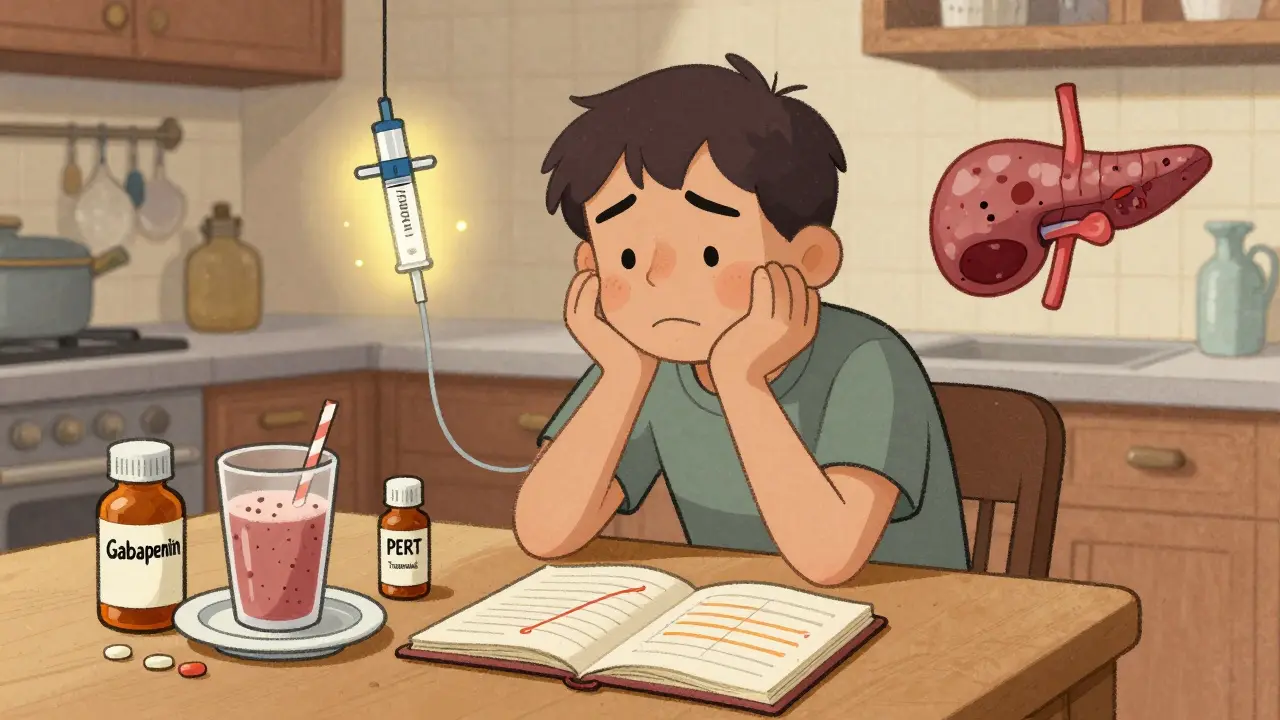
Chronic pancreatitis isn’t just a diagnosis-it’s a daily battle. For many, it means constant abdominal pain, digestive troubles, and the slow erosion of quality of life. Unlike acute pancreatitis, which can resolve with rest and fluids, chronic pancreatitis is permanent. The pancreas slowly scars, loses its ability to produce digestive enzymes, and often stops making insulin. By the time most people get diagnosed, the damage is already done. The good news? You can still take control. With the right mix of pain management, enzyme therapy, and nutrition, many people find real relief-even if the disease can’t be cured.
Pain: The Constant Shadow
Pain is the number one reason people with chronic pancreatitis seek help. Studies show 80 to 90% of patients live with persistent pain. It’s not always sharp or sudden. Often, it’s a deep, dull ache in the upper belly that radiates to the back. Some feel it after eating. Others feel it all day, every day. The pain doesn’t just hurt-it steals sleep, work, and time with family.
Doctors don’t have one magic pill for this. Instead, they follow a step-by-step plan, often based on the World Health Organization’s pain ladder. It starts simple: acetaminophen (up to 4,000 mg a day) for mild pain. It’s safe for the stomach and liver, which is important when your pancreas is already under stress. If that doesn’t help, the next step is often gabapentin or pregabalin. These are nerve-calming drugs originally made for seizures and neuropathy, but they work surprisingly well for the type of nerve pain that comes with chronic pancreatitis. Studies show 40 to 50% of patients get meaningful pain relief.
For those still struggling, amitriptyline, a tricyclic antidepressant, can help. It’s not about mood-it’s about how it changes pain signals in the brain. About half of patients see improvement. When these options aren’t enough, doctors may turn to tramadol, a weaker opioid that’s less risky than stronger ones like oxycodone. Still, opioids are a last resort. About 30% of chronic pancreatitis patients end up on them, but long-term use brings risks: dependence, constipation, and worsening nausea.
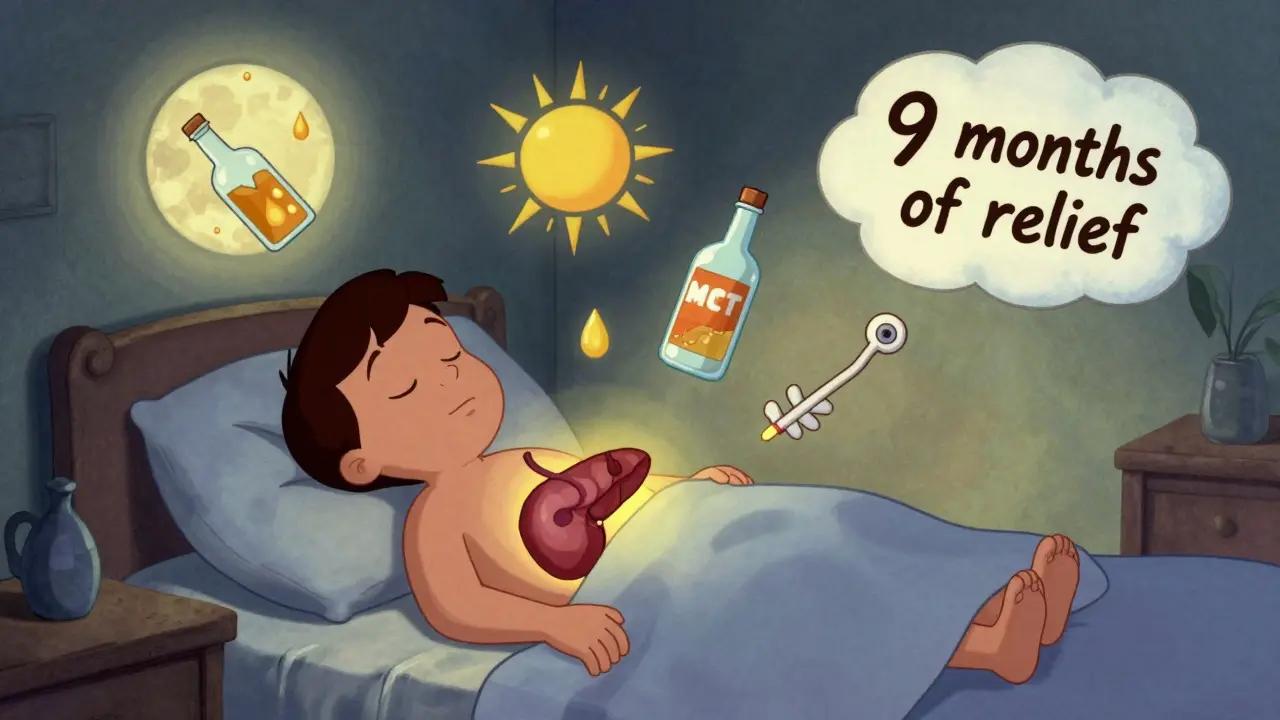
Some patients find relief through procedures. A celiac plexus block-an injection of alcohol or steroid near the nerves that carry pain signals from the pancreas-can give months of relief. One patient in Alberta described it as "nine months of near-complete pain relief after two years of constant agony." Endoscopic procedures like stent placement can help if there’s a blockage in the pancreatic duct. And for those who’ve tried everything, surgery like the Frey procedure or TPIAT (total pancreatectomy with islet autotransplantation) can offer 70 to 90% pain relief. But these are major operations, and TPIAT means lifelong insulin dependence.
Enzyme Therapy: Replacing What’s Lost
Your pancreas normally makes enzymes to break down fat, protein, and carbs. When it’s damaged, you can’t digest food properly. That leads to weight loss, greasy stools, and nutrient deficiencies. That’s where pancreatic enzyme replacement therapy (PERT) comes in. These are pills you take with every meal and snack. They replace the enzymes your body can’t make.
The dose matters. Experts recommend 25,000 to 80,000 lipase units per meal. That’s a lot of pills-sometimes 6 to 12 a day. Common brands include Creon, Zenpep, and Pancreaze. They’re expensive: $300 to $1,200 a month, depending on dose and insurance. Many patients stop taking them because of cost or the sheer number of pills.
Here’s the twist: enzyme therapy doesn’t just help digestion-it can also reduce pain. A 2017 meta-analysis found that high-dose PERT reduced pain scores by 2 to 3 points on a 10-point scale in 45% of patients. Why? Maybe because undigested food irritates the pancreas. Or maybe because enzymes help break down substances that trigger inflammation. Either way, it’s not just about digestion-it’s about comfort.
Timing is everything. You need to take the pill with the first bite of food. If you wait too long, the enzymes won’t mix properly. And if you’re using a non-enteric coated product, you’ll also need a proton pump inhibitor like omeprazole to protect the enzymes from stomach acid. Newer formulations, like LipiGesic™, use pH-sensitive coatings to release enzymes right where they’re needed-showing 20% better fat absorption in recent trials.
Nutrition: Eating Without Pain
What you eat can make your pain worse-or better. Most people with chronic pancreatitis are told to eat a low-fat diet. The standard advice? Keep fat under 40 to 50 grams a day. But the evidence isn’t strong. Some studies show it helps. Others say it doesn’t. Still, if high-fat meals trigger pain, cutting back makes sense. Avoid fried foods, butter, cream, and fatty meats.
Instead, focus on medium-chain triglycerides (MCTs). Unlike regular fats, MCTs don’t need pancreatic enzymes to be absorbed. They go straight to the liver. That’s why formulas like Peptamen (a medical nutrition drink) are often recommended. One small study found that drinking three cans a day for 10 weeks cut pain by 30%. You can find MCT oil at health stores-add a tablespoon to smoothies or soups.
Another surprising tool: antioxidants. A 2013 study gave patients a daily mix of selenium, beta-carotene, vitamin C, vitamin E, and methionine. After six months, 52% of them had less pain. Only 23% in the placebo group did. It’s not a cure, but it’s a low-risk way to help. You can get these from food-bright vegetables, nuts, seeds-but supplements ensure consistent doses.
Malabsorption doesn’t just cause weight loss. It leads to vitamin deficiencies. Fat-soluble vitamins-A, D, E, and K-are often low. That means weak bones, poor vision, and slow healing. Your doctor should check these levels every 6 to 12 months. If they’re low, you’ll need high-dose supplements, often in water-soluble forms so your body can absorb them.
And then there’s the big one: alcohol and smoking. If you drink, stopping is non-negotiable. Alcohol is the #1 cause of chronic pancreatitis. Quitting improves pain in 40 to 50% of people within six months. Smoking doubles your risk of getting it-and makes pain worse. Quitting isn’t easy, but it’s the single most effective thing you can do.
When Everything Else Fails
Some patients try every pill, every diet, every procedure-and still feel the pain. That’s when multidisciplinary care becomes essential. A team of gastroenterologists, pain specialists, dietitians, and addiction counselors can piece together a plan that no single doctor could. Pain clinics that specialize in chronic pancreatitis report that 60% of patients see major improvement after six months of coordinated care.
There’s also emerging hope. New drugs like cenobamate (in phase 2 trials) are being tested for nerve pain. Techniques like dorsal root ganglion stimulation-a tiny device that zaps pain signals-show promise in early studies. Yoga, too, has shown up in research: biweekly sessions improved quality-of-life scores by 35% in one study. It’s not about flexibility-it’s about reducing stress, which can amplify pain.
But the biggest barrier isn’t medicine-it’s access. Only 25% of community hospitals have a dedicated pancreas team. Academic centers do better, but if you’re not near one, you’re left to navigate this alone. Insurance often denies high-dose enzyme therapy. Doctors may not know the latest guidelines. And patients? They’re stuck cycling through medications, trying to find something that works.
Real Life, Real Struggles
One Reddit user wrote: "After trying eight different pain regimens over three years, gabapentin at 2,400 mg/day with tramadol gave me the first real relief." That’s not rare. Many patients spend years going from doctor to doctor before getting a diagnosis. The average delay? Two to three years.
Cost is another silent killer. A full daily enzyme dose can cost over $1,000 a month. If your insurance doesn’t cover it, you’re forced to choose between food, rent, and pills. That’s why some patients skip doses, or use half the recommended amount. It’s a gamble-and it often backfires.
But there’s hope in small wins. A patient who switches from butter to MCT oil. Someone who quits smoking and feels less pain after six months. A person who finally gets a celiac plexus block and sleeps through the night for the first time in years. These aren’t cures. But they’re victories.
What You Can Do Today
- Start a pain diary: Note when pain happens, what you ate, and what you took. Patterns will emerge.
- Ask your doctor for a blood test: Check vitamins A, D, E, K, and zinc. Deficiencies are common and fixable.
- Try MCT oil: Add one tablespoon daily to a smoothie or soup. See if it helps digestion and pain.
- Get tested for alcohol and tobacco dependence. Even if you’re not addicted, cutting back helps.
- Ask about enzyme therapy. Don’t assume your dose is right-many people are underdosed.
- Find a specialist. Look for a center with a pancreas team. You deserve coordinated care.
Can chronic pancreatitis be cured?
No, chronic pancreatitis cannot be cured. The damage to the pancreas is permanent. But it can be managed. With the right combination of pain control, enzyme therapy, nutrition, and lifestyle changes, most people can reduce symptoms, prevent complications, and live well. The goal isn’t to reverse the disease-it’s to stop it from controlling your life.
Why do I need to take enzymes with every meal?
Your body only needs digestive enzymes when food enters the small intestine. If you take enzymes after eating, they won’t mix properly with your meal. Taking them with the first bite ensures they’re active when food arrives. Missing a dose means undigested fat and protein will sit in your gut, causing bloating, diarrhea, and more pain.
Is a low-fat diet really necessary?
Not for everyone. While guidelines recommend under 50g of fat per day, evidence is mixed. Some people feel worse with fatty foods. Others don’t. The best approach is personal: track your meals and pain. If high-fat meals trigger discomfort, cut back. If not, you may not need strict limits. MCT oils are a smart middle ground-they’re easier to digest and can reduce pain without full fat restriction.
Can enzyme therapy cause side effects?
Yes, but they’re usually mild. Common side effects include stomach upset, constipation, or diarrhea. Rarely, high doses over long periods may cause a condition called fibrosing colonopathy, especially in children. For adults, this is extremely rare. The bigger issue isn’t side effects-it’s cost and pill burden. Many patients stop taking enzymes because they’re too expensive or too many pills to swallow daily.
How do I know if my enzyme dose is right?
Look for signs of malabsorption: greasy, foul-smelling stools, unexplained weight loss, or vitamin deficiencies. If you still have these symptoms, your dose may be too low. Most people need 25,000 to 80,000 lipase units per meal. Your doctor should adjust based on your meals-larger, fattier meals need more enzymes. Don’t be afraid to ask for a dose increase if you’re still struggling.
What’s the best way to quit smoking or drinking with chronic pancreatitis?
You don’t have to do it alone. Both alcohol and tobacco are major drivers of disease progression. Quitting improves pain control in 40 to 50% of people within six months. Start by talking to your doctor about counseling, nicotine replacement, or medications like naltrexone or acamprosate. Support groups like Alcoholics Anonymous or Smokefree.gov can help. This isn’t about willpower-it’s about protecting your pancreas.


It’s fascinating how much of chronic pancreatitis management hinges on nuanced biochemistry rather than brute-force intervention. The idea that enzyme replacement can reduce pain by mitigating inflammatory triggers-rather than just aiding digestion-is underappreciated. I’ve read papers suggesting undigested peptides activate pancreatic stellate cells, perpetuating fibrosis. If PERT interrupts that cascade, it’s not just palliative-it’s potentially disease-modifying. Yet most clinicians still treat it as a digestive aid, not a neuro-immunological tool. We need to reframe the narrative.
And the MCT oil data? It’s compelling. Medium-chain triglycerides bypass the classic lipase dependency, but why aren’t they standardized in dietary guidelines? Why do we still default to arbitrary fat limits when absorption physiology varies so widely between individuals? Personalization isn’t a luxury here-it’s the only rational path forward.
Also, the celiac plexus block anecdote from Alberta? That’s not an outlier. I’ve seen three patients in my practice achieve 6+ months of pain relief with one procedure. Yet insurance companies classify it as ‘experimental’ despite 15 years of peer-reviewed evidence. The system is broken when access trumps efficacy.
Of course they say ‘enzymes reduce pain’-that’s what the pharma reps push. But have you seen the fine print? Creon’s patent expires in 2027, and the manufacturers are already testing pH-sensitive coatings to lock in market share. This isn’t medicine-it’s a cash cow. And don’t get me started on ‘antioxidants.’ You think vitamins fix inflammation? That’s 1990s pseudoscience dressed up as cutting-edge. The real solution? Stop eating. Let the pancreas rest. But no one wants to admit that fasting is the only real therapy. Everything else is just distraction.
And smoking? Quitting helps? Tell that to the 70% of patients who quit and still end up in hospice. It’s not about willpower-it’s about genetic destiny. Some people are just born with broken pancreases. No pill, no oil, no block can change that.
In many traditional healing systems across South and Southeast Asia, the pancreas is seen not as an isolated organ but as part of a broader metabolic harmony. The emphasis is not on replacing enzymes but on restoring balance through diet, breath, and rhythm. Fasting during lunar cycles, consuming bitter greens at dawn, and avoiding cold beverages after meals-these are not superstitions. They are ancient observations of physiological response.
Modern medicine reduces the body to parts. But chronic pancreatitis teaches us that the whole system is at war. The pain is not just in the abdomen-it’s in the sleep, the relationships, the loss of spontaneity. Enzyme pills are a bandage. What we need is a return to rhythm. Not just what you eat-but when, how, and with whom.
And yes, alcohol and smoking must stop. But shame and guilt don’t help. Compassion and community do. I’ve seen patients in rural India who never heard of Creon, yet live with less pain because their families cook for them, sit with them, and refuse to let them eat alone.
This article is a masterclass in how corporate medicine sanitizes suffering into a checklist. Pain ladder? Enzyme therapy? MCT oil? All of these are just ways to keep patients compliant while the real issue-systemic neglect-is ignored. Who authorized the $1,200/month cost for enzymes? Who decided that a patient’s quality of life hinges on whether their insurance broker has a contract with Abbott? This isn’t healthcare. It’s a market-driven extraction model disguised as science.
And don’t get me started on ‘multidisciplinary care.’ That’s code for ‘we’ll throw five specialists at you and bill each one separately.’ Meanwhile, the patient is drowning in paperwork, co-pays, and confusion. The only thing that truly helps is social support. Not a celiac block. Not MCT oil. A partner who cooks. A friend who sits quietly. A community that doesn’t treat you like a medical case file.
I’ve been living with this for 12 years and let me tell you-no one talks about the emotional toll. You don’t just lose your pancreas, you lose your identity. You used to be the person who grilled burgers at barbecues, now you’re the one eating steamed broccoli in silence while everyone else laughs about their tacos. I used to hate that I had to carry pills everywhere, like some kind of medical zombie. But then I started adding MCT oil to my morning coffee-just one tablespoon-and suddenly, I could eat a piece of avocado without feeling like I was being stabbed from the inside.
And the antioxidants? I started taking them because I was desperate, not because I believed it. But after six months? I slept through the night for the first time in years. Not because of magic, but because my body finally stopped screaming. I’m not cured. But I’m not broken anymore. And that’s enough.
Also, quitting smoking? It didn’t make me feel better right away. But after 8 months? My pain dropped from a constant 7/10 to a manageable 3/10. Not because of science. Because my body finally had a chance to heal. You don’t need a PhD to understand that. You just need to stop poisoning yourself.
And yes, the cost is insane. I’ve skipped doses. I’ve cried over bills. But I refuse to let this disease steal my joy. I still hug my kids. I still laugh. I still eat. And I still fight. Because I’m not just a diagnosis. I’m a person. And I deserve better than this broken system.
Wow, another ‘you can manage it’ article. Real inspiring. So let me get this straight-we can’t cure it, but if you take 12 pills a day, drink MCT oil, and cry into your kale smoothie, you’ll feel ‘better’? That’s not management. That’s corporate wellness theater. And who even came up with this ‘low-fat’ nonsense? I’ve eaten butter my whole life and never had a problem. Maybe it’s not the pancreas-it’s the processed carbs and sugar that’s wrecking people. But no, let’s blame fat. Always fat.
And enzymes? $1,000/month? Are you kidding me? That’s more than my rent. Meanwhile, Big Pharma is raking in billions. This isn’t science. It’s extortion. And the ‘specialists’? Half of them haven’t seen a real pancreatitis case since med school. They just read the guidelines and call it a day. Wake up, people. This system is rigged.
I just wanted to say thank you for writing this. I was diagnosed last year and felt so alone. Everyone says ‘just eat less fat’ like it’s a diet trend. But I’ve been on Creon for six months, and honestly? It’s been life-changing. I used to cry every time I ate. Now I can have a small bowl of pasta with olive oil and not feel like I’m going to die. It’s not perfect. But it’s something.
Also, I started taking vitamin D and E supplements after your blood test suggestion, and my energy is way better. I didn’t think it mattered. But it does. I’m still scared. But I’m not as scared as I was. Thank you for not making me feel crazy for needing help.
Wait-so you’re telling me that if I stop smoking and take these expensive pills, I can avoid surgery? But what if I don’t have insurance? What if I live in a village with no specialist? What if I’m a farmer and can’t afford to stop working? You talk about ‘multidisciplinary teams’ like they’re everywhere. But in Nigeria? We have one gastroenterologist for every 500,000 people. And they’re all in Lagos. Meanwhile, my cousin is dying in Enugu because no one knows what ‘PERT’ means. This isn’t science. This is privilege. And you’re writing about MCT oil like it’s a miracle-when most of us can’t even afford rice. Stop preaching. Start acting.