
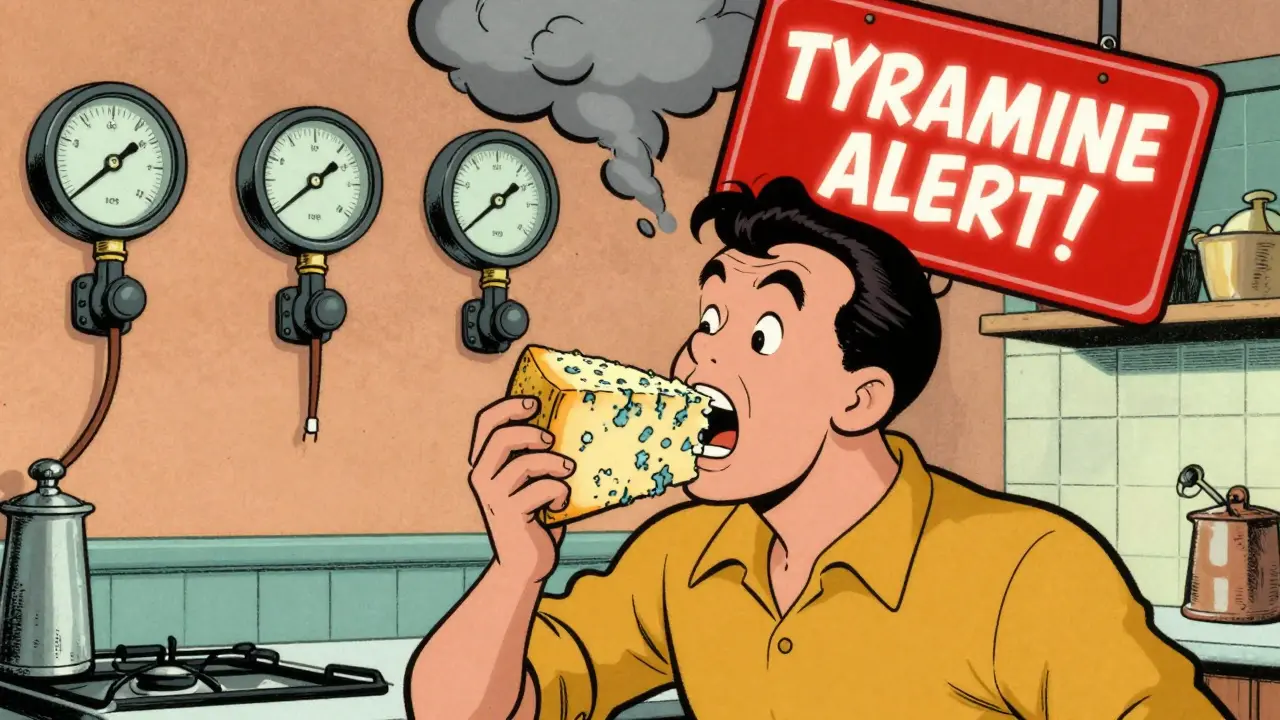
When you're taking an MAO inhibitor for depression, your diet isn't just about what feels good-it’s about what could save your life. A single bite of aged cheese, a sip of red wine, or even leftover stew left in the fridge too long can trigger a dangerous spike in blood pressure. This isn’t a myth. It’s a real, documented risk called a hypertensive crisis, and it happens because of how your body handles tyramine when MAOIs are in your system.
Why Tyramine Turns Dangerous on MAOIs
Your body normally breaks down tyramine, a natural compound found in certain foods, using an enzyme called monoamine oxidase-A (MAO-A). This enzyme works in your gut and liver to keep tyramine from entering your bloodstream in large amounts. But when you take a non-selective MAO inhibitor-like phenelzine (Nardil), tranylcypromine (Parnate), or isocarboxazid (Marplan)-that enzyme gets shut down. Suddenly, tyramine isn’t broken down. It builds up, floods into your blood, and forces your body to release a surge of norepinephrine. That’s what causes your blood pressure to skyrocket-sometimes by 30 to 50 mmHg in under 30 minutes.It doesn’t take much. Studies show that as little as 5 to 10 milligrams of tyramine can trigger a reaction in someone on an MAOI. A hypertensive crisis is generally defined as a systolic blood pressure over 180 mmHg, often accompanied by a severe headache at the back of your head, pounding heartbeat, sweating, and blurred vision. Left untreated, it can lead to stroke, heart attack, or death. While fatal cases are rare today-fewer than five per year in the U.S.-they still happen, especially when people don’t know what to avoid.
Which Foods Are Actually Dangerous?
Not all aged or fermented foods are equal. The danger comes from foods where tyramine levels have built up over time due to aging, fermentation, or spoilage. Fresh foods? Usually safe. Once they’ve been sitting, curing, or fermenting? That’s where the risk kicks in.- Aged cheeses: Blue cheese, cheddar, Swiss, parmesan, brie, camembert-these can contain 9 to over 400 mg of tyramine per 100 grams. Even a small slice (1 ounce) of aged cheese can push you over the danger threshold.
- Cured or fermented meats: Salami, pepperoni, pastrami, corned beef, and liverwurst are high. Homemade versions? Even riskier if not processed under controlled conditions.
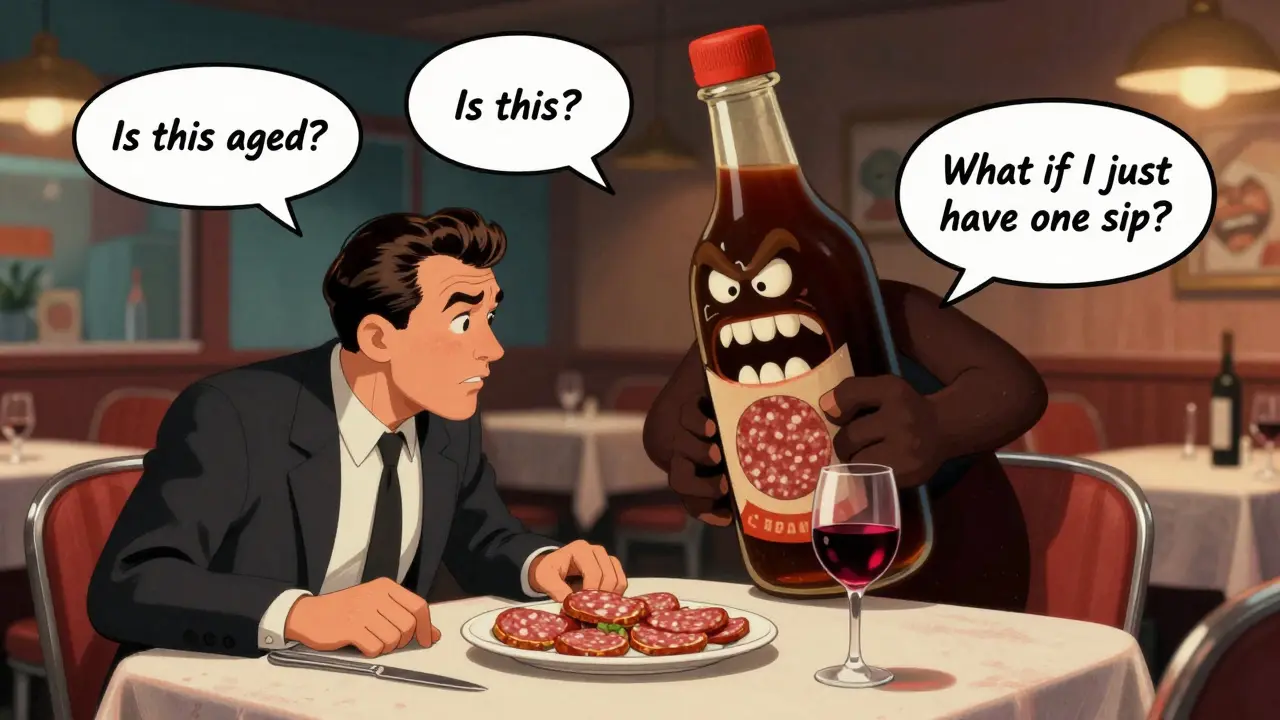
- Fermented soy products: Soy sauce, miso, tamari, and tempeh contain 20 to 70 mg per 100 ml. A tablespoon of soy sauce might be okay, but two? That’s risky.
- Tap and draft beer: Unpasteurized beer can have tyramine levels up to 15 mg per liter. Bottled, pasteurized beer is usually safe in moderation.
- Red wine and fortified wines: Chianti, sherry, and port can contain 4 to 15 mg per 100 ml. One glass might be fine for some, but it’s not worth the gamble.
- Pickled herring and other fermented fish: These can hit 110 to 230 mg per 100 grams. Avoid entirely.
- Overripe fruits: Bananas, avocados, and figs become risky when they’re very soft or starting to brown.
- Leftovers and spoiled food: Tyramine builds up as food ages. If it’s been in the fridge for more than 48 hours, it’s safer to toss it.
The USDA Food Composition Database and European Food Safety Authority both confirm that tyramine levels can jump 300-500% during aging. That’s why fresh mozzarella is fine, but aged Parmesan is not. It’s not about the type of food-it’s about how long it’s been sitting.
Not All MAOIs Are the Same
You might think all MAOIs require the same strict diet, but that’s not true. There are three main types, and their risk levels vary dramatically.| MAOI Type | Examples | Typical Tyramine Limit | Dietary Restrictions |
|---|---|---|---|
| Irreversible, non-selective | Phenelzine, tranylcypromine, isocarboxazid | <15 mg/day | Strict avoidance of all high-tyramine foods. No exceptions. |
| Reversible MAO-A inhibitor (RIMA) | Moclobemide | Up to 100 mg/day | Mild restrictions. Many patients can eat aged cheese in small amounts. |
| Transdermal selegiline (Emsam patch) | Emsam 6 mg/24h | No limit | No dietary restrictions at lowest dose. Higher doses (9 mg, 12 mg) require caution. |
That’s why some patients can eat cheese without issues while others can’t. If you’re on moclobemide (available outside the U.S.), your restrictions are much looser. And if you’re on the 6 mg Emsam patch, you can eat normally. The FDA approved this in 2006 after trials showed no hypertensive crisis at that dose. The European Medicines Agency updated its guidelines in 2023 to reflect this-only extremely high-tyramine foods (over 100 mg per serving) need avoiding, even at higher patch doses.
What About New Treatments?
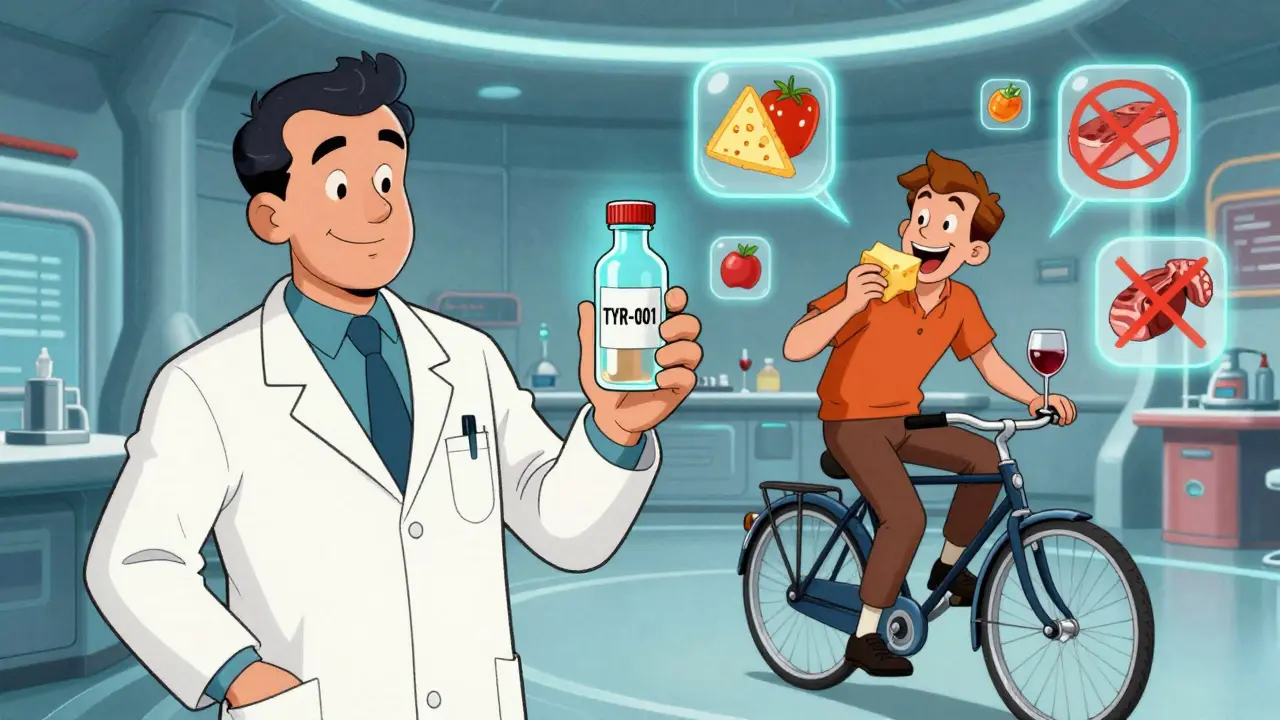
In March 2024, the FDA gave breakthrough designation to a new enzyme supplement called TYR-001, developed by Sage Therapeutics. In a Phase II trial with 120 patients, it allowed people to eat tyramine-rich foods up to 50 mg without any blood pressure spikes-while still keeping their MAOI working. This could be a game-changer. If Phase III trials succeed, by 2030, people on MAOIs might not have to count cheese slices or avoid wine altogether.Another update came in January 2024 from the American College of Medical Toxicology: nicardipine is now the first-line drug to treat MAOI-induced hypertensive crisis. Older treatments like nitroprusside could drop blood pressure too fast and damage the brain. Nicardipine gives doctors a safer, more controlled way to bring pressure down-without risking stroke.
Real-Life Challenges
Dietary restrictions are the number one reason people quit MAOIs. A 2022 analysis of 317 forum threads found that 68% of users stopped because they couldn’t handle the rules. Social events became stressful. Going to a restaurant? You have to ask if the cheese is aged. Eating at a friend’s house? You bring your own food. One Reddit user wrote: “I missed my sister’s wedding because I was scared of the charcuterie board.”But for those who stick with it, the payoff can be life-changing. A 2022 study in the Journal of Affective Disorders found that 61% of people on MAOIs for over two years said their depression lifted in ways other meds never did. They called it “the only thing that worked.”
Education makes a huge difference. A 2020 trial at Massachusetts General Hospital showed that a 45-minute teaching session-complete with food lists, portion sizes, and emergency symptom recognition-cut dietary violations from 32% to just 8% in six months. Patients learned: “A safe portion of cheese is less than one ounce. Fresh chicken? Fine. Leftover chicken from three days ago? Throw it out.”
What to Do If You Think You’re Having a Crisis
Symptoms usually hit fast: a pounding headache at the base of your skull, chest tightness, rapid heartbeat, blurred vision, nausea. If you feel this, check your blood pressure. If it’s above 180/110, call 911 or go to the ER. Don’t wait. Don’t try to tough it out. This isn’t a panic attack-it’s a medical emergency.Keep a home blood pressure monitor. Log your readings daily. Some devices can send alerts to your doctor automatically. The American Psychiatric Nurses Association recommends this for every MAOI user. It’s not paranoia-it’s prevention.
Final Advice
If you’re on an MAOI, you don’t need to live in fear. You need to be informed. Talk to your prescriber about which type you’re on. Ask for a printed food list. Keep it in your wallet. Use apps that scan barcodes for tyramine content (some are now available in the U.S. thanks to FDA labeling updates). When in doubt, don’t eat it. And remember: fresh is always safer than aged. Leftovers? Reheat them, but don’t keep them more than two days.MAOIs aren’t the first-line treatment for depression anymore-but they’re still the last hope for some. And with better tools, clearer guidelines, and new therapies on the horizon, the future for people on these meds is getting safer-not harder.

Man, I wish I had this guide when I was on Parnate. I thought my migraines were just stress-turns out I was snacking on blue cheese like it was popcorn. One time I ate a whole wedge and ended up in the ER with my heart doing the cha-cha. This post? Lifesaver. Seriously, someone should turn this into a printable cheat sheet and hand it out with prescriptions.
STOP BEING SO CARELESS. I’ve seen two friends die from this. Not ‘maybe’ or ‘probably’-DEAD. Aged cheese isn’t a snack, it’s a landmine. If you’re on an MAOI and you’re still drinking red wine because ‘it’s just one glass,’ you’re not brave-you’re stupid. I’m not being dramatic. I’m being the guy who buried his roommate after he ate salami at a BBQ. READ THE LIST. DON’T GUESS.
YOOOOOOO. I’m on Emsam 6mg and I just ate a whole wheel of brie at a party last night. No headache. No panic. Just vibes. 🤙 This is why science is LIT. The old rules were written in 1987 by people who thought tap water was a drug. We’re living in the future, folks. Don’t let fear dictate your life. Also, if you’re still using paper lists? Download the Tyramine Tracker app. It’s got barcode scanning. I scanned my soy sauce and it said ‘SAFE AS F’. YES.
Let’s be real-this whole ‘tyramine crisis’ narrative feels like medical theater. How many people actually die from this? Five per year in the U.S.? That’s less than lightning strikes. Meanwhile, antidepressants like SSRIs cause sexual dysfunction in 70% of users, and no one screams about banning those. We’re pathologizing food to sell fear. Also, ‘overripe banana’? That’s just nature being nature. If your body can’t handle a little tyramine, maybe the problem isn’t the food-it’s the drug.
As an Indian woman who grew up on fermented foods-dosas, idlis, pickles-I find this entire Western hysteria laughable. We’ve been consuming tyramine-rich diets for millennia. My grandmother ate 20-year-old soy sauce and lived to 98. This is colonial medicine rebranding tradition as ‘danger.’ Also, why are we pathologizing aging? Is it the food that’s dangerous-or the fear of it? I refuse to be a victim of pharmaceutical gatekeeping. Let us eat. Let us live.
There’s a crucial nuance missing here: the difference between tyramine content and individual metabolic sensitivity. Not everyone reacts the same way, even on the same MAOI. A 2021 study in *Pharmacogenomics* showed polymorphisms in the MAO-A gene significantly affect tyramine metabolism. So while the general guidelines are useful, personalized risk assessment-via genetic testing-is the future. Also, fresh mozzarella is safe because it’s not aged; it’s curdled. The distinction matters.
Stick to the list. No exceptions. Fresh food only. Leftovers go in the trash after 48 hours. Period.
Thank you for this meticulously researched and compassionate overview. As a psychiatric nurse, I’ve witnessed the profound isolation that dietary restrictions can impose. Your emphasis on education over fear aligns with best practices. I distribute the Massachusetts General Hospital handouts to every new MAOI patient. The reduction in noncompliance-from 32% to 8%-is a testament to clarity and empathy. Please continue sharing these vital resources. Your work saves lives.