
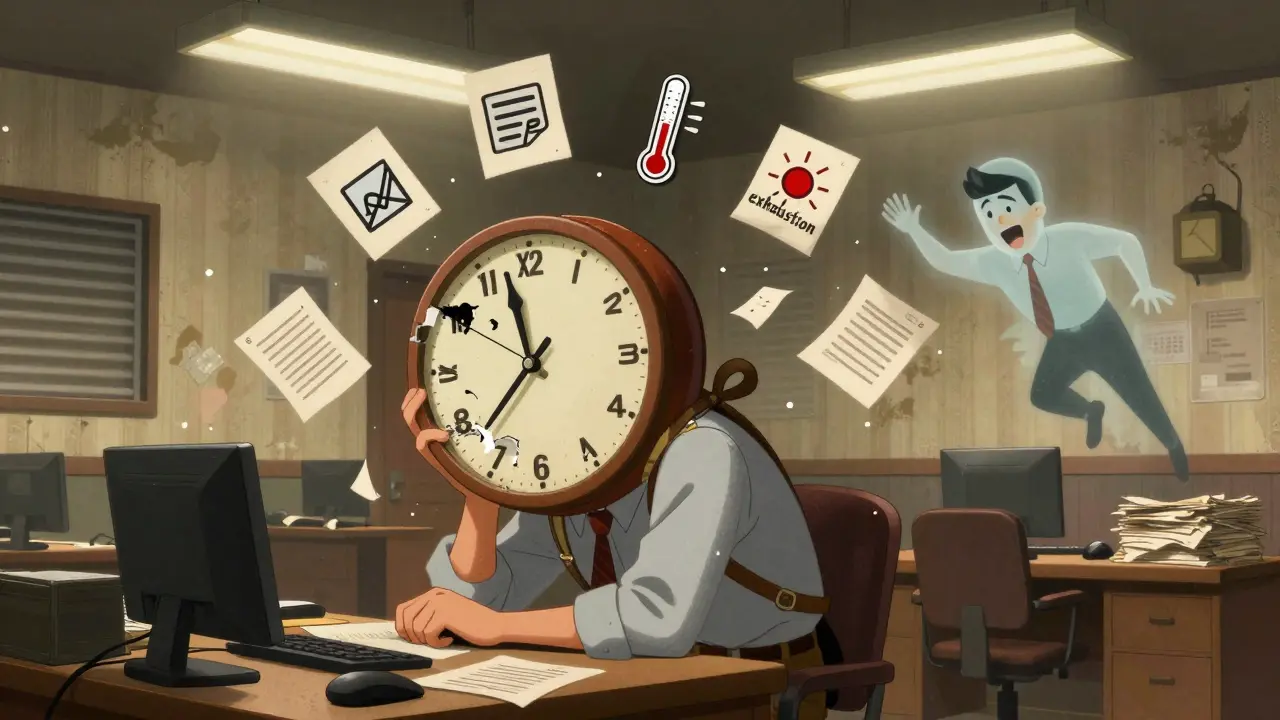
More than 1 in 4 workers worldwide say they're burned out at work-often, and sometimes always. That’s not just feeling tired after a long week. That’s a clinical syndrome recognized by the World Health Organization since 2019. Burnout isn’t laziness. It’s not weakness. It’s what happens when chronic stress at work goes unaddressed. And it’s costing businesses billions.
When you’re burned out, you don’t just feel drained. You feel detached. You stop caring. You doubt your own competence. You might lie awake at night replaying emails, or scroll through Slack at midnight because you never really logged off. You’re not broken. Your workplace might be.
What Burnout Really Looks Like
Burnout isn’t one thing. It’s three. First, exhaustion-constant fatigue that doesn’t go away with sleep. Second, cynicism-starting to see your job as meaningless, your coworkers as annoyances, your tasks as pointless. Third, reduced performance-you used to get things done. Now, even simple tasks feel overwhelming.
Studies show 63% of burned-out workers report chronic fatigue. 42% struggle with insomnia. 57% say they can’t focus. These aren’t vague complaints. They’re measurable symptoms backed by data from Gallup, the American Psychological Association, and the Maslach Burnout Inventory-the gold standard tool used in research since the 1980s.
And it’s not just you. In 2023, 44% of employees globally felt considerable stress every day. In the U.S., 77% of workers experienced work-related stress in the last month. Half of them said it led to fatigue, lack of motivation, or anxiety. This isn’t an individual problem. It’s a system failure.
Why Burnout Happens: The Real Causes
Most companies blame overwork. But it’s rarely just about workload. The Job Demands-Resources model, developed by organizational psychologists Arnold Bakker and Evangelia Demerouti, breaks it down into six key stressors:
- Excessive workload (cited by 67% of employees)
- Lack of control (49%-no say in how, when, or where you work)
- Insufficient rewards (42%-pay, recognition, or meaning don’t match effort)
- Breakdown of community (38%-no real connection with coworkers)
- Absence of fairness (34%-favoritism, unclear rules, inconsistent treatment)
- Conflicting values (29%-your job asks you to do things that go against your ethics)
These aren’t hypothetical. They’re patterns confirmed by surveys across industries. If your job feels like a treadmill with no off switch, you’re not alone. And you’re not failing. The system is.
How Organizations Can Prevent Burnout
Companies are spending $12.5 billion on wellness programs by 2025. But most of it fails. Why? Because they focus on yoga mats and meditation apps instead of fixing broken systems.
Successful prevention starts with workload audits. Gallup recommends doing them quarterly-not annually. Companies that do this reduce burnout linked to overwork by 78%. AI tools now help distribute tasks more evenly. Salesforce and Microsoft cut burnout by 32% using these systems.
Flexible schedules matter too. A study of 1,200 employees found that letting people work from home on Wednesdays and choose their start times reduced burnout by 27%. Why? Because people work better when they’re in sync with their natural energy-not a 9-to-5 clock.
Connection is another pillar. Teams with strong social bonds have up to 40% less burnout. That doesn’t mean mandatory happy hours. It means clear roles, real feedback, and space to talk about things that aren’t work. One company saw a 52% increase in program adherence when they added 4.5 hours of burnout prevention training to onboarding.
And then there’s psychological safety. Google’s Project Aristotle found that teams where people felt safe speaking up had 47% less burnout. If your manager shuts down questions or punishes mistakes, you’re not just stressed-you’re at risk.
The Manager’s Role: The Biggest Lever
Jim Harter, Gallup’s Chief Workplace Scientist, says managers account for 70% of the difference in employee engagement. That’s huge. A bad manager can ruin even the best job. A good one can prevent burnout before it starts.
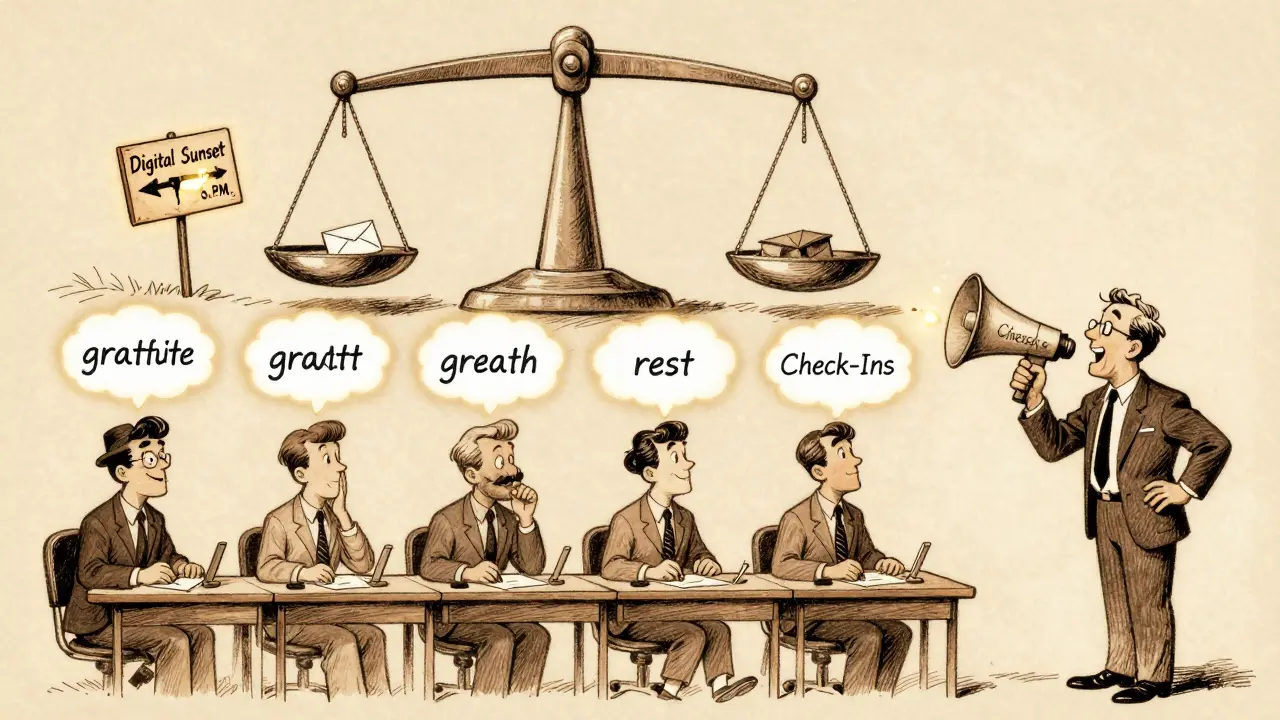
Managers who have five key conversations with their team-about strengths, purpose, wellbeing, growth, and recognition-see 41% lower burnout rates. These aren’t performance reviews. They’re check-ins that say: I see you. I care about you. You matter.
Open-door policies don’t work if you never open the door. Weekly 1:1s that include mental health questions reduce burnout by 35%. Companies like Unilever and Johnson & Johnson saw 28% higher retention when they trained managers to talk about stress-not just deadlines.
And boundaries? They’re non-negotiable. Companies that enforce a digital sunset-automatic shutdown of work systems after hours-see 31% less after-hours communication and 26% lower burnout. If your phone pings at 10 p.m., someone in leadership needs to fix that.
What You Can Do: Individual Strategies That Work
Yes, organizations must change. But you can protect yourself too.
Set hard boundaries. Employees who refuse to check email after 6 p.m. have 39% lower burnout rates. Turn off notifications. Block your calendar. Say no. Permission to say no reduces burnout by 34%-but only 15% of companies actually allow it.
Time-block your day. Instead of reacting to emails all day, schedule deep work blocks. One study of 1,200 knowledge workers found this improved task completion by 28% and cut burnout symptoms by 22%.
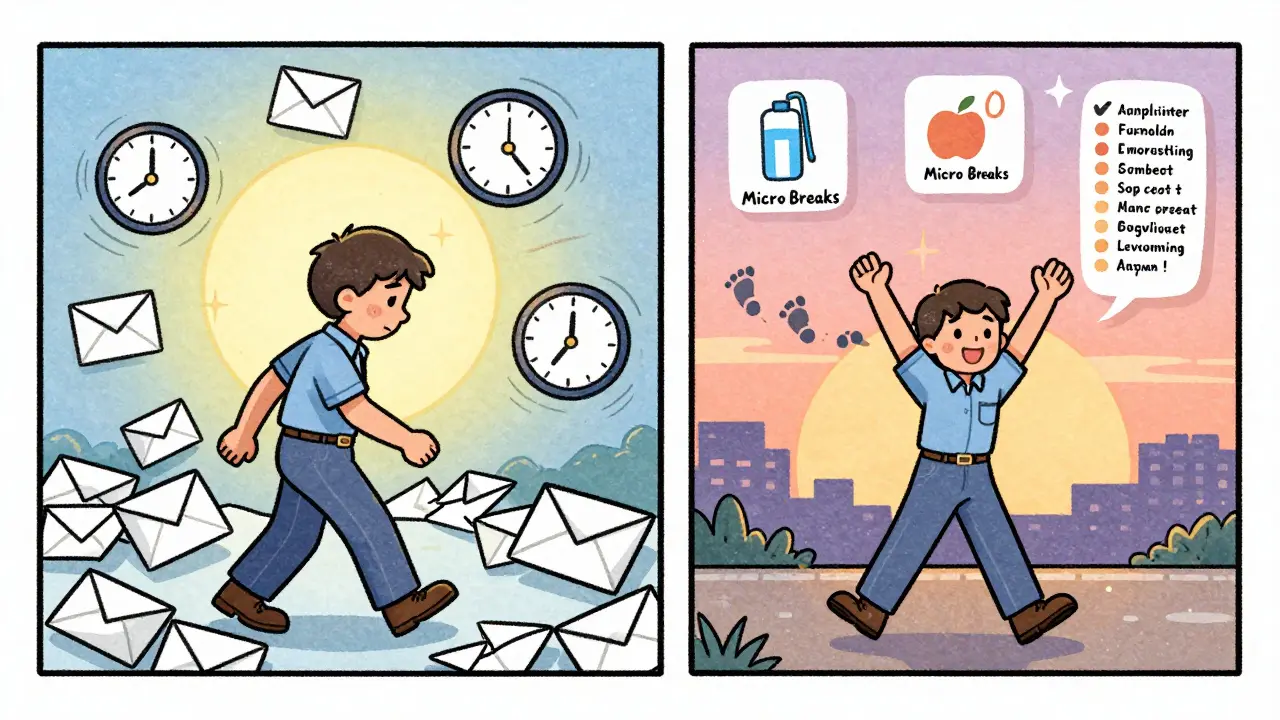
Take micro-breaks. Every 90 minutes, step away for 5-10 minutes. Harvard Business Review found this boosts productivity by 13% and reduces burnout markers by 17%. Walk. Stretch. Look out the window. Don’t scroll.
Move your body. Walking meetings are used by 68% of Fortune 500 companies. They reduce sedentary time by 27 minutes a day. And hydration? Companies that offer water stations and protein snacks report 19% fewer fatigue-related absences.
Bookend your day. MIT researchers studied 500 remote workers. Those who took a 15-minute walk before and after work saw stress levels drop by 22%. It signals your brain: work starts here. Work ends here.
Recovering From Burnout
Recovery isn’t a vacation. It’s a process.
First, recognize it. Use tools like Gallup’s Q12 survey to spot early signs. If you’re dreading Monday, feeling numb, or losing sleep over work, it’s time to act.
Second, intervene. Talk to your manager. Ask for a temporary reduction in workload. Shift tasks. Get help. Don’t wait until you’re broken.
Third, restore. The APA recommends a 48-72 hour digital detox. No work emails. No Slack. No calls. One study found this improved emotional exhaustion by 63%.
And here’s the most powerful tip: start a list of what you’ve accomplished, not what’s left to do. Keystone Partners found this simple shift speeds return-to-productivity by over three weeks. Gratitude works. Tracking wins works. Your brain needs proof you’re not failing.
Employees who use mental health benefits within 14 days of noticing symptoms recover 82% faster than those who wait. If your company offers therapy, counseling, or coaching-use it. Now. Not later.
Why Most Programs Fail
Companies launch wellness initiatives. They host yoga. They give out stress balls. Then, six months later, it’s gone.
Why? Only 17% of programs last beyond a year. The rest fail because they’re treated like perks, not priorities. Successful ones tie wellbeing to performance reviews. They make it part of how managers are evaluated. One company increased manager accountability by linking 30% of their bonus to team wellbeing scores.
And consistency matters. A healthcare provider saw burnout drop by 52% when they embedded prevention into onboarding. Not as a one-time talk. As a routine. Like safety training.
The Future Is Predictive
By late 2025, 65% of Fortune 500 companies will use AI to predict burnout. These systems analyze email patterns, calendar density, and login times to flag at-risk employees with 82% accuracy. It’s not surveillance. It’s early warning.
Some companies are going further. Basecamp and Shopify have 4-day workweeks. Early adopters like American Express and Procter & Gamble use data from sick days, EAP usage, and productivity metrics to calculate individual burnout risk scores. They’ve cut burnout incidence by 38%.
Neuroscience is stepping in too. HRV (Heart Rate Variability) monitors-used in pilot programs at Google and Intel-show 29% greater reduction in burnout than traditional methods. Your body is telling you when you’re stressed. We just need to listen.
Final Thought: It’s Not Your Fault
Dr. Christina Maslach, who created the burnout inventory, says it plainly: Burnout is not an individual failure. It’s a systems failure.
You didn’t choose to be exhausted. You didn’t choose to lose motivation. You didn’t choose to feel disconnected from your work. The system did.
Change starts with awareness. Then, action. Whether you’re an employee, a manager, or a leader-you have power. Use it. Protect your energy. Demand better. And if you’re burned out? You’re not broken. You’re signaling something needs to change. Listen.
What are the main signs of workplace burnout?
The three core signs are: 1) chronic exhaustion that doesn’t improve with rest, 2) increased cynicism or emotional distance from your job, and 3) feeling less competent or productive despite effort. Studies show 63% of burned-out workers report fatigue, 42% struggle with sleep, and 57% have trouble concentrating. These aren’t temporary feelings-they’re persistent patterns.
Can burnout be prevented without changing jobs?
Yes, but only if the workplace supports change. Prevention requires structural fixes: workload audits, flexible schedules, psychological safety, and clear boundaries. Individual habits like time-blocking and digital detoxes help, but they’re not enough on their own. If your job consistently overloads you, undervalues you, or ignores your needs, changing jobs may be the healthiest option.
How long does it take to recover from burnout?
Recovery varies, but research shows that employees who take a 48-72 hour digital detox see a 63% improvement in emotional exhaustion. Those who use mental health support within 14 days of symptoms recover 82% faster. Full restoration typically takes weeks to months, depending on how deep the burnout is and whether the root causes (like workload or lack of control) are addressed.
Do wellness programs like yoga or meditation actually help with burnout?
They help a little-but not enough. The American Psychiatric Association found self-care programs alone fix only 20% of burnout causes. Yoga and meditation reduce symptoms temporarily, but they don’t fix toxic workloads, unfair policies, or poor management. Real change requires systemic fixes: better scheduling, fair recognition, and psychological safety.
Is burnout covered under mental health benefits?
Yes, if your employer offers mental health benefits, burnout is typically covered. Most digital therapy platforms (like Spring Health or Lyra) include burnout-specific coaching and therapy. In 2024, 87% of large employers offered these benefits. Using them early cuts recovery time by 82%. Don’t wait until you’re overwhelmed-reach out before you hit crisis.
What’s the difference between stress and burnout?
Stress is a short-term reaction to pressure-like meeting a deadline or handling a crisis. You feel overwhelmed, but you still care. Burnout is long-term exhaustion from chronic, unmanaged stress. You feel empty, detached, and cynical. Stress motivates you to act. Burnout makes you want to quit. Stress is a signal. Burnout is a breakdown.
Workplace burnout is not inevitable. It’s preventable. And recovery is possible. The data is clear. The solutions exist. What’s missing is the will to implement them.



they give us yoga mats but take away our lunch breaks. genius.
it’s like telling someone with a broken leg to ‘just walk it off’.
then i quit. no regrets. u deserve better.
i don’t want to fix my job. i want to unsee it.
and when you stop producing? they replace you. easy.
turnover dropped 40%. engagement shot up. why isn’t this standard??
we’re not robots. we’re humans with families, trauma, and weird hobbies.
but also... maybe you just need to stop being so dramatic.
my boss says ‘we value work-life balance’ then pings me at 11pm on a Sunday. 🙃
they called me ‘reliable.’ i called it a slow suicide.
but honestly? i’ve seen people collapse at their desks. no one says anything.
the difference between us and the west? we don’t even have therapy benefits. we just pray harder.
but i’m glad someone’s finally talking about this. maybe one day we’ll get there too.