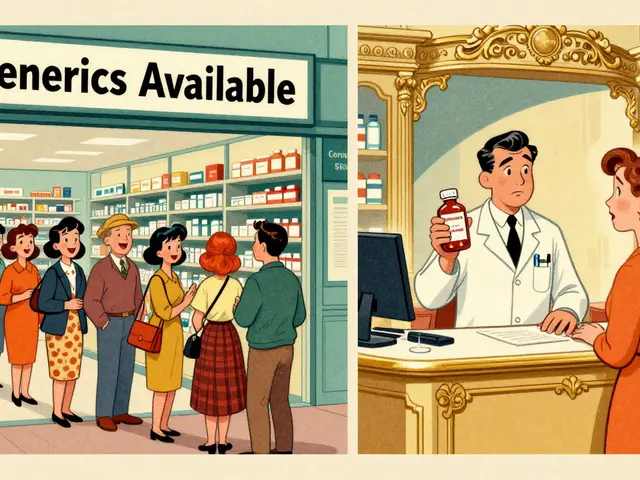
When you pick up a generic pill at the pharmacy, it’s easy to assume it’s just a cheaper copy of the brand-name drug. But behind that simple label is a complex, tightly regulated legal process that ensures safety, effectiveness, and fairness. This is the ANDA process-Abbreviated New Drug Application-and it’s the backbone of generic drug approval in the United States. If you’re wondering how a generic drug gets legal clearance to hit the market, here’s how it actually works.
What Is the ANDA Process?
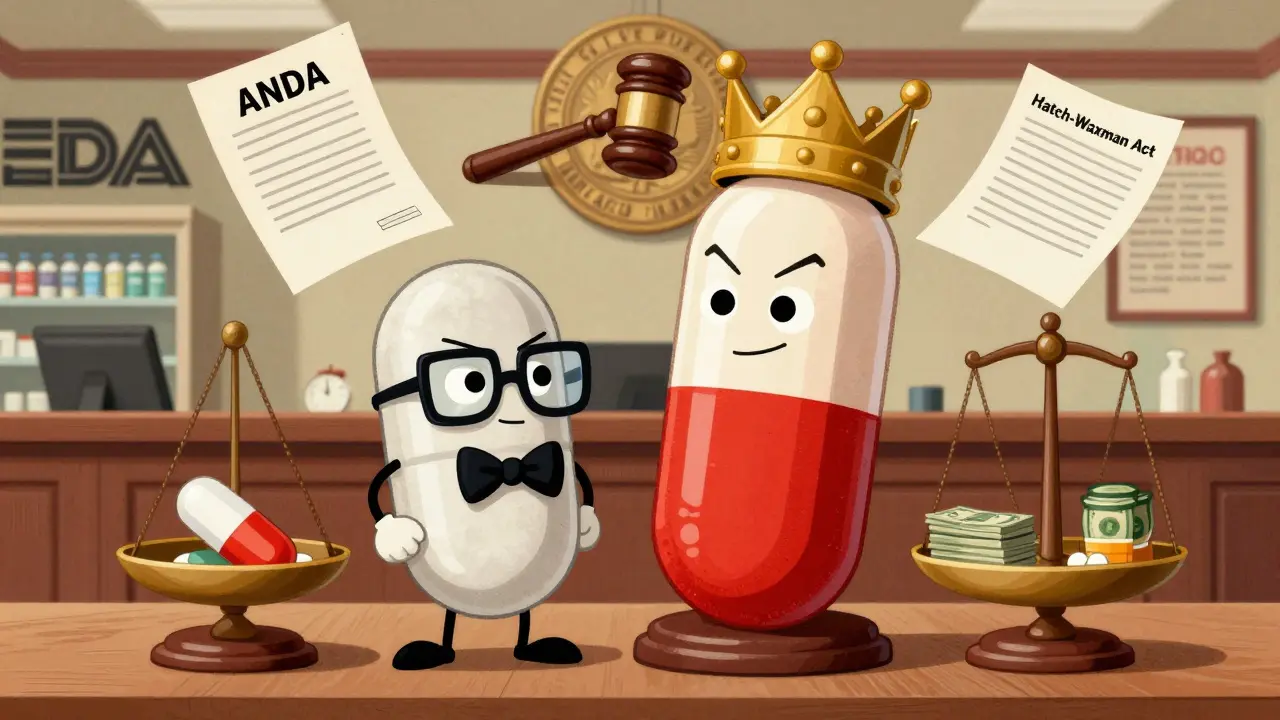
The ANDA process isn’t just paperwork. It’s a legal pathway created by Congress in 1984 under the Hatch-Waxman Act to balance two goals: protecting innovation and making medicines affordable. Before this law, generic manufacturers had to repeat expensive clinical trials just to prove a drug worked-trials that had already been done and approved by the FDA for the original brand. The ANDA system changed that. Instead of starting from scratch, generic companies can rely on the FDA’s prior findings about safety and effectiveness. All they need to prove is that their version is the same in every meaningful way.
This isn’t a loophole. It’s a carefully designed system. The FDA doesn’t lower its standards. It just avoids repeating work that’s already been done. The result? Generic drugs now make up 90.5% of all prescriptions filled in the U.S., but cost only about 18% of what brand-name drugs do. That’s not luck. That’s the ANDA process working as intended.
Legal Requirements for ANDA Approval
To get an ANDA approved, a company must meet five strict legal requirements set by the FDA. Missing any one of them means rejection.
- Identical active ingredient: The generic must contain the exact same active drug substance as the brand-name product. No exceptions unless the manufacturer files a special suitability petition.
- Same dosage form, strength, route, and use: If the original is a 10mg tablet taken orally once daily, the generic must match that exactly. You can’t change the pill shape, the dose, or how it’s taken without going through a different approval path.
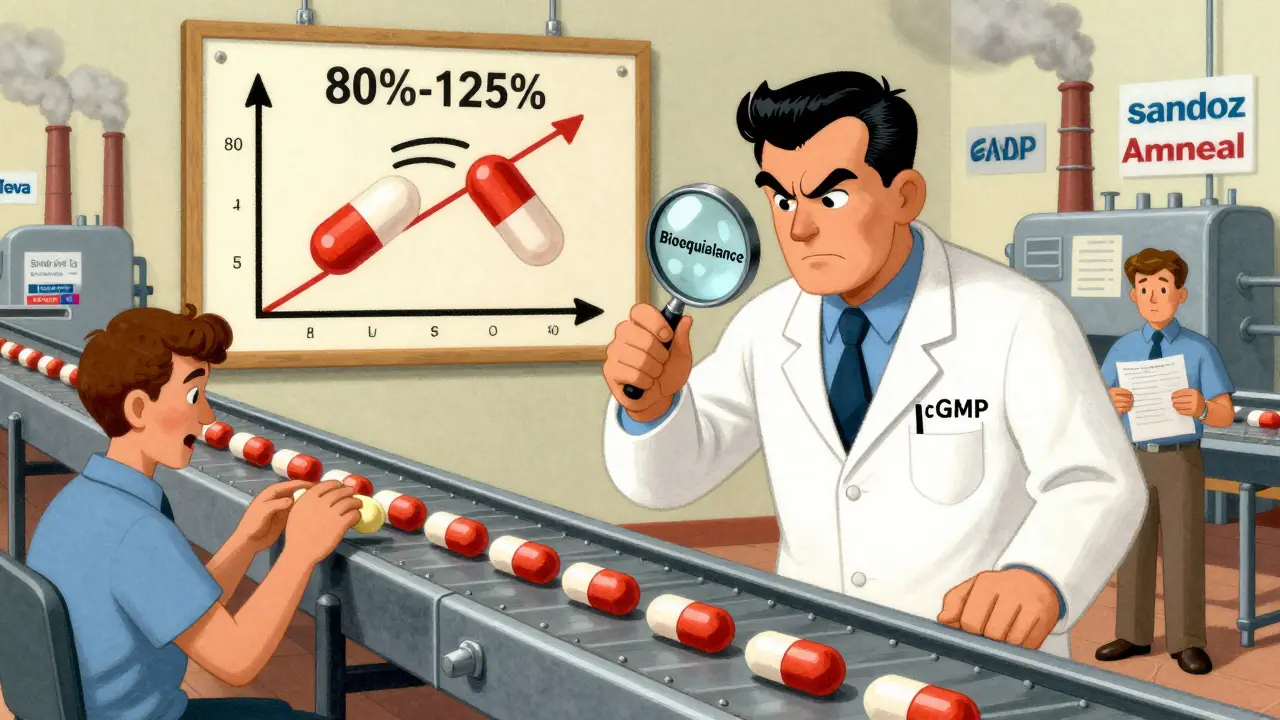
- Bioequivalence: This is the core scientific requirement. The generic must deliver the same amount of drug into the bloodstream at the same rate as the brand. The FDA requires pharmacokinetic studies showing that the area under the curve (AUC) and maximum concentration (Cmax) fall within 80% to 125% of the brand’s values. This range isn’t arbitrary-it’s based on decades of clinical data showing no meaningful difference in effect within those limits.
- Identical labeling: The prescribing information (package insert) must match the brand’s, except for minor differences like the manufacturer’s name or patent expiration dates. No misleading claims. No added warnings. No omitted side effects.
- Manufacturing quality: The FDA doesn’t just check the pill. They inspect the factory. All manufacturing must follow Current Good Manufacturing Practices (cGMP). This includes detailed documentation on how the drug is made, how it’s tested, how it’s stored, and how it’s packaged. Even small changes in the manufacturing process can trigger a rejection.
These aren’t suggestions. They’re legal requirements under the Federal Food, Drug, and Cosmetic Act. Violations can lead to warning letters, import bans, or even criminal charges.
Why the ANDA Process Exists
The Hatch-Waxman Act didn’t just create a faster approval path-it created a legal bargain. Brand-name drugmakers get up to five years of data exclusivity and patent protection. In return, generic companies get a clear path to market once those protections expire. This trade-off is why the U.S. generic drug market is worth over $127 billion.
Without ANDA, generics would be too expensive to make. The average cost to develop a new brand-name drug is $2.3 billion. The average cost for a generic? $5-10 million. That difference is why 9 out of 10 prescriptions in the U.S. are filled with generics. It’s also why patients with chronic conditions like high blood pressure or diabetes can afford to take their meds every day.
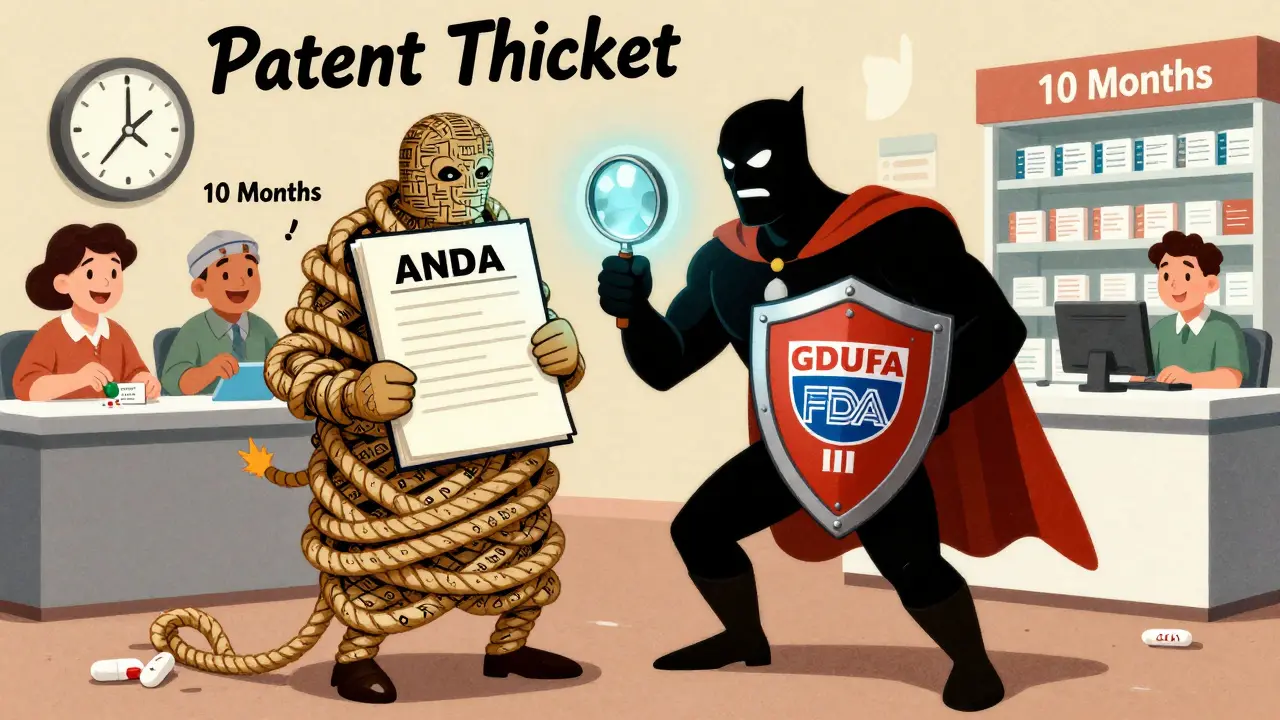
But it’s not perfect. Some brand companies use patent thickets-filing dozens of minor patents-to delay generic entry. The FDA’s 2023 Drug Competition Action Plan specifically targets these tactics. And complex generics-like inhalers, nasal sprays, or topical creams-are still tough. Only 42% of those get approved on the first try, compared to 78% for simple tablets.
What Happens After Submission?
Submitting an ANDA isn’t a one-time form. It’s a multi-step process with real consequences.
- Electronic submission (eCTD): All applications must be submitted in the standardized eCTD format. Paper submissions are rejected.
- Payment of user fees: For fiscal year 2024, the fee for a new ANDA is $129,500. There’s also a $5,000 fee for any major changes after approval.
- Manufacturing at commercial scale: The FDA requires test batches made under the same conditions as the final product. Minimum size? 100,000 dosage units or 10% of commercial batch size-whichever is larger.
- Patent certification: The applicant must certify whether the brand’s patents are expired, invalid, or will be challenged. If they challenge a patent (Paragraph IV certification), the brand can sue, triggering a 30-month legal hold that delays approval.
- Inspection: The FDA inspects the manufacturing facility before approval. Overseas plants account for 68% of all FDA inspection findings.
According to FDA data, 58% of first-time ANDAs get a deficiency letter. The most common reasons? Incomplete bioequivalence protocols (28%) and poor Chemistry, Manufacturing, and Controls (CMC) documentation (23%). One industry expert on Reddit said: “We lost three ANDAs because the container closure system wasn’t validated properly.” That’s not a technical glitch-it’s a legal failure.
ANDA vs. Other Approval Paths
Not all generic drugs go through ANDA. There are two other paths:
- New Drug Application (NDA): Used for brand-name drugs. Requires full clinical trials. Takes 10-15 years and costs over $2 billion.
- 505(b)(2) NDA: A hybrid path for drugs that are similar to existing ones but have changes-like a new dose, new formulation, or new route. It can rely on some existing data, but still requires new studies. Costs $50-100 million and takes 7-9 years.
ANDA is the fastest and cheapest path-but only if your drug is an exact copy. If you want to tweak the formula, add a new delivery system, or change the release profile, ANDA won’t work. That’s why many companies use 505(b)(2) for “improved” generics. But if you’re just matching the brand? ANDA is the only way.
Who Uses the ANDA Process?
The biggest players are companies like Teva, Sandoz, Amneal, and Lupin. Teva alone holds nearly 19% of the U.S. generic market. But it’s not just big firms. Hundreds of smaller manufacturers submit ANDAs every year.
Success stories exist. Lupin got approval for a generic version of Jardiance in just 9.5 months-under the FDA’s 10-month GDUFA III target-by submitting a “clean application” with flawless CMC data. On the flip side, Teva spent 42 months and over $28 million trying to get approval for a generic version of Advair Diskus. Why? Because the inhaler device had to match the brand’s performance exactly. The FDA rejected it three times over device testing issues.
These aren’t isolated cases. They’re the reality of the ANDA process. It’s simple in theory. But in practice? It’s a high-stakes game of precision.
What’s Changing Now?
The FDA’s Generic Drug User Fee Amendments (GDUFA) III, which runs from 2023 to 2027, is pushing for faster approvals. The goal: 90% of standard ANDAs approved within 10 months. That’s a big jump from the 30-36 months it took just a few years ago.
They’re also investing $15 million in 2024 to improve scientific tools for complex generics. And they’re cracking down on anti-competitive behavior-like brand companies refusing to sell samples to generic makers, which delays testing.
But the biggest shift? The FDA is now using AI to help review documents. It’s not replacing humans-it’s helping them find errors faster. This could cut review times even further.
What You Need to Know
If you’re a patient: Generic drugs are safe, effective, and legal. The ANDA process ensures they’re held to the same standard as brand-name drugs.
If you’re a manufacturer: The ANDA process is a legal minefield. One missing piece of documentation, one poorly designed bioequivalence study, or one unaddressed patent issue can delay approval for years. Expertise matters.
If you’re a policymaker: The system works-but it’s under pressure. Patent thickets, manufacturing delays, and complex products are slowing down access. The solution isn’t to weaken standards-it’s to improve the process.
The ANDA process isn’t just about drugs. It’s about access. It’s about fairness. And it’s about making sure millions of people can afford the medicines they need.
What is the main legal basis for the ANDA process?
The main legal basis is the Hatch-Waxman Act of 1984, formally known as the Drug Price Competition and Patent Term Restoration Act. This law created the ANDA pathway by allowing generic manufacturers to rely on the FDA’s previous findings of safety and effectiveness for brand-name drugs, eliminating the need for redundant clinical trials. It also established patent certification requirements and data exclusivity periods to balance innovation and competition.
Can a generic drug have different inactive ingredients than the brand-name version?
Yes. The active ingredient must be identical, but inactive ingredients-like fillers, dyes, or preservatives-can differ. However, these differences must not affect the drug’s safety, strength, quality, purity, or performance. The FDA evaluates whether any change in inactive ingredients could impact bioequivalence. If there’s a risk, the applicant must provide additional data to prove equivalence.
How long does it typically take to get an ANDA approved?
Under current FDA performance goals (GDUFA III), the target is 10 months for standard ANDAs and 8 months for priority applications. In practice, the average timeline has increased to 30-36 months due to higher deficiency rates, especially for complex products. Delays often come from incomplete submissions, patent litigation, or manufacturing inspection issues.
What happens if a generic drug is found to be unsafe after approval?
Once approved, generic drugs are monitored just like brand-name drugs. If safety issues arise-such as contamination, unexpected side effects, or manufacturing defects-the FDA can issue recalls, warning letters, or even suspend approval. Manufacturers are legally required to report adverse events and maintain compliance with cGMP. Non-compliance can lead to import bans, fines, or criminal prosecution.
Are all generic drugs approved through the ANDA process?
No. The ANDA process applies only to small-molecule drugs that are exact copies of brand-name products. Biologics, complex injectables, and certain inhalers often use the 505(b)(2) pathway or the 351(k) biosimilar pathway. Some drugs, like over-the-counter medications, may be approved under OTC monographs instead. The ANDA is specifically for traditional, orally administered generics with identical active ingredients.