
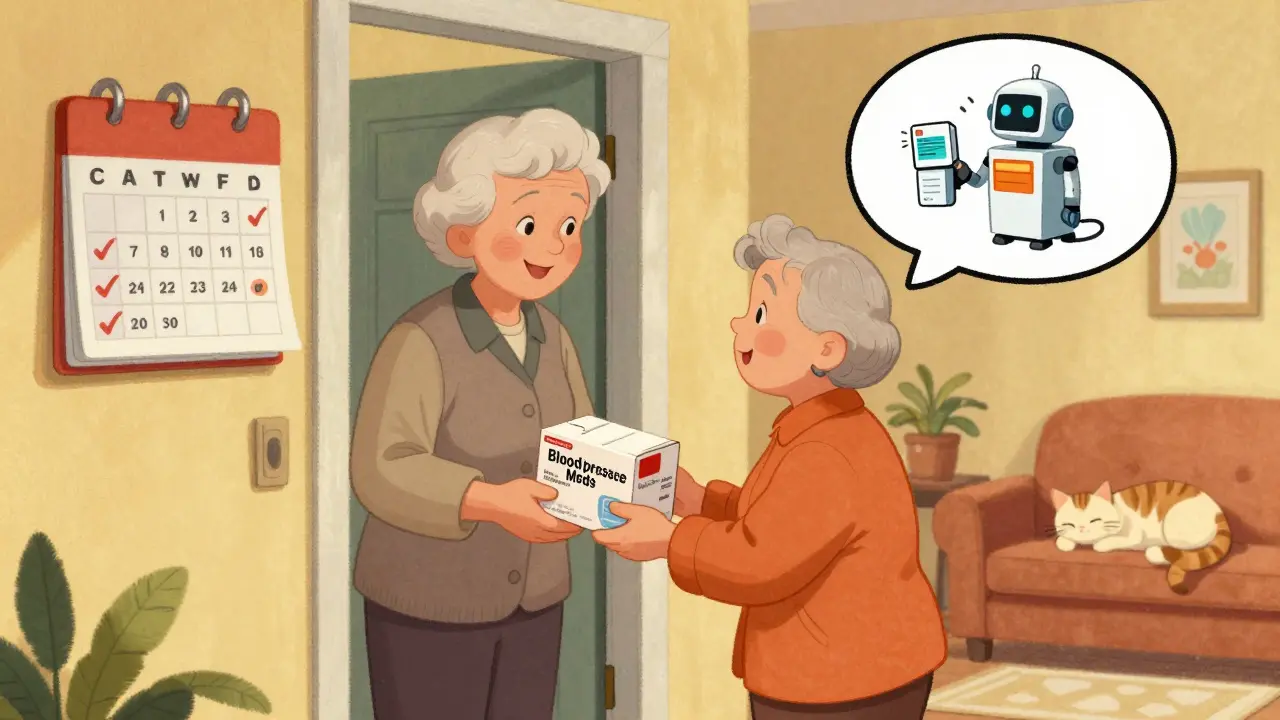
Keeping up with daily medications shouldn’t be a chore-especially when you’re taking generic drugs for long-term conditions like high blood pressure, diabetes, or cholesterol. Yet, millions of people forget to refill their prescriptions on time. That’s where automated refills come in. This isn’t science fiction. It’s a simple, proven system used by major online pharmacies and retail chains today to help patients stay on track without lifting a finger.
Here’s how it works: instead of waiting until you’re out of pills and then remembering to call or log in to reorder, the pharmacy does it for you. Around five to seven days before your current supply runs out, they automatically send a refill request to your doctor, process it, and ship your medication-or make it ready for pickup. No calls. No apps to open. No sticky notes on the fridge. Just your medicine arriving on time, every time.
Why Automated Refills Work Better Than Forgetting
It’s not magic-it’s math. A 2016 study tracking over 100,000 Medicare patients found that those enrolled in automated refill programs had significantly higher adherence rates. For statins, adherence jumped by 7.2%. For diabetes meds, it went up 6.8%. Even for blood pressure drugs (RASA), the improvement was 3.9%. These aren’t small numbers. Missing doses for chronic conditions can lead to hospitalizations, heart attacks, or strokes. Automated refills cut that risk.
And it’s not just about health. It’s about convenience. People with busy schedules, memory issues, or limited mobility benefit the most. One 72-year-old woman in Ohio told her pharmacist she used to miss refills because she forgot which day she needed to call. After enrolling in automatic refills, she hasn’t missed a dose in over two years. Her pharmacy now tracks her adherence rate at 97%.
How It Actually Works Behind the Scenes
Most automated refill systems run on pharmacy management software connected to electronic health records. When you sign up, you give consent-HIPAA-compliant, of course-and the system starts tracking your prescription cycle. If you take a 30-day supply, the system triggers a refill request at day 23. If you take a 90-day supply, it waits until day 83.
Modern systems don’t just guess. They learn. CVS Health, for example, now uses AI to adjust refill timing based on your actual refill history. If you usually pick up your meds two days late, the system starts the process earlier. If you always get them on time, it waits longer. This personalization reduces waste and keeps your supply steady.
Notifications come through your preferred channel: SMS, email, or even a phone call. Most major online pharmacies-like CVS, Walgreens, Amazon Pharmacy, and One Medical-support all three. And 92% of these systems now integrate with mobile health apps. Apple Health, for instance, can now show your refill status alongside your steps and sleep data.
Real Benefits You Can See
- Less stress: No more scrambling when you’re out of pills on a weekend.
- Lower costs: Many programs offer free shipping and discounts on generics. Amazon’s RxPass, launched in January 2023, gives access to 60 common generic medications for just $5 a month to Prime members.
- Fewer pharmacy visits: You save time and avoid long lines. One Medical reports that 78% of their delivery users choose automatic refills specifically to skip trips to the pharmacy.
- More time for pharmacists: Staff spend 37% less time handling manual refill requests. That means more time to answer your questions or check for drug interactions.
Independent pharmacies are catching up too. While national chains like CVS and Walgreens have had these systems since at least 2015, 47% of independent pharmacies now offer automated refills-up from just 21% in 2020.
What Could Go Wrong?
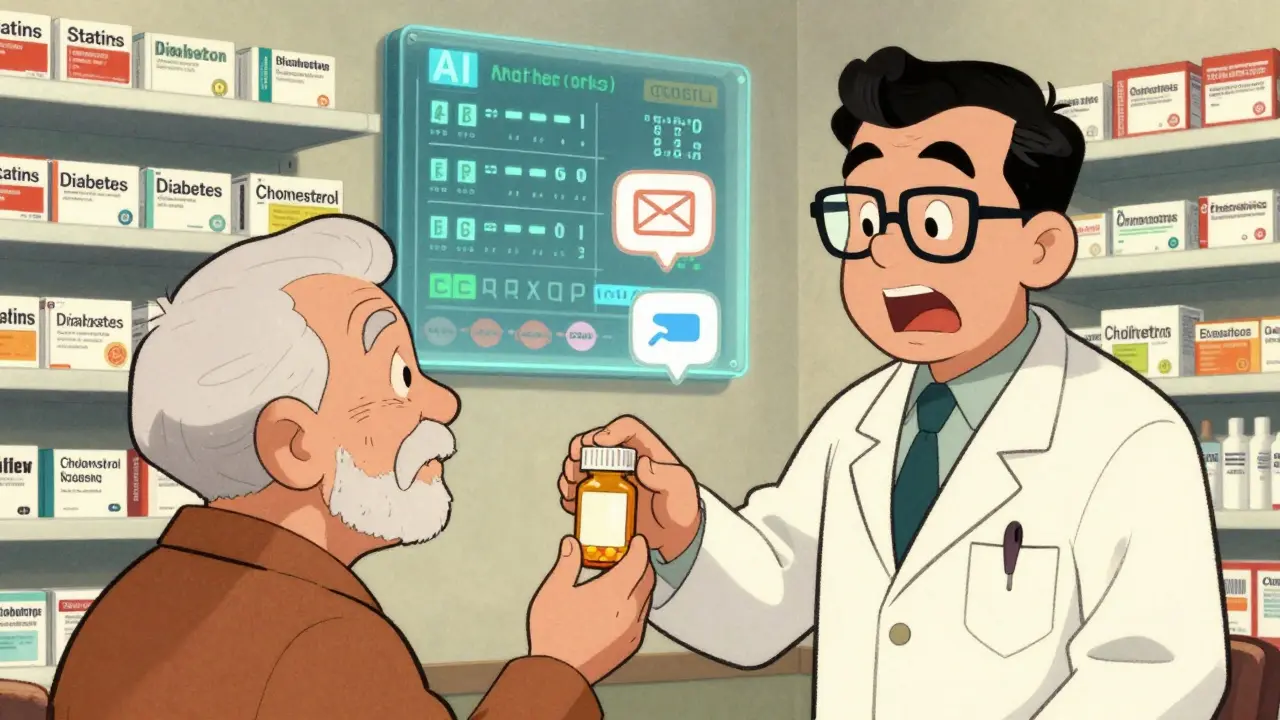
Automated refills aren’t perfect. The biggest risk? Dosage changes.
Imagine your doctor increases your diltiazem from 240 mg to 360 mg. If the automated system doesn’t catch that update, you could keep getting the old dose. That’s happened. In December 2024, Consumer Medication Safety documented a case where a patient received the wrong dosage for weeks because the pharmacy’s system didn’t sync with the doctor’s new e-prescription.
Another issue: some mail-order pharmacies and pharmacy benefit managers (PBMs) set refill triggers too early. For example, if you’re on a 90-day supply, they might trigger a refill at day 60-not because you need it, but because it generates more revenue. Judi Health found that some systems do this intentionally, creating 50% more refill cycles per year than necessary.
And then there’s the lack of awareness. About 31% of negative reviews on platforms like Trustpilot mention being enrolled without knowing. Some pharmacies automatically sign patients up during initial prescription fills. That’s legal if consent is given, but not always clearly explained.
How to Get Started Safely
Enrolling is easy. Here’s how to do it right:
- Ask your pharmacy if they offer automated refills. Most do-especially if you’re on long-term meds.
- Confirm the medication and dosage. Double-check the name, strength, and frequency with your pharmacist.
- Choose your notification method. SMS is fastest. Email is good for records.
- Set up a quarterly review. Every three months, look at your refill history. Did you get extra doses? Was there a gap? Did your dosage change?
- Update your doctor. If you stop a medication, tell your doctor-and call the pharmacy to cancel the refill.
Most pharmacies offer in-person help for seniors or people unfamiliar with tech. CVS, for example, has staff available during off-hours to walk you through enrollment. It takes less than 10 minutes.
What’s Next? The Future of Automated Refills
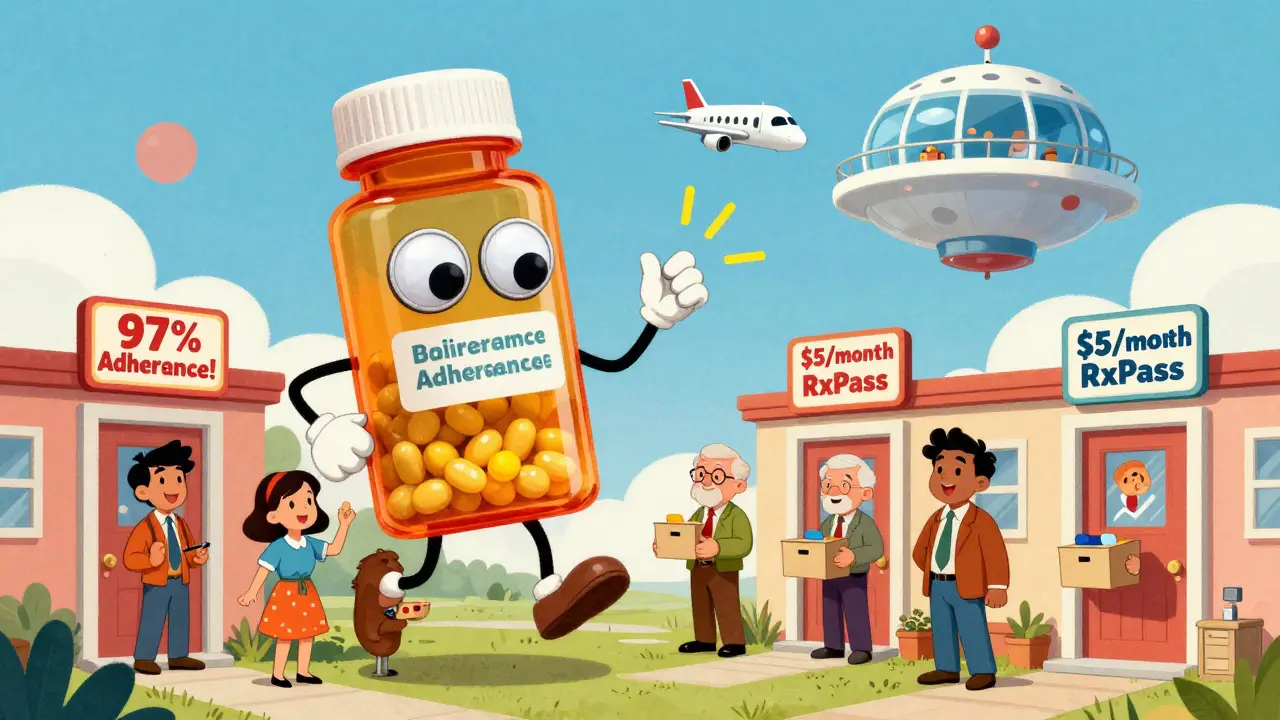
The market is exploding. The global pharmacy automation market is projected to hit $12.3 billion by 2027. By next year, 67% of refill systems will use AI to predict individual refill patterns-like whether you’re likely to miss a dose based on weather, travel, or past behavior.
Integration with telehealth is growing fast. If you have a virtual visit for a blood pressure check, your refill might update automatically. Some platforms are even testing smart pill bottles that beep when you miss a dose and notify your pharmacy.
But experts warn: don’t let automation replace human care. KevinMD, a physician blog, argues that eliminating monthly refill check-ins removes a chance for pharmacists to catch side effects, ask about lifestyle changes, or notice depression. The goal isn’t to remove touchpoints-it’s to enhance them.
Bottom Line
If you take generic medicines every day, automated refills are one of the easiest, cheapest, and most effective ways to stay healthy. They’re not perfect, but they’re better than forgetting. And with more pharmacies adopting them, better technology, and stronger safeguards, they’re getting smarter every year.
Don’t wait until you’re out of pills. Ask your pharmacy today. It takes minutes. It could save your health.
Do automated refills cost extra?
No. Most pharmacies offer automated refills at no additional cost. Some, like Amazon Pharmacy’s RxPass, even charge less-$5 a month for 60 generic medications. Shipping is often free, and you may get discounts on co-pays. The only cost is your time to enroll.
Can I opt out if I change my mind?
Yes. You can cancel automated refills anytime through your pharmacy’s app, website, or by calling them. Just make sure you have a plan to refill manually or you risk running out. Some pharmacies send a reminder before canceling to confirm your decision.
What if my dosage changes?
Always tell your pharmacist when your doctor changes your dosage. Even with automated systems, updates don’t always sync instantly. Ask them to manually override the refill schedule until the system catches up. Most pharmacies will do this at no charge.
Are automated refills safe for seniors?
Yes, and they’re especially helpful for older adults. Many seniors forget to refill prescriptions. Automated systems reduce missed doses and prevent dangerous gaps in treatment. Pharmacies like CVS and Walgreens offer in-store help for seniors who need assistance setting up the system.
Do automated refills work with insurance?
Absolutely. Automated refills work the same way as manual ones when it comes to insurance. Your co-pay, deductible, and coverage limits stay unchanged. In fact, some insurers encourage enrollment because it improves adherence-and lowers their long-term costs.
Automated refills are a game-changer, honestly. I’ve seen my uncle in India go from missing doses to having his meds delivered like clockwork-no more begging neighbors to check his fridge for pill bottles. The real win? It’s not just convenience, it’s dignity. No more feeling like a burden. Just quiet, reliable care. And yeah, the AI tweaks timing based on your habits? Genius. My aunt’s system started sending her refills a day earlier because she always picked them up on Fridays. It noticed. That’s not magic-that’s empathy coded.
Look I get the hype but lets be real this is just another way for big pharma to lock you in. They dont care if you live or die they care about your 90 day supply cycle. Thats why they trigger refills at day 60. Thats not service thats profit. And dont get me started on amazon pharmacy. Theyre not here to help theyre here to own your health data. You think your blood pressure stats are safe? Think again.
Been using automated refills for 3 years now. Best thing that happened to my hypertension management. No more scrambling before holidays. No more forgetting. My pharmacist says I’m one of the most consistent patients he’s ever had. Honestly? It’s not even about tech. It’s about removing friction. If you’re on meds long-term, this isn’t a luxury. It’s basic self care. And yes it’s free. No hidden fees. Just ask your pharmacy.
OMG YES!!! I’ve been doing this for my mom and it’s been LIFE CHANGING 😭 She used to cry because she’d run out on weekends and no one was at the pharmacy. Now she gets a text saying ‘Your meds are ready!’ and she just picks them up like it’s a coffee run ☕️❤️ I told her to sign up and she said ‘You’re a genius’-so now I’m the family pharmacy coordinator 😅
So I’ve been thinking-what if the system learns you’re a weekend pill-taker? Like, maybe you always take your meds on Sunday mornings? What if it delays the refill until Monday because it knows you’re not gonna pop one on Saturday? That’d be wild. AI doesn’t just predict when you run out-it predicts when you’ll actually take it. That’s next-level personalization. Not just automation. Behavioral nudging. Kinda creepy? Or kinda brilliant? Both?
EVERYONE IS BEING MANIPULATED. The ‘automated refill’ system is a Trojan horse. They get your data, track your habits, then sell it to insurers who use it to raise premiums if you ‘miss’ a dose. That’s not healthcare. That’s behavioral surveillance. And don’t tell me about ‘consent’-you think people read those 12-page PDFs during their first prescription? Nah. They click ‘agree’ because they’re tired. And now? You’re a data point. This isn’t helping you. It’s monetizing your vulnerability.
I just… I need to say this. I’ve been on statins for 11 years. I used to forget. I’d look at the bottle and think, ‘Wait… was it yesterday? Or the day before?’ And then I’d panic. I’d cry. I’d feel like I was failing myself. Then I signed up. Now I get a little ping every Friday. No pressure. No guilt. Just… ‘Your meds are on the way.’ And I don’t cry anymore. I just… sigh. And smile. I don’t know why I’m telling you this. I just needed to say it. Thank you.
Think about this: what if the system isn’t automating your care… but automating your compliance? Who decides what ‘adherence’ means? Is it the algorithm? The insurance company? The pharmacist who gets a bonus for your refill rate? We’re not being helped-we’re being optimized. Like a widget on a conveyor belt. ‘Patient 482: 97% adherence. Good job. Now keep taking this pill even if you feel worse.’ Where’s the humanity? Where’s the dialogue? Automation without empathy is just control with a smiley face.
UK’s been doing this since 2012. We call it ‘repeat dispensing.’ No drama. No apps. Just your GP sends the script to the chemist, and you pick it up every 28 days. Simple. Efficient. No Amazon nonsense. No surveillance. No data mining. Just care. And guess what? Our adherence rates are higher than yours. Because we don’t turn health into a subscription service. We treat it like a right. Not a perk.
Okay but what if you’re one of those people who takes meds because they’re supposed to… not because they want to? What if you hate taking pills? What if you’re just… tired? Does the system still send you refills? Or does it… I dunno… send you a little voice note saying ‘Hey, you good?’ Maybe that’s the real innovation. Not the automation. The emotional support. The gentle nudge. The pharmacy that doesn’t just ship pills… but checks in.
So let me get this straight: we’re celebrating a system that reduces human interaction in healthcare… while also admitting that human interaction is the part that saves lives? Like… we’re automating the logistics so the pharmacist can finally have time to ask, ‘How are you really doing?’ That’s beautiful. And also… deeply tragic. We built a machine to do the boring part so the human could do the hard part. We’re not saving time. We’re saving souls. And we call it ‘convenience.’
I’ve been on a 90-day refill for my diabetes med since 2021. Never missed one. Never had to call. Never had to think about it. The system even adjusted when I went on a 3-week road trip-sent me a 60-day supply instead. No questions asked. Just… got it. I didn’t even know it did that. I just got a package. Felt like magic. Now I tell everyone. It’s not tech. It’s just… care that shows up.
One thing the article doesn’t mention: automated refills reduce medication waste. People don’t hoard pills anymore. They don’t take ‘just in case’ stockpiles. That’s huge for environmental impact. And cost. Less overproduction. Less expired pills in landfills. Less money wasted on unused meds. It’s not just personal health-it’s systemic efficiency. Quietly brilliant.
My mom got enrolled without asking. She didn’t even know. Got a letter saying ‘Your refills are now automatic.’ She was furious. Thought it was a scam. Called the pharmacy. They said, ‘Oh, we do this for everyone over 65. You’re welcome.’ She’s now one of their most loyal customers. Because she realized… they didn’t do it to control her. They did it because they care. And that’s the real story. Not the tech. The intent.