
MedWatch Reporting Checker
Is This a Reportable Event?
The FDA defines a serious adverse event as one that results in:
Results
Next steps:
- Visit www.fda.gov/medwatch
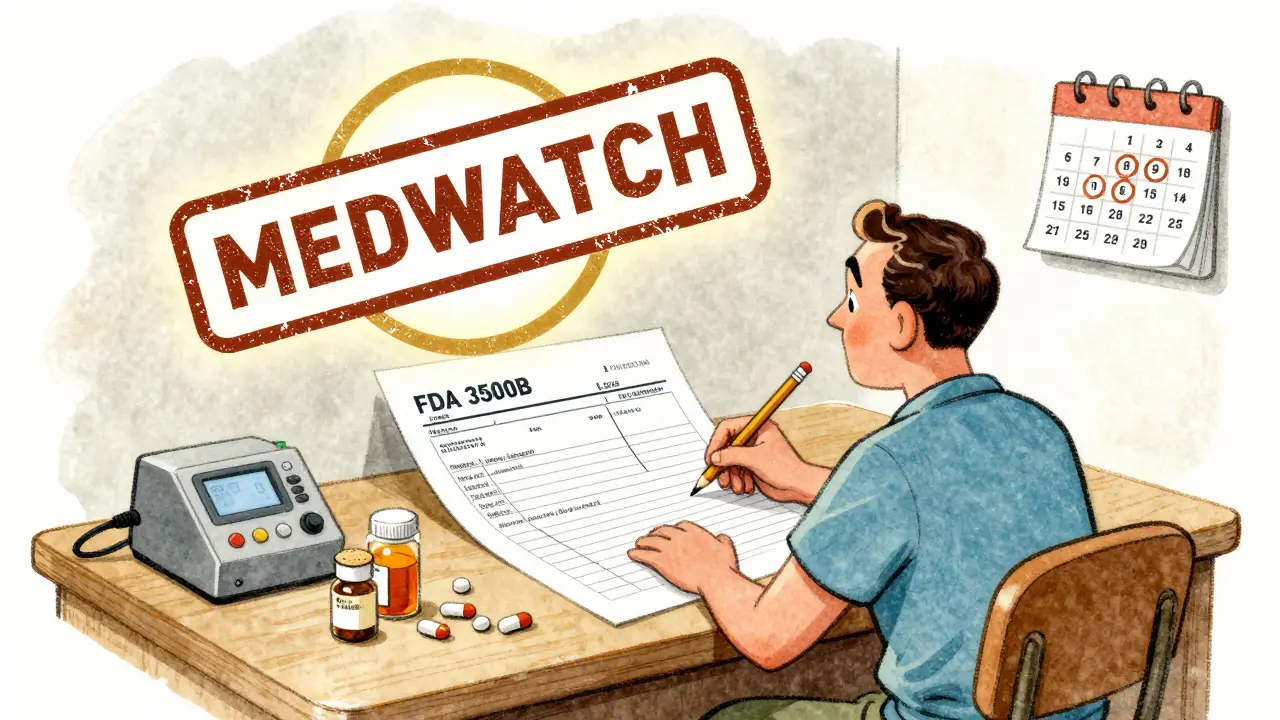
- Complete Form FDA 3500B
- Include product name, dates, symptoms, and actions taken
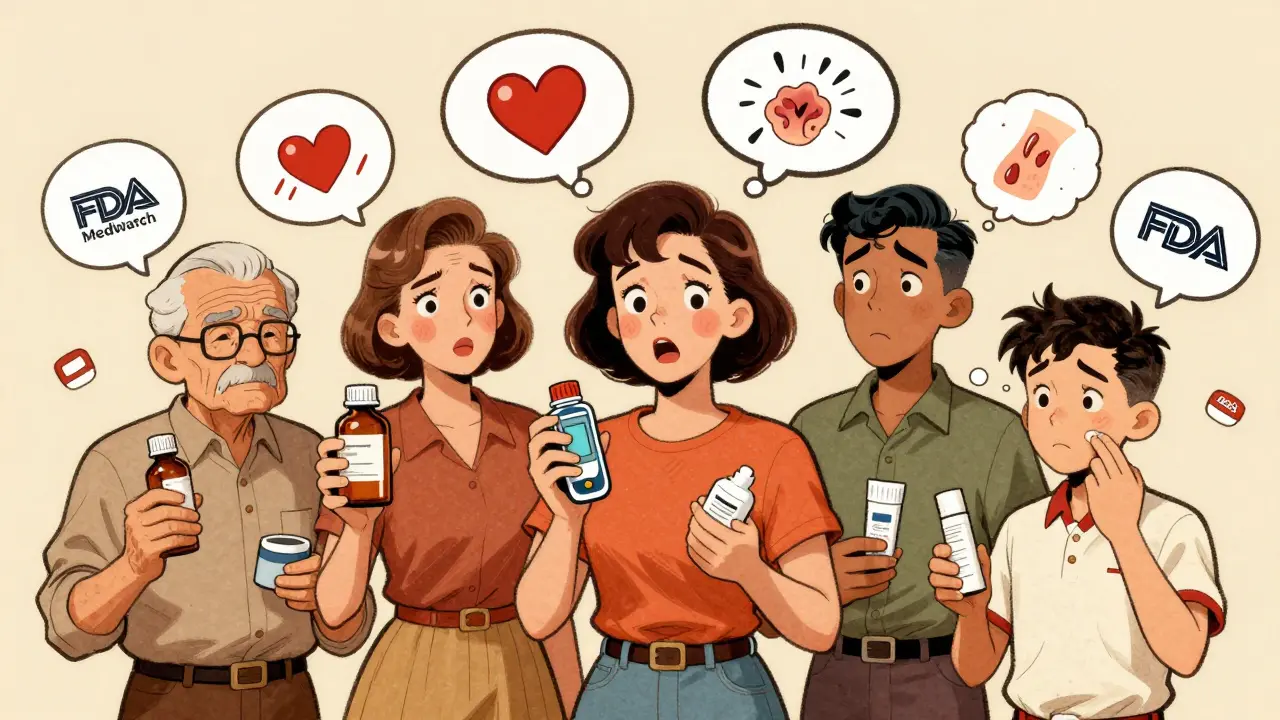
Every year, over a million reports of bad reactions to medicines and medical devices flow into the FDA. Most of these come from doctors and hospitals. But a surprising number come from regular people-like you-who noticed something wrong after taking a pill, using a glucose monitor, or applying a new cream. These reports aren’t just paperwork. They’re the early warning system that can lead to safer drugs, updated labels, or even product recalls. If you’ve had a serious side effect, you’re not just a patient-you’re part of a safety net that protects millions.
What Is MedWatch?
MedWatch is the FDA’s official system for collecting reports about harmful side effects, product failures, and other safety issues with medical products. It’s not a suggestion box. It’s a legal and public health tool. The FDA uses these reports to spot patterns that clinical trials might have missed. A drug might work great for 10,000 people in a trial, but if 500 people in the real world start having seizures after taking it, MedWatch is how that gets noticed.
It covers almost everything the FDA regulates: prescription and over-the-counter drugs, medical devices like insulin pumps or home test kits, biologics like blood transfusions and gene therapies, even CBD products and cosmetics. The only things it doesn’t cover are vaccines (those go to VAERS), animal drugs, and tobacco.
MedWatch works because it’s two systems in one. Healthcare providers and manufacturers are legally required to report serious problems. But anyone-patients, caregivers, family members-can report too. That’s where your voice matters.
When Should You Report?
You don’t need to be a doctor to know when something’s wrong. The FDA defines a serious adverse event as one that results in:
- Death
- Life-threatening condition
- Hospitalization (or prolonging an existing hospital stay)
- Permanent disability
- Birth defect
- Requires medical or surgical intervention to prevent one of the above
For example: You start taking a new blood pressure medication and end up in the ER with a severe allergic reaction. Your glucose monitor gives wildly inaccurate readings, causing you to miss insulin doses. A new skin cream causes blistering that won’t heal. These aren’t just bad luck-they’re red flags that need to be flagged.
Even if you’re not sure it was the product, report it anyway. The FDA doesn’t need proof. They need patterns. If five other people report the same issue with the same brand of earbuds causing dizziness, that’s a signal.
How to Report: The Two Forms
There are two simple forms, depending on who you are.
Form FDA 3500B - For Patients and Consumers
This is the one you use if you’re reporting for yourself or someone in your family. It’s shorter, written in plain language, and available in English and Spanish. You’ll need:
- Your name and contact info
- The name of the product (brand and generic if you know it)
- When you started using it
- When the problem started
- What happened (describe symptoms in your own words)
- What you did after (did you stop using it? Go to the doctor?)
- Any other medications or devices you were using
It takes about 10 to 20 minutes. The online form has big buttons, clear fields, and a step-by-step layout. But some terms still trip people up. Words like “event abated” or “dose frequency” aren’t everyday language. If you’re stuck, don’t guess. Write it in plain English: “I felt dizzy after taking the pill,” not “I experienced orthostatic hypotension.”
Form FDA 3500 - For Healthcare Professionals
If you’re a doctor, nurse, pharmacist, or other medical worker, you use Form 3500. It’s more detailed. You’ll include your license number, specialty, and whether you’ve reported it to the manufacturer. You’ll also add clinical details like lab results, diagnosis codes, and treatment steps. Most professionals finish it in 10-15 minutes. Many say the system is fast and the FDA sends a confirmation email-which matters. It tells you your report was seen and valued.
What Happens After You Submit?
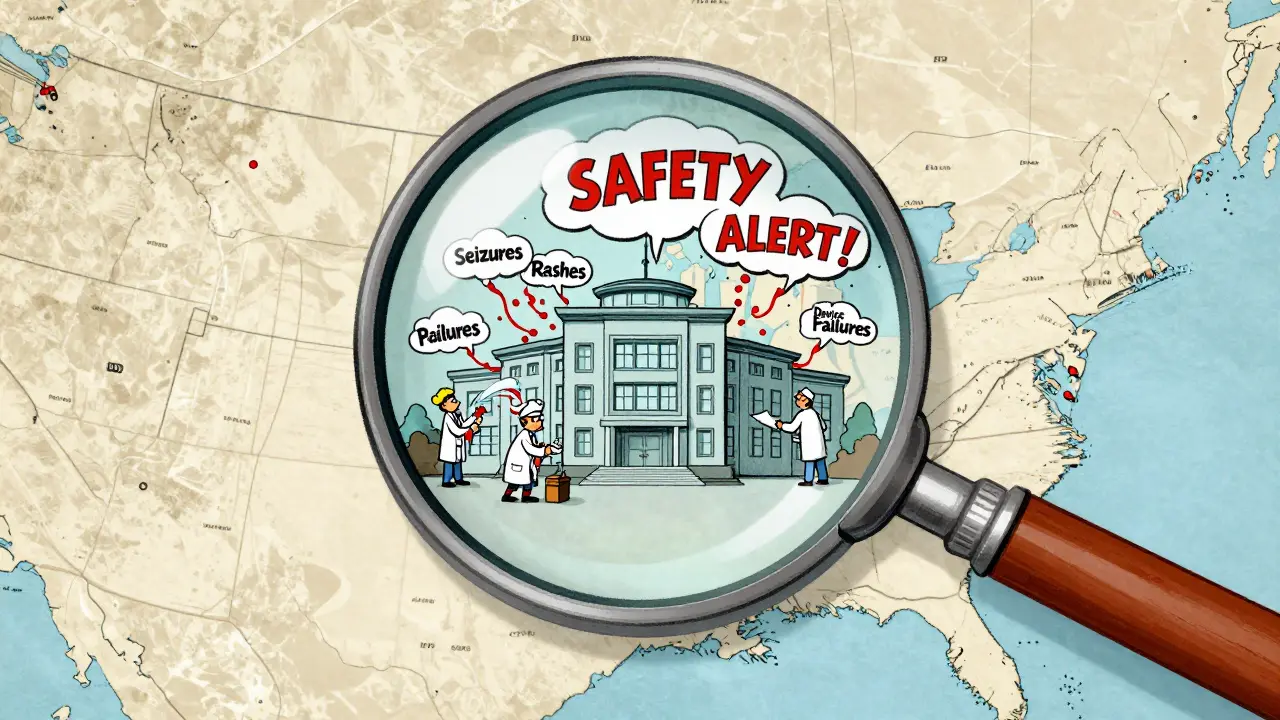
Once you hit submit, your report goes into a database with over 1.2 million entries per year. The FDA doesn’t respond to every single report with a personal reply. But they do review them in batches. Analysts look for clusters-same drug, same symptom, same device, repeated across different locations.
If enough reports point to a pattern, the FDA can:
- Update the drug’s warning label to include a new side effect
- Send out a safety alert to doctors and pharmacies
- Require the manufacturer to run a new study
- Require a boxed warning-the strongest warning they can give
- Order a recall
One real example: In 2018, dozens of patients reported severe skin reactions after using a common acne cream. The FDA reviewed the reports, confirmed the link, and updated the label to warn against use on broken skin. That change likely prevented hundreds of future injuries.
Your report might be the one that triggers the change.
Common Problems and How to Avoid Them
Not every report gets processed cleanly. About 15% of consumer reports need follow-up because they’re missing key info. Here’s how to avoid that:
- Don’t skip the product name. If you don’t know the generic name, write the brand and look it up on the bottle or receipt. “The blue pill with the ‘A’ on it” isn’t enough.
- Include dates. When did you start? When did symptoms begin? When did you stop?
- Be specific about symptoms. “Felt weird” isn’t helpful. “Felt like my heart was racing, couldn’t catch my breath, and my hands shook for 4 hours” is.
- Don’t assume your doctor will report it. The FDA says clearly: Your doctor is NOT required to report. They might not even know about MedWatch.
If you’re unsure, take the form to your doctor. They can help fill in medical details from your records. But you don’t need their permission to submit. You can report on your own.
Why Most People Don’t Report (And Why You Should)
Here’s the hard truth: Experts estimate only 1% to 10% of serious side effects are ever reported. That means for every 100 people who have a bad reaction, 90 to 99 stay silent.
Why? People think:
- “It was just bad luck.”
- “It’s not that serious.”
- “No one will care.”
- “The form is too complicated.”
But here’s what you’re not seeing: The FDA doesn’t have magic powers. They don’t know what’s happening unless someone tells them. If no one reports, the FDA can’t act. A drug stays on the shelf with a warning label that doesn’t mention the real risk. A device keeps being sold with a design flaw that causes injury.
Your report could be the reason a product gets fixed-or pulled.
Where to Report and How to Stay Updated
You can report online at www.fda.gov/medwatch. You can also download printable forms, call 1-800-FDA-1088, or fax them. Online is fastest and most reliable.
After you report, you can sign up for free alerts. The FDA sends out emails and RSS feeds about:
- New safety warnings
- Drug recalls
- Label changes
- Product withdrawals
It’s a simple way to stay informed. If a product you take gets flagged, you’ll know before it hits the news.
What’s Next for MedWatch?
The FDA is working to make MedWatch easier. In 2021, they launched a new online portal with mobile-friendly design. By 2025, they plan to connect MedWatch directly to electronic health records-so when a doctor sees a patient with a bad reaction, the system can auto-fill a report. They’re also testing AI tools that help patients pick the right words when describing symptoms.
As medicines get more personalized-gene therapies, targeted cancer drugs, custom biologics-the need for detailed, real-world reports will grow. Rare side effects in small groups can only be caught through widespread reporting.
MedWatch isn’t perfect. But it’s the only system we have. And it only works if people use it.
FAQ
Do I need a doctor’s note to report a side effect?
No. You can report on your own. The FDA explicitly says your healthcare provider is not required to report for you. You can use Form 3500B and submit it yourself. However, if you have access to your medical records, sharing details like lab results or diagnosis codes can help the FDA understand your case better.
Can I report a side effect from a supplement or cosmetic?
Yes. MedWatch covers cosmetics, dietary supplements, and CBD products-even though they’re not as tightly regulated as prescription drugs. If you had a serious reaction like a rash, swelling, liver problems, or an allergic response, report it. The FDA uses these reports to track safety trends and may issue warnings or take action if patterns emerge.
What if I don’t remember the exact name of the product?
Try to find the packaging, receipt, or prescription label. If you can’t, describe it as clearly as possible: color, shape, markings, where you bought it, and how you used it. The FDA has databases that can match descriptions to products. It’s better to report with partial info than not at all.
Is MedWatch only for U.S. residents?
Yes. MedWatch is for products sold or used in the United States. If you’re outside the U.S. and had a reaction to a product you bought in the U.S., you can still report it. If the product was sold in the U.S., the FDA can act on your report. For products sold only in other countries, contact your local health authority.
Will my report be kept private?
Yes. The FDA protects your personal information. Your name and contact details are not shared publicly. Reports are anonymized before being used for analysis. Only authorized FDA staff have access to identifiable data, and it’s used solely for safety monitoring.
How long does it take for the FDA to act on a report?
There’s no set timeline. Some reports trigger immediate alerts if they’re part of a clear pattern. Others take months or years to build enough evidence. One report alone rarely causes action-but 50 similar reports can. That’s why consistent reporting matters, even if you don’t see results right away.
Next Steps
If you’ve ever had a bad reaction to a medicine or device, don’t ignore it. Even if you think it was a one-time thing, someone else might be going through the same thing. Take five minutes. Go to www.fda.gov/medwatch. Fill out Form 3500B. Submit it.
You’re not just reporting a side effect. You’re helping make the next generation of medicines safer-for everyone.


Let’s be real-most people don’t report because they assume the system is a black hole. But I’ve submitted three reports over the years, and two led to updated warnings. The FDA doesn’t reply, sure, but they don’t need to. The fact that a drug’s label now says ‘may cause sudden vertigo’ after my 2021 report? That’s victory. You think your voice doesn’t matter? It’s the only thing that does.
And no, you don’t need a medical degree. Just honesty and a willingness to be the person who says, ‘This wasn’t normal.’
bro i took that new sleep aid last month and woke up screaming because my arm felt like it was on fire?? thought i was having a stroke. didn’t report it. why? because i thought they’d just say ‘lol ur fine’
but now i’m gonna submit it. this shit matters.
There’s something deeply human about this system. It’s not just bureaucracy-it’s collective care. Every report is a quiet act of solidarity. You’re not just protecting yourself-you’re protecting the next person who picks up that same pill, uses that same monitor, applies that same cream.
It’s easy to feel powerless in a healthcare system that often feels impersonal. But MedWatch? It turns patients into witnesses. And witnesses change things.
Even if it takes years. Even if no one thanks you. You’re still part of the architecture of safety.
MedWatch is a trap. The FDA uses your reports to justify more regulation, more control, more pharmaceutical monopolies. You think they care about safety? They care about liability. Every time you report, you’re feeding the machine that makes drugs more expensive and harder to access.
They’ll never admit it, but this system exists to scare manufacturers into paying fines-not to save lives. The real solution? Deregulate. Let the market decide. Your report won’t change anything except your peace of mind-and that’s the illusion they want you to believe in.
Let me break this down for anyone still on the fence. You’re not just reporting a side effect-you’re building a database that saves lives. Think about it: a teenager takes a new acne cream, gets a horrific chemical burn, and doesn’t tell anyone. Months later, another kid does the same thing. And another. And another. By the time the FDA notices, dozens have been scarred for life.
But if even one of those kids had reported it? That cream gets a warning label before the third person gets hurt. That’s not hypothetical. That’s happened. Repeatedly.
And yes, the form is clunky. Yes, you might not remember the exact name. But you know the color. You know the shape. You know how it smelled. Write that down. Don’t wait for perfect. Perfect is the enemy of protection.
If you’ve ever had a weird reaction, even if you thought it was ‘just stress’-go report it. Five minutes now could save someone from a year of pain. That’s not activism. That’s basic decency.
Just submitted mine. Took me 12 minutes. Had to dig up a receipt from 2022. But worth it.
My heart started pounding like a jackhammer after taking that new migraine med. Thought it was anxiety. Turns out it’s a known but underreported interaction. Now it’s in the system. Someone else won’t have to figure it out the hard way.
Thanks for the nudge, OP. This matters.
My mom had a bad reaction to a blood pressure med last year. She didn’t report it because she thought the doctor would. He didn’t. I found out months later when I was going through her pills and saw the label change. That’s when I submitted it myself.
It’s not about blame. It’s about making sure the next person doesn’t have to live through what she did. That’s all.
The FDA is a federal agency. It is not a customer service hotline. Reports are not petitions. They are data points. The notion that individual citizens can influence drug safety through anecdotal reporting is a dangerous myth. This system exists because Congress mandates it-not because it works.
Real safety comes from rigorous clinical trials, not from people typing ‘I felt weird’ into a web form.
Do not mistake participation for impact.
I read this post and felt proud. Not because I’m American, but because this is how systems should work-when they’re designed with humanity in mind.
In Nigeria, we don’t have anything like MedWatch. When someone has a bad reaction, they just stop using the medicine and hope it doesn’t happen again. No one tracks it. No one learns.
I’m going to share this with my community. Maybe one day, our government will build something like this. Until then, I’ll report anything I see-even if it’s just for the people who come after me.
Used a new glucose monitor. Readings were off by 50%. Thought it was me. Turned out the sensor batch was faulty. Reported it. Got an email back from FDA saying ‘thank you for your vigilance.’
That’s all I needed.
As someone who works with immigrant communities, I’ve seen how language and fear keep people silent. Many don’t report because they don’t trust the system. Or they think their English isn’t good enough.
But the form accepts plain language. ‘My face swelled up’ is better than ‘facial angioedema.’ You don’t need to sound like a doctor. You just need to be honest.
I’ve helped five people submit reports. None of them believed it mattered. Now they all say the same thing: ‘I’m glad I did it.’
Reported a bad reaction to a CBD gummy. Got zero response. No email. No update. No recall. So what was the point?
Waste of time. The FDA doesn’t care. They’re just collecting data to sell to pharma lobbyists.
Don’t believe the hype. This is performative safety.
My sister’s rash from a new lotion turned into a hospital stay. We reported it. Two weeks later, the company pulled the product. Coincidence? Maybe. But I’ll never not report again.
There’s a quiet magic in this-the way ordinary people, scattered across time zones and languages and incomes, all press submit on the same form, hoping their tiny act will ripple outward.
I once reported a reaction to a cheap hair dye. Three months later, a woman in Ohio emailed me-she’d had the same thing. We didn’t know each other. But we’d both reported. And because we did, the product got a warning. That’s the kind of thing that makes you believe in people again.
Don’t underestimate the power of your story. It’s not just data. It’s a thread in a tapestry. Pull one thread, and the whole thing might unravel-or it might hold together a little longer. That’s worth five minutes.