

Statin Tolerance Risk Calculator
Select your statin medication and SLCO1B1 genotype to estimate your risk of statin-induced muscle pain. This tool is based on current medical guidelines and research.
Most affected by SLCO1B1 variants
Minimal genetic risk
Minimal genetic risk
Lowest genetic risk
Low genetic risk
2 copies of risk allele
1 copy of risk allele
No risk alleles
Every year, millions of people take statins to lower cholesterol and prevent heart attacks. But for some, the medication causes muscle pain so severe they have to stop. What if your genes could explain why? This isn't just theoretical-it's happening right now in clinics around the world. pharmacogenomics testing is a tool that helps doctors predict how you'll respond to statins based on your DNA.
What Is Pharmacogenomics Testing for Statins?
Pharmacogenomics testing looks at how your genes affect how your body processes medications. For statins, it focuses on specific genetic variants linked to side effects, especially statin-induced myopathy. A landmark study in the New England Journal of Medicine in 2008 found that a variant in the SLCO1B1 gene increases the risk of severe muscle problems with simvastatin. This discovery led to the development of tests that can now be done with a simple blood or saliva sample.
Key Genetic Players in Statin Response
The SLCO1B1 gene is the most important player. It encodes a protein that helps move statins into the liver for processing. The rs4149056 variant (c.521T>C) has been linked to higher risks of muscle pain. People with two copies of the C allele (CC genotype) face up to 4.5 times the risk of severe muscle issues when taking simvastatin. Those with one copy (TC) have 2.6 times higher risk. About 1-2% of Europeans have the CC genotype, and 15% have TC.
Other genes also play roles. The CYP2D6 enzyme processes some statins, and poor metabolizers (7-10% of Caucasians) may have higher drug levels. Genes like ABCB1 and ABCG2 affect how statins are transported out of cells. A 2021 study in Circulation found new genes like GATM and CACNA1S linked to muscle symptoms, though their exact roles are still being studied.
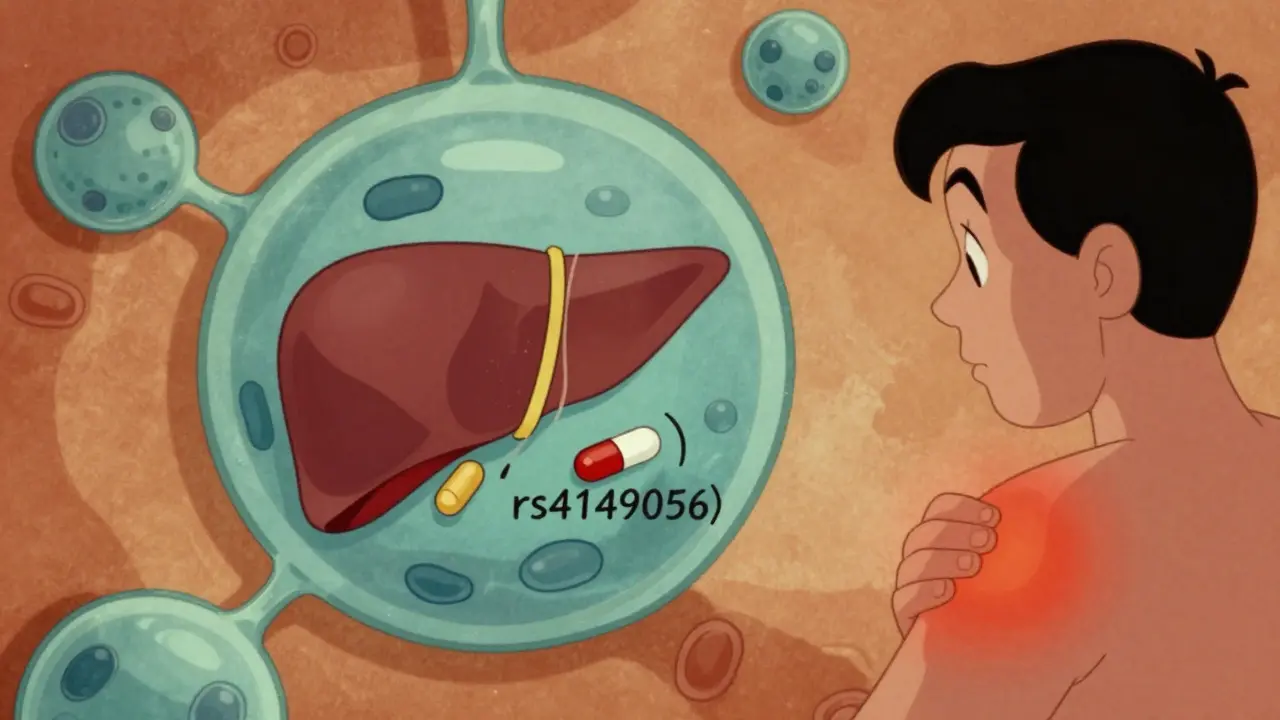
How Statin Type Affects Genetic Risk
Not all statins are the same when it comes to genetics. The simvastatin is affected most by SLCO1B1 variants. A 2021 study of over 11,000 people found no significant connection between SLCO1B1 and muscle symptoms for atorvastatin or rosuvastatin. This explains why the Clinical Pharmacogenetics Implementation Consortium (CPIC) guidelines only recommend SLCO1B1 testing for simvastatin. For people with high-risk genotypes, doctors often switch to pravastatin or fluvastatin, which rely less on the SLCO1B1 transporter. Studies show pravastatin has 80% lower muscle risk in CC genotype carriers compared to simvastatin.
Real-World Testing Experiences
Patients have mixed experiences with pharmacogenomics testing. A Mayo Clinic survey of 2,145 people found 78% of those with prior statin intolerance successfully restarted on a different statin after genetic testing. On Reddit's genetics community, 62% of respondents reported better tolerance after genotype-guided choices. However, 27% of users on MedHelp still had muscle symptoms despite testing. Insurance coverage is another hurdle-only 28% of commercial insurers covered SLCO1B1 testing in 2022, with out-of-pocket costs between $150-$400.

Challenges in Implementation
Doctors face real-world barriers. A 2021 survey found only 43% of primary care physicians felt confident interpreting test results. Cardiologists were more comfortable (82%), but most doctors need better tools. Electronic health record systems like Epic and Cerner now include decision support that flags high-risk genotypes when simvastatin is prescribed. Still, timing matters: testing before the first statin prescription improves adherence by 18.7% compared to testing after side effects start, according to a 2021 study in Pharmacotherapy.
What's Next in Research
Researchers are moving beyond single-gene tests. A January 2023 study in Clinical Chemistry showed combining 15 genetic variants into a polygenic risk score improved prediction accuracy from 58% to 67%. The Statin Pharmacogenomics Implementation Consortium, launched in 2023, aims to standardize testing across 50 U.S. healthcare systems by 2025. While challenges remain, the potential to personalize statin therapy for millions is clear.
What is the SLCO1B1 gene's role in statin tolerance?
The SLCO1B1 gene produces a protein that transports statins into the liver. A specific variant (rs4149056) reduces this transport, causing higher blood levels of statins and increasing muscle pain risk. People with two copies of the C allele (CC genotype) have up to 4.5 times higher risk of severe muscle damage when taking simvastatin.
How does pharmacogenomics testing work for statins?
Testing usually involves a blood or saliva sample sent to a lab. The lab checks for specific genetic variants like SLCO1B1 rs4149056. Results are typically ready in 5-10 business days. Doctors use these results to choose the right statin and dose, avoiding high-risk options for certain genotypes.
Which statins are most affected by genetic factors?
Simvastatin is the statin most affected by SLCO1B1 variants. Atorvastatin and rosuvastatin show little to no connection with this gene. This is why clinical guidelines only recommend SLCO1B1 testing for simvastatin. Patients with high-risk genotypes often switch to pravastatin or fluvastatin, which have lower muscle risk.
Is pharmacogenomics testing covered by insurance?
Insurance coverage varies widely. As of 2022, only 28% of commercial insurers covered SLCO1B1 testing. Out-of-pocket costs range from $150-$400. Medicare covers PGx testing only in specific cases under the Molecular Diagnostic Services Program. Some healthcare systems include testing in standard care, but it's not universal.
How do doctors use test results to adjust statin therapy?
For patients with the CC genotype, doctors avoid high-dose simvastatin (80mg) and may choose lower doses or alternative statins like pravastatin. The Clinical Pharmacogenetics Implementation Consortium (CPIC) guidelines provide specific dosing recommendations based on genotype. Some EHR systems automatically flag high-risk genotypes when simvastatin is prescribed, helping doctors make safer choices.
What are the limitations of current genetic testing for statins?
Current testing only explains part of the risk. SLCO1B1 accounts for about 6% of statin muscle symptom risk, meaning many cases aren't predicted by genetics alone. Guidelines exist only for simvastatin, not other statins. Also, testing doesn't always improve adherence-studies show mixed results on whether genetic results change patient behavior long-term.





I had muscle pain on simvastatin and switched to pravastatin after testing. Worked great! 😊
Pharma companies push this testing to make money they don't care about real health just profit
US healthcare is failing we aren't doing this testing for everyone it's a shame 😠
The purported benefits of pharmacogenomics testing for statins are dubious at best. This appears to be a calculated move by Big Pharma to maximize profits under the guise of personalized medicine.
They have been pushing this testing for years, but the evidence just isn't there. I've read studies that show no significant correlation between the genetic markers and actual side effects.
It's all just a scheme to sell more tests and drugs. The FDA hasn't even approved these tests for routine use.
Why are we wasting money on something that's not proven? It's clear that the pharmaceutical industry is manipulating the system.
They're not interested in real health outcomes, only in the bottom line. I've seen firsthand how these tests lead to unnecessary procedures and costs.
This is just another way for them to squeeze money out of patients. We need to demand transparency and evidence before adopting these practices.
The truth is, most people don't need genetic testing for statins. The risks are minimal, and the benefits are nonexistent.
This is really helpful! Many folks aren't aware of how genetics can influence statin tolerance. Switching based on tests can prevent serious side effects. Thanks for the info!
The SLCO1B1 variant's correlation with statin myopathy lacks robust evidence. This is a pharmaceutical marketing ploy disguised as precision medicine.
This testing is not reliable data insufficient we shouldn't waste resources
Interesting point about the studies. While some evidence is emerging, it's important to note that SLCO1B1 testing has helped many patients avoid side effects. It's not perfect, but it's a step forward.
The cost difference between testing and potential side effects is worth it.
This is cool 😃 insurance doesn't cover it need more info on costs
My doctor never mentioned this testing. Not sure if it's worth it.
American healthcare is the best this should be standard pharma companies should be held accountable
This testing is pointless. Statins work fine for everyone. Stop overcomplicating.
The government should mandate this testing. It's a matter of public health.
OMG this is so messed up! Pharma is lying about statins. Theyre trying to kill us. 😡