
The Orange Book isn't a physical book you can hold - it's a living, digital database run by the U.S. Food and Drug Administration (FDA) that tells the world which drugs are approved, when generics can enter the market, and which ones can be safely swapped for each other. It’s the backbone of how generic drugs become available, how prices drop, and how millions of Americans get affordable medications every day. If you’ve ever filled a prescription for a generic version of a brand-name drug, you’ve benefited from the Orange Book - even if you didn’t know it.
What Exactly Is the Orange Book?
The official name is Approved Drug Products With Therapeutic Equivalence Evaluations. It started in 1979, but it really became powerful after the 1984 Hatch-Waxman Act. That law changed everything. Before then, generic drug makers had to run full clinical trials just to prove their version worked. The Hatch-Waxman Act let them rely on the original brand’s data - as long as they could prove their product was the same in active ingredients, strength, dosage form, and how it’s absorbed by the body.
The Orange Book is where all that gets recorded. It lists every small-molecule drug approved by the FDA - that means pills, injections, patches, inhalers - but not biologics like insulin or cancer antibodies. Those go in the Purple Book. The Orange Book only deals with traditional chemical drugs.
Each drug listing includes:
- The brand name (like Eliquis)
- The generic name (apixaban)
- Dosage form (tablet, capsule, etc.)
- Strength (5 mg, 10 mg)
- Route of administration (oral, IV, etc.)
- The NDA (New Drug Application) or ANDA (Abbreviated New Drug Application) number
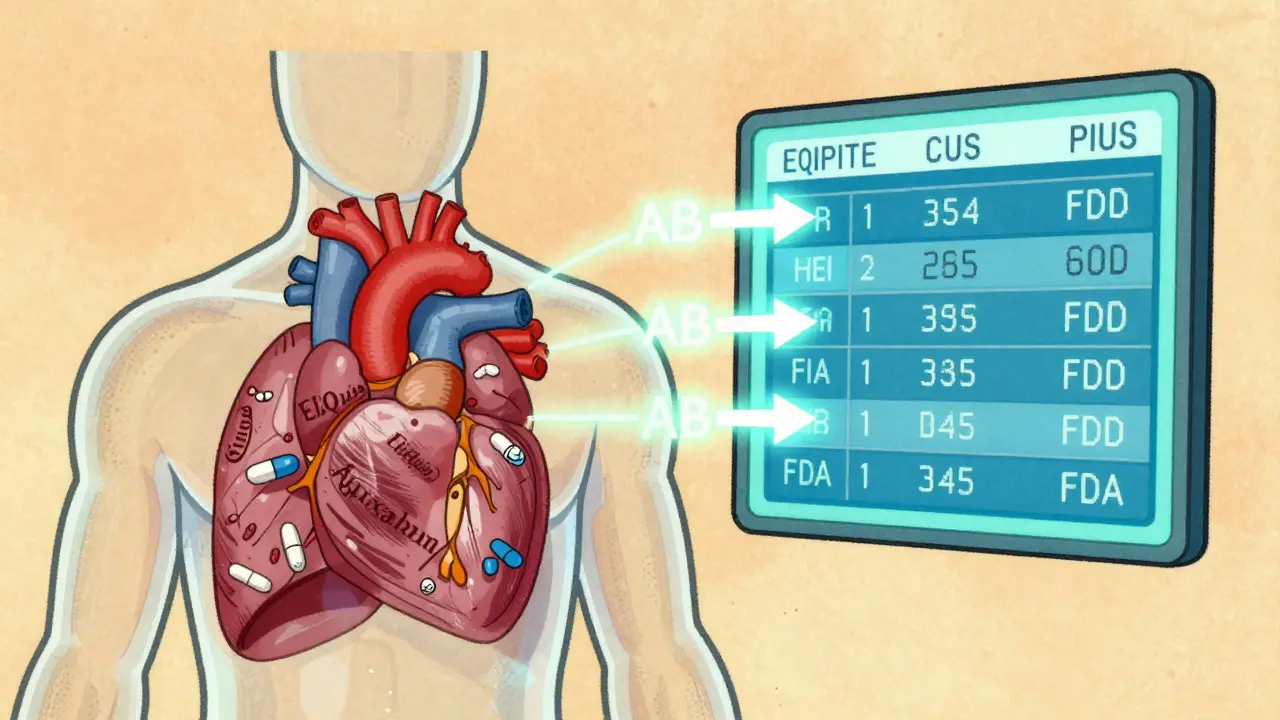
But the real magic is in the therapeutic equivalence ratings. These are one or two letters - most commonly “AB.” An AB rating means the generic is bioequivalent to the brand. That means your body absorbs it the same way. If a drug has an AB rating, pharmacists can legally substitute it without asking the doctor. That’s how you save money.
Patents and Exclusivity: The Clock That Controls Generic Entry
The Orange Book doesn’t just list drugs. It also lists patents. And not just any patents - the ones that matter for blocking generics.
When a brand-name company gets FDA approval, they have 30 days to submit any patents they think protect their drug. The FDA then publishes those in the Orange Book. Each patent gets a number, an expiration date, and a use code. The use code tells you which specific medical condition the patent covers. For example, a patent might only cover using a drug for treating high blood pressure - not for heart failure. That’s important because a generic can still be approved for the unpatented use.
There are over 5,500 patents listed in the Orange Book tied to just over 2,100 brand-name drugs. That sounds like a lot - and it is. But here’s the catch: not all patents are created equal. Some are legitimate. Others? They’re filed just to delay competition. That’s called “evergreening.” A company might patent a new coating on a pill or a slightly different dosing schedule - not because it’s a breakthrough, but because it resets the clock.
The Orange Book also tracks regulatory exclusivity - extra protection that’s not based on patents. These include:
- New Chemical Entity (NCE) exclusivity: 5 years of market exclusivity for a drug with a completely new active ingredient.
- Orphan Drug Exclusivity: 7 years for drugs treating rare diseases (fewer than 200,000 patients in the U.S.).
- Pediatric Exclusivity: 6 months added to existing patents or exclusivity if the company tested the drug in children.
These aren’t patents. They’re legal shields granted by the FDA. And they’re just as important as patents when figuring out when a generic can launch.
How Generic Companies Use the Orange Book
Generic drug makers don’t guess when they can enter the market. They check the Orange Book - every single day. The FDA updates it daily. That’s how fast things move.
A generic company files an ANDA. In that application, they must say whether they’re challenging any patents listed in the Orange Book. There are four types of certifications:
- Paragraph I: No patents listed.
- Paragraph II: The patent has expired.
- Paragraph III: The patent will expire on a certain date - so the generic will wait.
- Paragraph IV: The patent is invalid or won’t be infringed - this triggers a lawsuit from the brand-name company.
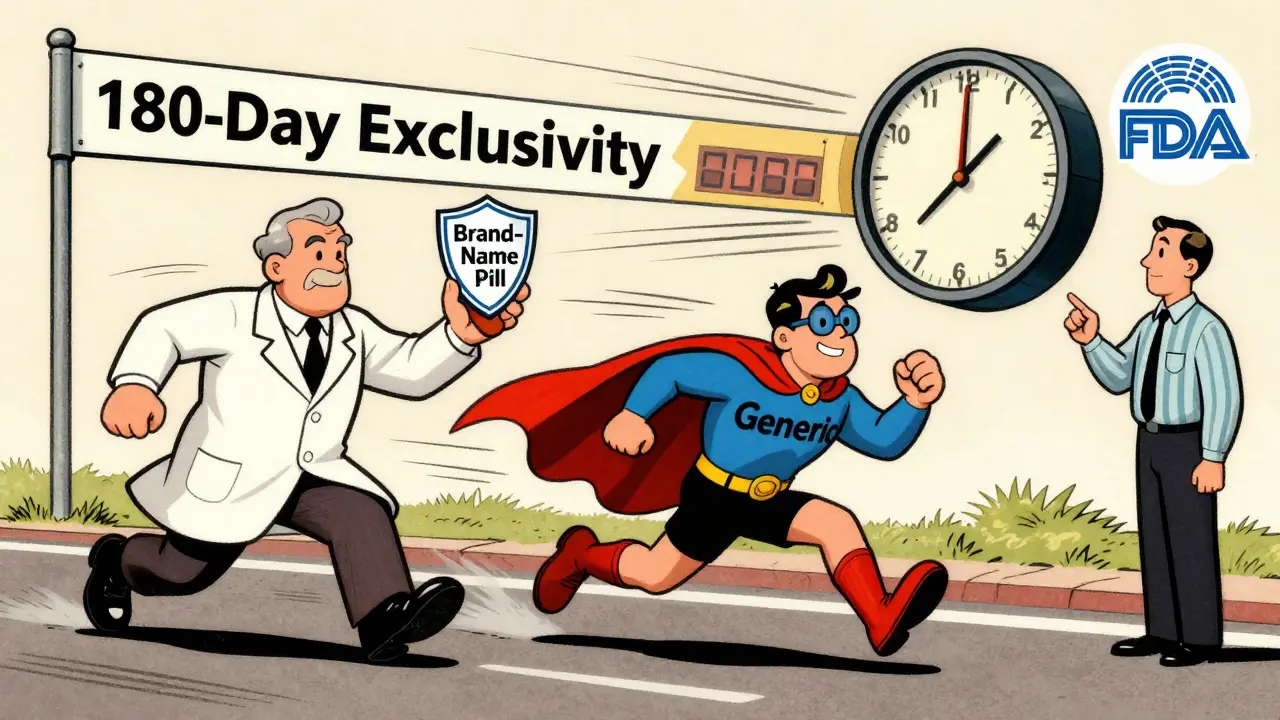
Paragraph IV is the big one. It’s how generics challenge weak patents. But it’s risky. If the brand sues, the generic gets 180 days of exclusivity - but only if they’re the first to file. That’s why companies race to submit their ANDAs. The Orange Book tells them exactly when the clock starts ticking.
One real example: apixaban (Eliquis). The brand’s key patents were set to expire in 2026. Generic manufacturers tracked every patent, every exclusivity period, every legal challenge in the Orange Book. They built their entire pipeline around it. When the patents expire, the U.S. could save $12 billion a year. That’s all because of the Orange Book.
Who Uses It - And How?
It’s not just generic drug companies. Pharmacists use it daily. When a doctor writes a prescription for a brand-name drug, the pharmacist checks the Orange Book to see if there’s an AB-rated generic. If there is, they can swap it - and often do - unless the doctor says “dispense as written.”
Doctors and nurses learn to use it in residency. Pharmacists learn it in pharmacy school. Legal teams at big pharma spend weeks training just to read the patent use codes. The FDA offers free online tutorials. Over 1.2 million people visit the public website every month. That’s up from 400,000 in 2018.
But it’s not easy. The patent use codes - A, B, C - can be confusing. A code might say “treatment of hypertension,” but the patent only covers a specific dosage for that condition. If you misread it, you could think a generic is blocked when it’s not. That’s why the FDA gets about 5,000 questions a year from professionals trying to understand it.
Limitations and Criticisms
The Orange Book is powerful, but it’s not perfect. It doesn’t cover:
- Manufacturing process patents - so a company could change how a drug is made and still block generics.
- Biologics - those go in the Purple Book, which is less detailed.
- Settlements between brand and generic companies - if they strike a deal to delay entry, it doesn’t always show up in the Orange Book right away.
And yes, there’s abuse. Some companies list patents that are clearly weak or irrelevant - just to scare off generic makers. The FDA knows this. In January 2024, they proposed new rules to require more specific patent descriptions and faster updates. They’re also building an API so developers can build tools that pull data directly from the Orange Book. The beta launched in March 2023 and now handles over 2 million queries a day.
Still, the system works. Between 1984 and 2022, the Orange Book helped bring 11,200 generic drugs to market. Those generics saved the U.S. healthcare system $1.68 trillion. Today, 90% of prescriptions are filled with generics - but they cost only 23% of what brand-name drugs do.
The Future of the Orange Book
The FDA says the Orange Book is “central” to their mission. And they’re not done improving it. With $157 billion in branded drugs set to lose patent protection by 2028, the pressure is on to make sure generics can enter as fast as possible.
Reforms are coming. Stricter patent listing rules. Faster updates. Better transparency. The goal? Cut delays. Stop gaming the system. Make sure patients get affordable drugs when they’re legally allowed.
The Orange Book isn’t glamorous. It doesn’t make headlines. But every time someone fills a cheaper prescription, it’s because this quiet, technical database did its job.
Is the Orange Book only for U.S. drugs?
Yes. The Orange Book only lists drugs approved by the U.S. Food and Drug Administration (FDA) for sale in the United States. It does not include drugs approved in other countries, even if they’re the same product. If you’re outside the U.S., you’ll need to check your own country’s drug regulatory database.
Can I find my medication in the Orange Book?
If it’s a small-molecule prescription drug approved in the U.S., yes. You can search by brand name, generic name, or manufacturer at accessdata.fda.gov. The site is free and public. You’ll see the approved versions, therapeutic equivalence ratings, patents, and exclusivity periods. It’s the same tool pharmacists and generic companies use.
Why do some generics cost more than others?
Even if two generics have the same AB rating, their prices can differ. That’s because the first generic to market gets 180 days of exclusivity - during that time, they’re the only one allowed, so they can charge more. After that, more competitors enter, and prices drop. The Orange Book shows who filed first and when exclusivity ends.
Do over-the-counter (OTC) drugs appear in the Orange Book?
No. The Orange Book only includes prescription drugs approved through the NDA or ANDA process. OTC drugs are regulated under a different system called the OTC Monograph system. They’re not listed in the Orange Book, even if they contain the same active ingredient as a prescription drug.
What’s the difference between the Orange Book and the Purple Book?
The Orange Book covers small-molecule drugs - traditional chemical pills and injections. The Purple Book covers biological products like insulin, vaccines, and monoclonal antibodies. The Purple Book has less detailed patent information and follows different rules under the Biologics Price Competition and Innovation Act (BPCIA). So if you’re looking for info on Humira or Enbrel, you need the Purple Book - not the Orange Book.
How often is the Orange Book updated?
The Electronic Orange Book (EOB) is updated daily. New drug approvals, patent filings, exclusivity grants, and patent expirations are added every business day. This real-time update system replaced the old monthly supplements in 2005. For professionals who need the latest data, daily updates are critical - especially when planning generic drug launches.

Wow, I never realized how much goes into making generics affordable. I just thought pharmacists picked the cheapest option. Learning about the AB ratings and how they work made me appreciate the system way more. Thanks for breaking this down - it’s like a hidden engine running behind every prescription I’ve ever filled.
So this is why my insulin still costs a fortune?? 😅 I thought the Orange Book covered everything. Guess I need to check the Purple Book now. Thanks for the heads up! 🙌
As a pharmacist, I can confirm: the Orange Book is our bible. We check it daily. I’ve seen patients get angry when we switch their brand to generic, not realizing it’s not just a cheaper version - it’s the exact same medicine, proven by bioequivalence data. This database saves lives and money every single day.
The Orange Book is a façade. It's presented as transparent, but the patent use codes are deliberately obfuscated to confuse generic manufacturers. The FDA's own data shows that over 60% of patents listed are filed within 48 hours of NDA approval - clearly strategic, not protective. This isn't innovation protection; it's legal obstructionism disguised as regulation.
So you're telling me this whole system is designed so that Big Pharma can delay generics by patenting the color of the pill? That's not innovation - that's extortion. And now we're supposed to applaud this as 'efficiency'? Please. The real innovation is how they turned a public health tool into a corporate monopoly engine.
While the Orange Book has undoubtedly facilitated generic access, its structure perpetuates systemic inefficiencies. The patent listing mechanism, while ostensibly objective, lacks enforceable standards for patent relevance. Consequently, non-essential patents are routinely submitted, thereby extending monopolistic periods beyond statutory intent. This undermines the very purpose of Hatch-Waxman - to balance innovation with accessibility.
Oh wow, so the FDA is just letting pharma companies play chess with our prescriptions? "Oh, we patented the coating on the pill" - genius. Next they’ll patent the sound the bottle makes when you open it. At this point, the Orange Book isn’t a database - it’s a corporate playbook.
I didn’t know the Orange Book was updated daily. That’s wild. I always thought it was some old PDF. Now I get why my local pharmacy knows exactly when a new generic drops - they’re probably refreshing the site every morning with their coffee. 😄
Wait… so the government is publishing a list of patents… and then letting companies use it to delay competition? That’s not regulation, that’s collusion. Who’s really running this? Big Pharma? The FDA? Congress? Someone’s making billions while people can’t afford their meds. This feels like a setup.
Let’s be real - the Orange Book is a distraction. The real issue? The FDA doesn’t have the staff to audit these patents properly. They’re overwhelmed. So they just publish whatever’s submitted. That’s why you see patents for "a blue pill taken at 8 AM" - it’s not science, it’s paperwork theater. And we’re supposed to trust this?
They call it "affordable meds" but look at the prices now - even generics are rising. Why? Because the first company to file gets 180 days of monopoly pricing. So instead of competition, we get one company jacking up prices for half a year. Then five more show up and prices drop. It’s not a system - it’s a rigged game.
Why are we letting foreign companies profit off American innovation? The Orange Book lets them copy our drugs and sell them cheaper - but we’re the ones paying for the research. We’re the ones funding the trials. And then they get to undercut us? This isn’t free market - it’s betrayal.
I used to think generics were just as good - until my sister had a bad reaction to one. Turns out, the inactive ingredients changed. The Orange Book doesn’t track those. So yeah, the active ingredient’s the same… but what about the fillers? The dyes? The gluten? You can’t just assume it’s safe. This system is built on trust - and trust gets broken.