
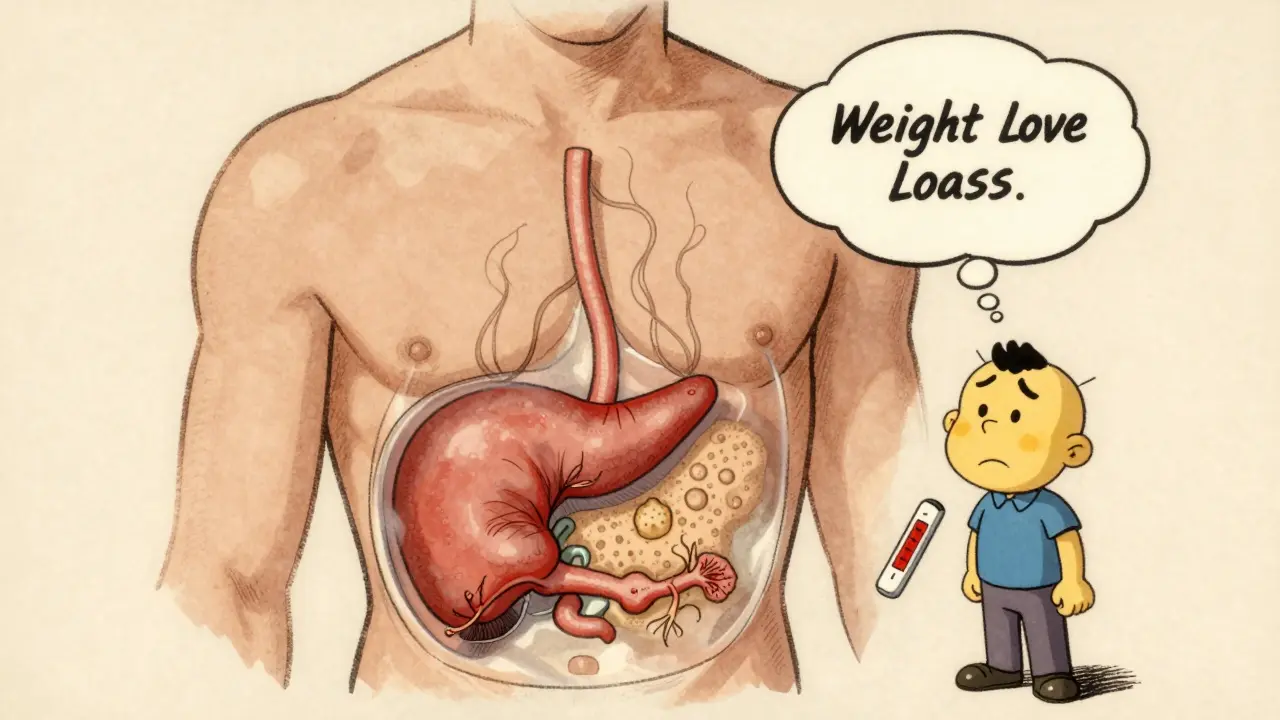
Most people don’t realize pancreatic cancer can sneak up on them for months before anyone notices. The pancreas hides behind the stomach, quiet and out of sight. By the time symptoms show up, the cancer is often already spreading. That’s why survival rates stay so low - only 12% of people live five years after diagnosis. But things are changing. New research is uncovering early warning signs we used to ignore, and treatments are getting better for those caught in time.
What You Might Notice Before It’s Too Late
Early pancreatic cancer doesn’t come with a red flag. There’s no easy test, no obvious sign like a lump or a cough. Instead, it whispers. You might feel off - not sick enough to go to the doctor, but not quite right either.
Unexplained weight loss is one of the most common red flags. If you’ve lost 10 pounds or more in a few months without trying, it’s not just stress or a busy schedule. About 60% of patients report this before diagnosis, according to the Journal of Clinical Oncology. It’s not about dieting - it’s your body struggling to digest food because the pancreas can’t produce enough enzymes.
Then there’s jaundice. Yellow skin, yellow eyes, dark urine, and pale, greasy stools that float. This happens when a tumor blocks the bile duct. It’s most common in cancers near the head of the pancreas, and it affects about 70% of those patients. The itching that comes with it? That’s not allergies. It’s bile salts building up under your skin.
New-onset diabetes is another silent signal. If you’re over 50, never had diabetes before, and suddenly your blood sugar is high - get checked. Research from Columbia University shows 80% of pancreatic cancer patients develop diabetes within 18 months of the cancer starting. Their fasting glucose jumps from normal (under 100 mg/dL) to diabetic levels (over 126 mg/dL) in just a few months. Doctors are now watching for this pattern more closely.
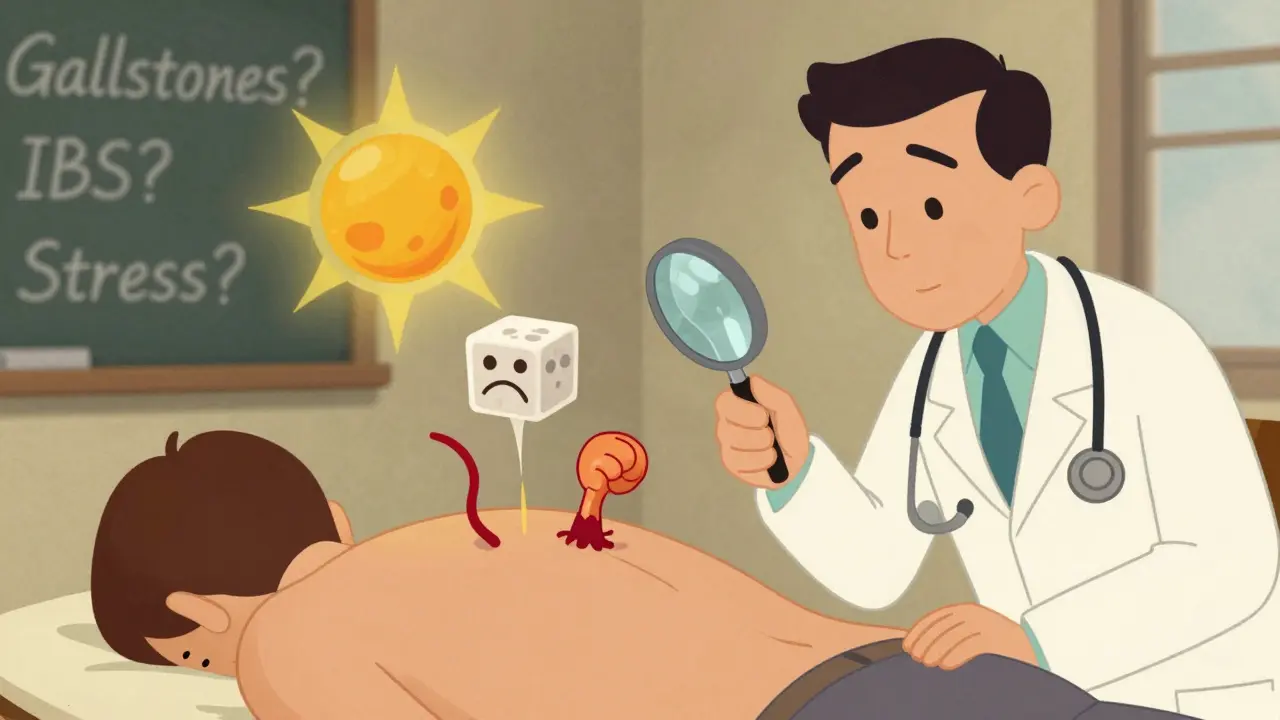
Back pain that doesn’t go away? It might not be from lifting something heavy. About two-thirds of patients report pain in the upper abdomen or back. It’s often dull, constant, and gets worse after eating. Many mistake it for a bad back or stomach bug. One study found 72% of patients were first told they had gallstones or IBS.
And then there’s the mood. Depression or anxiety that comes out of nowhere - no job stress, no personal loss - can be an early warning. A 2018 study found nearly half of pancreatic cancer patients had these symptoms six months before physical signs appeared. It’s not ‘all in your head.’ The tumor releases chemicals that affect brain function.
Why It’s So Hard to Catch Early
The pancreas sits deep in the body, tucked behind the stomach and wrapped around major blood vessels. There’s no way to feel a tumor during a regular exam. No one’s going to notice a small growth unless it’s pressing on something or blocking a duct.
That’s why there’s no routine screening test for the general public. Blood tests like CA 19-9 are unreliable for early stages - they catch only 30-50% of tumors before they spread. CT scans miss tumors smaller than 2 centimeters. Even endoscopic ultrasound, one of the best tools, needs to be done by a specialist.
Most people don’t get scanned until they’re already sick. By then, the cancer is often stage III or IV. Only 1 in 5 cases are caught early enough for surgery. That’s why survival stays so low. But for those who do get caught early - before the cancer spreads - the five-year survival rate jumps to 44%.
Treatment Has Changed - and So Have Outcomes
Twenty years ago, a diagnosis of advanced pancreatic cancer meant months to live. Today, some patients live years.
Surgery is still the only real chance for a cure. The Whipple procedure - removing the head of the pancreas, part of the small intestine, gallbladder, and sometimes part of the stomach - is complex, but it works. At top centers, patients with early-stage tumors have a 20-25% chance of surviving five years after surgery.
But surgery isn’t always the first step anymore. For tumors that are borderline resectable - meaning they’re close to major blood vessels - doctors now use chemotherapy first. FOLFIRINOX (a combo of four drugs: 5-FU, leucovorin, irinotecan, oxaliplatin) shrinks tumors in over half of cases. That means more people become eligible for surgery than before.
For those with metastatic cancer, the game has changed. The 2022 PRODIGE 24 trial showed patients on modified FOLFIRINOX lived nearly 4.5 years on average - more than double what they lived on older treatments like gemcitabine. That’s not a cure, but it’s life. Real, meaningful life.
And then there are targeted therapies. If your tumor has a BRCA gene mutation (about 5-7% of cases), olaparib - a drug originally developed for breast cancer - can slow the disease for nearly eight months longer than placebo. If your tumor has MSI-H or dMMR markers (rare, but about 3-4% of cases), pembrolizumab can trigger a strong immune response. For these patients, the results can be dramatic.
What’s Coming Next
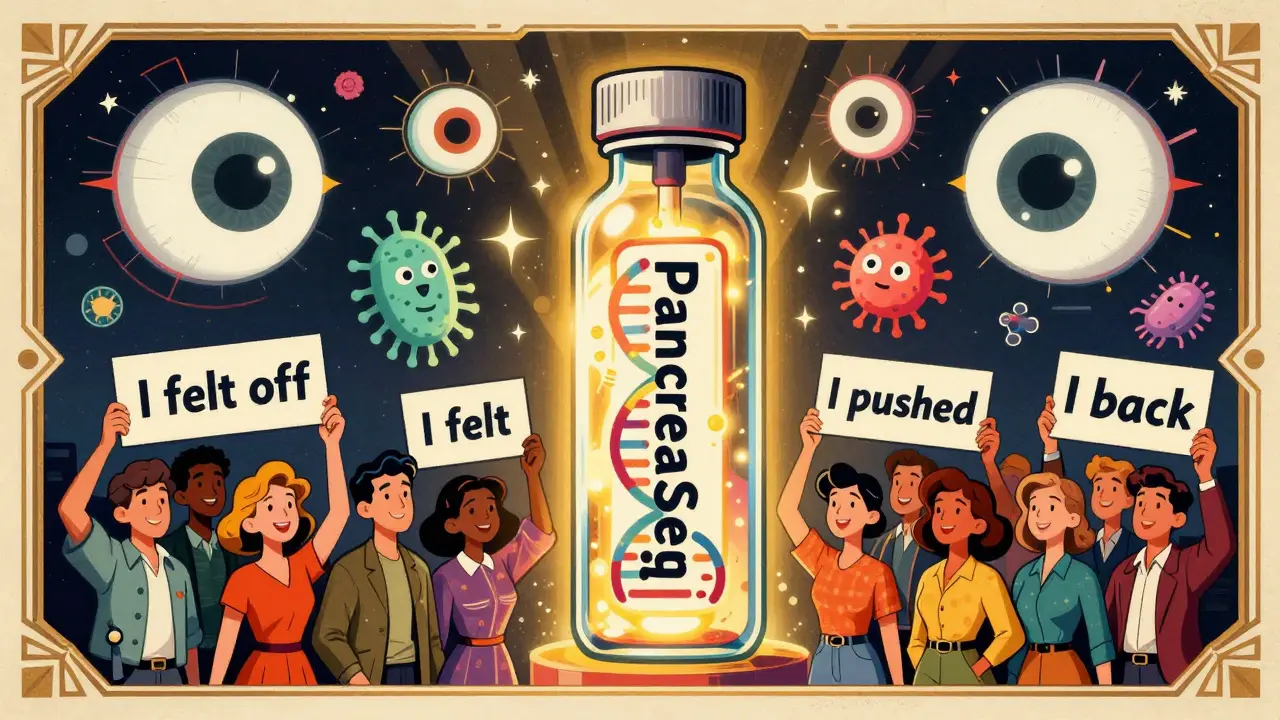
Scientists are racing to find pancreatic cancer before it causes symptoms. One promising test, PancreaSeq, developed at Johns Hopkins, detects cancer DNA in blood samples with 95% accuracy in high-risk groups. Another, the DETECTA trial, uses a blood test to measure protein markers and tumor DNA. Early results show 85% accuracy.
AI is helping too. Google Health’s LYNA algorithm can spot cancer cells on tissue slides with 99.3% accuracy - better than many pathologists. Microbiome research is also turning up clues: the gut bacteria in pancreatic cancer patients are different from healthy people’s. A 2023 study showed a stool test could identify cancer with 80% accuracy.
Doctors are now asking: Who should be tested? People with a family history of pancreatic cancer, those with BRCA mutations, or those with hereditary pancreatitis. But there’s growing support for screening people with new-onset diabetes after age 50. One study found this group had a 1 in 130 chance of having pancreatic cancer - high enough to warrant imaging.
What You Can Do
You can’t prevent pancreatic cancer. But you can pay attention to your body.
- If you’ve lost weight without trying, don’t brush it off.
- If your skin or eyes turn yellow, get checked - even if you think it’s just sun exposure.
- If you’re over 50 and suddenly have diabetes, ask your doctor about a scan.
- If you have persistent back or belly pain that doesn’t respond to treatment, push for more tests.
- If you’ve had depression or anxiety with no clear cause, mention it. It could be a clue.
And if you have a family history of pancreatic, breast, ovarian, or colon cancer, talk to your doctor about genetic testing. Knowing your risk can lead to earlier detection - and a better chance.
The outlook is still tough. But it’s not hopeless. More people are surviving longer. More are getting treated before it’s too late. The tools are getting sharper. The knowledge is growing. And for the first time, there’s real hope - not just for survival, but for better, longer life.
Can pancreatic cancer be detected early with a blood test?
There’s no single blood test that reliably detects early pancreatic cancer in the general population. The CA 19-9 test is used, but it’s only 30-50% accurate for early-stage tumors and can be elevated in other conditions like pancreatitis or liver disease. New tests - like PancreaSeq and those in the DETECTA trial - are showing promise by detecting tumor DNA and protein markers in blood, with accuracy above 85% in early trials. These are still being studied and aren’t yet standard for everyone.
Is jaundice always a sign of pancreatic cancer?
No, jaundice isn’t always caused by pancreatic cancer. It can also come from gallstones, hepatitis, or liver disease. But when jaundice appears with unexplained weight loss, new-onset diabetes, or back pain, it becomes a major red flag. About 70% of pancreatic cancers in the head of the pancreas cause jaundice because they block the bile duct. If you develop jaundice and no other explanation fits, imaging tests like an ultrasound or CT scan are essential.
What does new-onset diabetes have to do with pancreatic cancer?
New-onset diabetes after age 50 can be an early warning sign. Pancreatic cancer damages the insulin-producing cells in the pancreas, causing blood sugar to rise. Studies show 80% of patients develop diabetes within 18 months of their cancer diagnosis. If you’re over 50 and suddenly need medication for diabetes - especially if you’re not overweight or don’t have a family history - your doctor should consider imaging the pancreas to rule out cancer.
Can you survive pancreatic cancer if it’s caught early?
Yes. When pancreatic cancer is caught before it spreads beyond the pancreas - called localized disease - the five-year survival rate jumps to 44%. That’s compared to just 3% for cancer that’s spread to distant organs. The key is surgery, usually the Whipple procedure, often followed by chemotherapy. Early detection is rare, but it’s possible, especially in high-risk groups like those with BRCA mutations or new-onset diabetes.
Are there new treatments that actually extend life?
Yes. The FOLFIRINOX chemotherapy regimen has dramatically improved survival. In metastatic cases, patients on modified FOLFIRINOX lived an average of 54.4 months - more than double what they lived on older treatments. Targeted drugs like olaparib help patients with BRCA mutations live longer without the cancer growing. Immunotherapy works for the rare 3-4% with MSI-H tumors. These aren’t cures, but they’re turning pancreatic cancer from a death sentence into a manageable chronic condition for some.
What’s Next for Patients
If you’ve been diagnosed, ask about genetic testing. It’s not just for your family - it can guide your treatment. If you have a BRCA mutation, olaparib might be an option. If your tumor has specific markers, immunotherapy could help.
If you’re at high risk - family history, hereditary syndromes, or new diabetes after 50 - talk to your doctor about surveillance. Annual MRI or endoscopic ultrasound might be right for you.
And if you’ve been told you’re fine but still feel off - keep pushing. Pancreatic cancer doesn’t shout. It whispers. And sometimes, the only thing standing between you and early detection is your own persistence.




Oh please, another fear-mongering article about pancreatic cancer. Everyone’s scared of cancer these days like it’s some supernatural curse. I’ve seen way too many people panic over weight loss and call it cancer-most of the time it’s just stress or bad coffee. The real problem is overdiagnosis. We’re scanning everyone now like we’re hunting for aliens. 12% survival? Yeah, and 80% of people who get diagnosed are already dead inside from anxiety before the biopsy even happens.
I just lost my dad to this. 💔 He ignored the weight loss for months because he thought it was ‘just aging.’ Then the jaundice came-and by then, it was too late. I wish someone had told him about the diabetes connection. He was 58, never had sugar issues, then bam-diabetic in 3 weeks. Please, if you’re reading this and you’re over 50 and feeling ‘off’-don’t wait. Push. Even if they say ‘it’s probably nothing.’
Love you, Dad. 🌸
Let’s cut through the noise: early detection isn’t about symptoms-it’s about biomarkers. CA 19-9 is garbage for screening, but ctDNA panels like PancreaSeq are game-changers. The sensitivity in high-risk cohorts hits 90%+ with specificity over 92%. We’re not talking about ‘maybe’ anymore. We’re talking about liquid biopsies replacing CTs in surveillance protocols within 5 years. The data’s solid. It’s just not accessible to everyone yet because of cost and lack of insurance coverage.
Also-new-onset diabetes after 50? That’s not a red flag. It’s a siren.
Look, I get it-you want people to panic so they go get scans. But here’s the cold truth: even if you catch it early, the Whipple is brutal. 20% mortality on the table. 6 months of chemo after. Half the people who survive end up with diabetes, malabsorption, and chronic pain. Is living 5 more years with a half-digested body really worth it? I’d rather have 2 good years than 5 miserable ones. Just saying.
Also, FOLFIRINOX? That’s not treatment, that’s a chemical warzone.
Everything is a symptom. Everything is a sign. We’ve turned the human body into a riddle book where every ache is a clue to death. But maybe the real cancer isn’t in the pancreas-it’s in the system that turns every sigh into a terminal diagnosis.
Perhaps the answer isn’t more scans. Perhaps it’s less fear.
Anyone who believes in this early detection nonsense hasn’t read the real literature. The DETECTA trial? Small sample. Selection bias. PancreaSeq? Still in phase 2. And don’t get me started on olaparib-BRCA mutations are rare. You’re telling me we should screen every 50-year-old with sugar issues? That’s a $10 billion waste. The real breakthrough? Stopping the hype. Stop scanning healthy people. Stop selling false hope. Let the dying die with dignity instead of being pumped full of toxins for 18 extra months
so u say if u lose weight and get jaundice u got cancer?? wow big brain move. next u gonna say if u sneeze its a sign of alien abduction
I’ve been following this for a while. My uncle had it. He didn’t have any of the classic signs. Just… got tired. Then couldn’t eat. Then pain. No jaundice. No weight loss he noticed. Just a slow fade.
What struck me was how many doctors dismissed him. ‘It’s just stress.’ ‘You’re getting older.’
So yeah-listen to your body. But also-push back when you’re ignored. It’s not paranoia. It’s persistence.
i had unexplained weight loss last year and thought it was just cuz i stopped eating carbs but then my eyes turned yellow and i was like… wait that’s not normal?? went to the doc and they did a ct and found a 1.8cm nodule. turned out benign but still. if i hadn’t googled ‘yellow eyes and weight loss’ i would’ve ignored it. thanks for the heads up
There’s a metaphysical truth here buried beneath the jargon: cancer doesn’t care about your timeline. It doesn’t respect your appointments, your insurance, your denial. It grows in silence while you scroll through TikTok, while you rationalize fatigue as burnout, while you tell yourself ‘I’ll get checked next month.’
The pancreas is not a metaphor. It is a silent god in the gut-unseen, unacknowledged, until it speaks with bile and blood.
And yet-we are the ones who gave it silence. We built a medical system that rewards reaction, not vigilance. We monetize survival, not prevention.
So yes-get scanned. But ask yourself: why did it take a tumor to make you worthy of care?
The data presented here is methodologically sound and aligns with current clinical guidelines from the American College of Gastroenterology and the National Comprehensive Cancer Network. The integration of liquid biopsy technologies into high-risk surveillance protocols represents a paradigm shift in oncology. Further longitudinal studies are warranted to validate population-wide screening feasibility, particularly in aging demographics with metabolic comorbidities. The ethical imperative to prioritize early detection in vulnerable cohorts is increasingly evident.
Marie-Pier-your comment about your dad… I cried. My mom had the same thing. She didn’t have jaundice. She had depression. No one connected it. She was 61. We thought it was grief after my dad died. Turns out, the tumor was releasing cytokines that messed with her serotonin.
Doctors need to stop treating symptoms in silos. This isn’t just a pancreatic issue-it’s a systemic one. We need mental health screenings alongside glucose tests. We need to stop asking ‘what’s wrong?’ and start asking ‘what’s changing?’
Thank you for saying what so many of us are too scared to say.