
When you pick up a generic pill at the pharmacy, you expect it to work just like the brand-name version. But how do regulators know it’s truly the same? The answer lies in pharmacokinetic studies - the most common and trusted method used worldwide to prove that a generic drug behaves the same way in your body as the original. Yet calling it the "gold standard" isn’t quite right. It’s not perfect. It’s not always enough. And for some drugs, it might even be the wrong tool entirely.
What Pharmacokinetic Studies Actually Measure
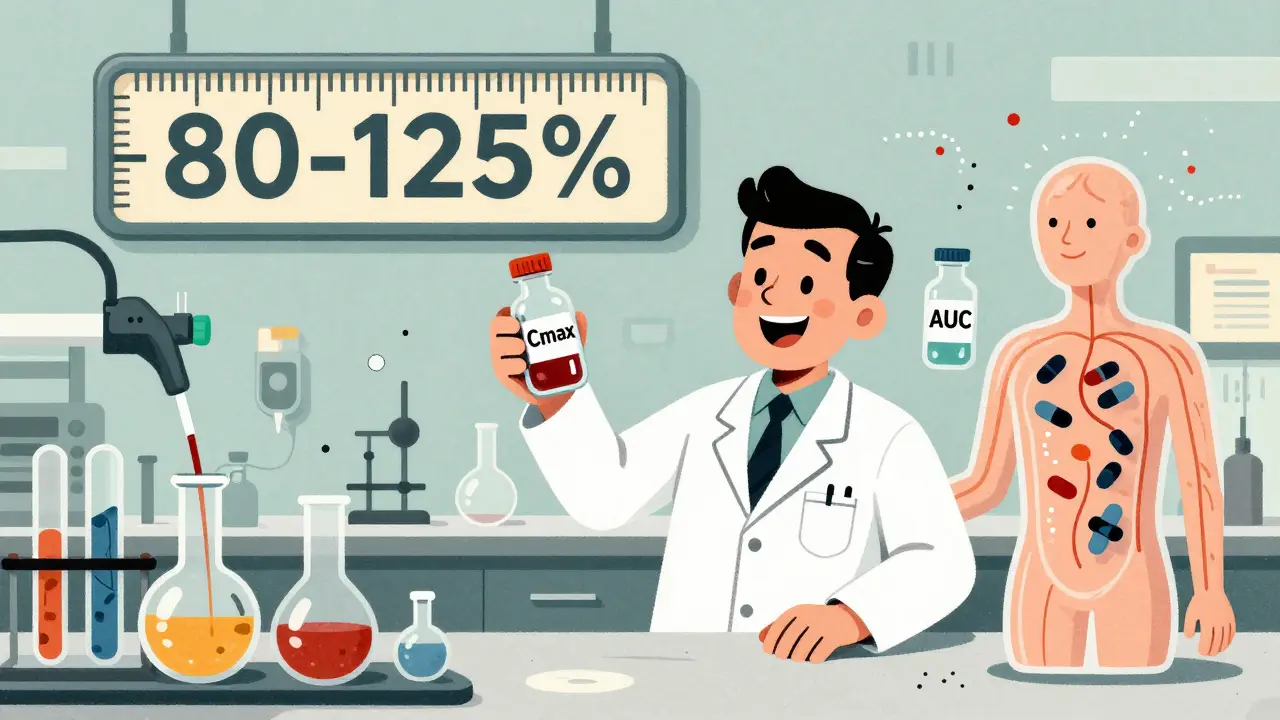
Pharmacokinetic studies track how a drug moves through your body. Specifically, they measure two key numbers: Cmax (the highest concentration of the drug in your blood) and AUC (the total amount of drug your body is exposed to over time). These aren’t just lab curiosities - they tell regulators whether the generic version gets absorbed at the same rate and to the same extent as the brand-name drug.
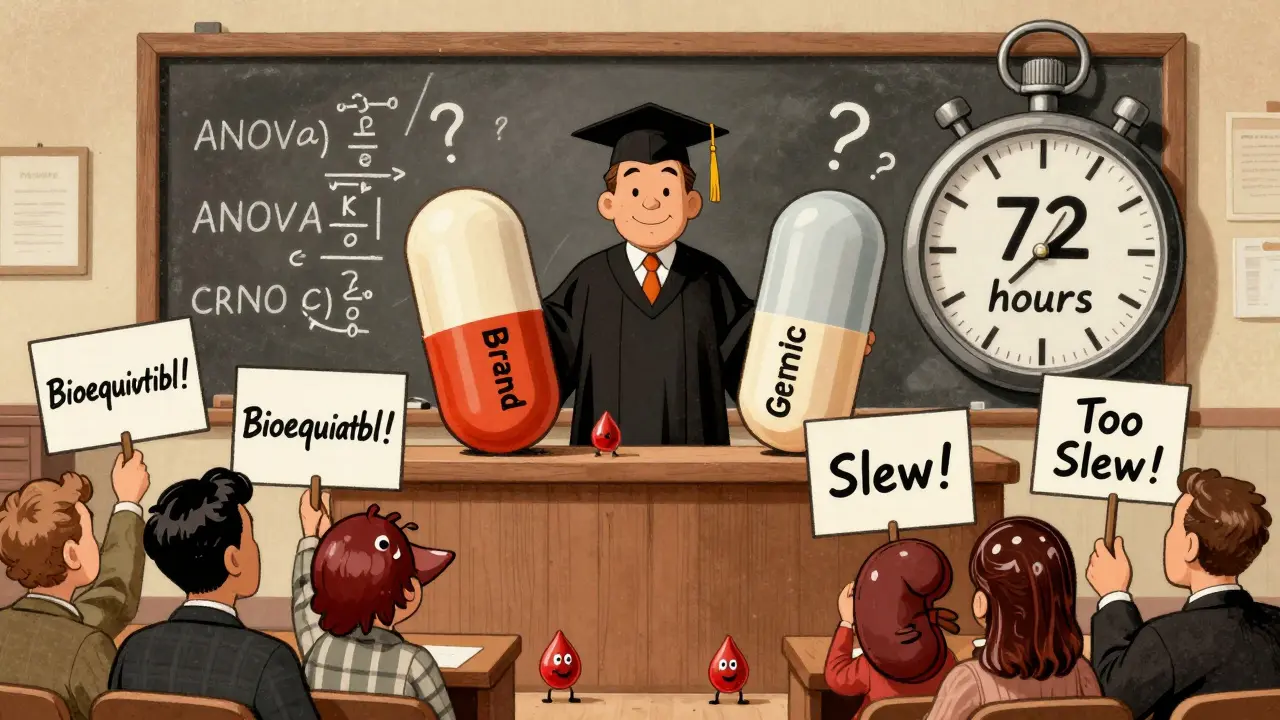
Here’s how it works: 24 to 36 healthy volunteers take both the generic and the brand-name drug in a controlled crossover study. Half take the generic first, then switch after a washout period. The other half does the reverse. Blood samples are taken frequently over 24 to 72 hours, depending on the drug. The data is analyzed using statistical methods like ANOVA to calculate the 90% confidence interval for the ratio of generic to brand.
The rule? That ratio must fall between 80% and 125%. If it does, regulators accept the two drugs as bioequivalent. For drugs with a narrow therapeutic index - like warfarin, phenytoin, or digoxin - the window tightens to 90% to 111%. That’s because even small differences in absorption can lead to serious side effects or treatment failure.
Why This Method Became the Default
The system wasn’t always like this. Before 1984, generic manufacturers had to run full clinical trials to prove their drugs worked - a process that took years and cost millions. The U.S. Hatch-Waxman Act changed everything. It created a shortcut: if a generic drug was chemically identical and could prove bioequivalence through pharmacokinetic studies, it didn’t need new safety or efficacy trials. The logic? If your body absorbs the drug the same way, the effect will be the same.
This was a game-changer. Today, nearly 95% of generic drug approvals in the U.S. rely on this method. Globally, over 50 national regulators follow similar guidelines, often aligned with WHO and ICH M13A standards. The result? Generic drugs now make up more than 90% of all prescriptions filled in the U.S. and save patients and health systems billions annually.
Where the System Breaks Down
But here’s the uncomfortable truth: pharmacokinetic studies don’t always predict real-world outcomes. In 2010, a study in PLOS ONE found that two generic versions of gentamicin - both passing all standard bioequivalence tests - showed significant differences in how they affected patients’ clinical responses. The active ingredient was identical. The dissolution profile matched. The Cmax and AUC were within limits. Yet one version didn’t work as well.
Why? Because absorption isn’t the only thing that matters. For drugs that act locally - like inhalers, eye drops, or topical creams - what happens in the bloodstream tells you almost nothing. A cream might absorb poorly into the blood but still deliver the right dose to the skin. A generic inhaler might have the same active ingredient and dissolve at the same rate, but if the particle size or spray pattern is off, the drug won’t reach the lungs properly.
That’s why the FDA now requires special testing for complex products. For topical corticosteroids, dermatopharmacokinetic (DMD) methods are being used to measure drug levels directly in the skin. For inhaled drugs, in vitro lung deposition tests are replacing human PK studies. In some cases, in vitro tests are proving more reliable than human trials. A 2009 paper in PMC even argued that for certain immediate-release tablets, well-designed dissolution tests can be more accurate than measuring blood levels.
The Hidden Costs and Challenges
Running a single bioequivalence study isn’t cheap. It typically costs between $300,000 and $1 million and takes 12 to 18 months from formulation to approval. For manufacturers, this is a major barrier - especially for small companies. The process is also highly unpredictable. Minor changes in excipients - the inactive ingredients - can completely alter how a drug is absorbed. A change in tablet binder or coating that seems insignificant in the lab can throw off Cmax or AUC by 20%.
That’s why the FDA now has over 1,800 product-specific guidances. There’s no one-size-fits-all rule. A generic version of a simple aspirin tablet has very different requirements than a sustained-release opioid or a nanoparticle-based cancer drug. Manufacturers are increasingly turning to the Biopharmaceutics Classification System (BCS) to see if they can qualify for a waiver. Only about 15% of drugs meet the criteria - mostly highly soluble, highly permeable drugs like metformin or atenolol. For the rest, they’re stuck with human trials.
Are We Missing Better Tools?
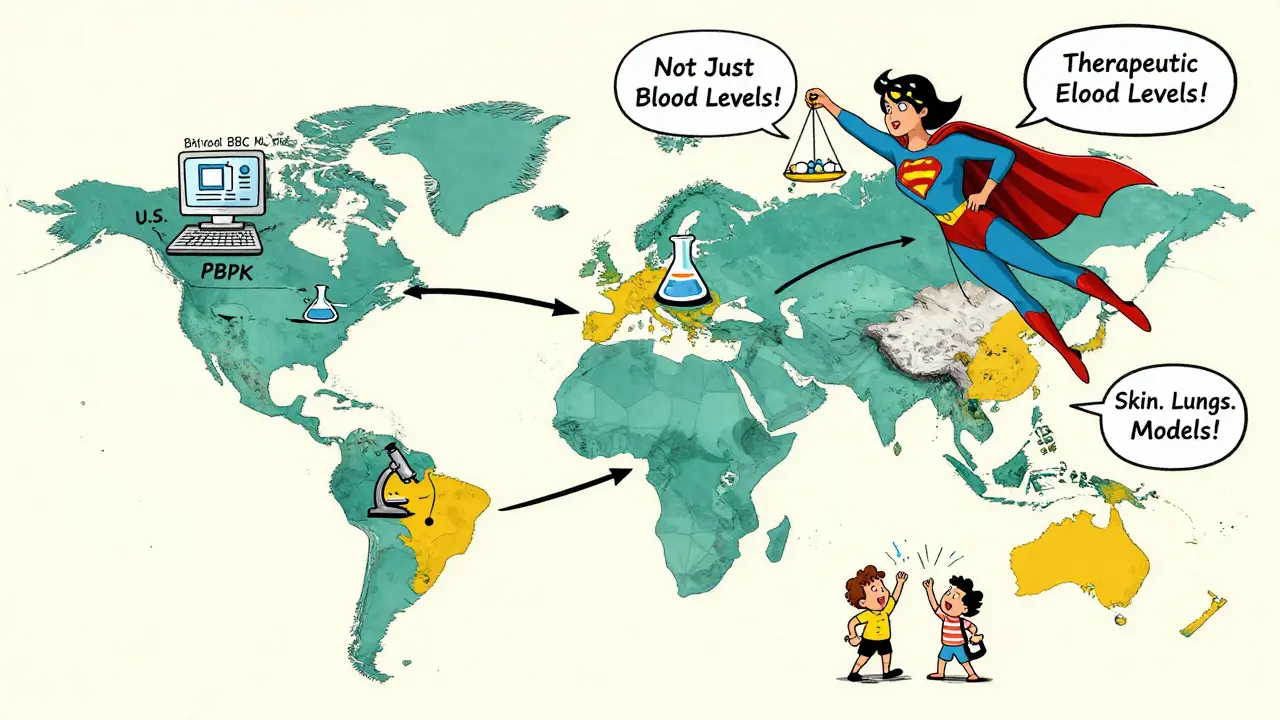
The field is changing. Physiologically-based pharmacokinetic (PBPK) modeling is gaining traction. Instead of testing drugs in people, scientists use computer simulations based on how the body absorbs, distributes, and metabolizes compounds. The FDA has accepted PBPK models to waive bioequivalence studies for certain BCS Class I drugs since 2020. It’s faster, cheaper, and reduces the need for human testing.
For topical products, newer methods like in vitro permeation testing (IVPT) using cryopreserved human skin are showing better precision than clinical endpoint studies. One 2019 study showed these methods could detect differences in bioavailability with over 90% power - far more than traditional PK studies for creams and ointments.
Regulators are catching on. The FDA’s Complex Generic Drug Products Initiative has issued 149 product-specific guidances since 2018. The European Medicines Agency still leans heavily on traditional PK studies, creating headaches for global manufacturers trying to meet both U.S. and EU standards. Meanwhile, emerging markets often lack the labs, funding, or expertise to run these studies properly, leading to inconsistent quality.
What This Means for You
If you’re taking a simple, well-established generic drug - like lisinopril or atorvastatin - you can be confident it works just like the brand. The system works incredibly well for these drugs. The failure rate is under 2%.
But if you’re on a narrow therapeutic index drug - or a complex formulation like a patch, inhaler, or extended-release capsule - you should be more cautious. Some patients report subtle differences when switching generics. It’s not always about the drug failing. Sometimes, it’s about your body reacting differently to a new coating, filler, or release mechanism.
That’s why your doctor or pharmacist might recommend sticking with the same generic brand if you’ve been stable on it. It’s not about loyalty - it’s about consistency.
The Bottom Line
Pharmacokinetic studies are the most widely used tool to prove generic drug equivalence - and for good reason. They’re practical, scientifically sound, and have delivered safe, affordable medicines to millions. But calling them the "gold standard" is misleading. They’re a tool - not a guarantee.
The real standard is therapeutic equivalence: does the drug work the same way in patients, with the same safety and effectiveness? Sometimes, pharmacokinetic studies prove that. Sometimes, they don’t. And increasingly, regulators are using other tools - in vitro tests, computer models, skin measurements - to fill the gaps.
What hasn’t changed is the goal: every generic drug, no matter how it’s tested, must deliver the same result as the original. The methods are evolving. The stakes haven’t.
Are generic drugs really as effective as brand-name drugs?
For most common medications - like blood pressure pills, antibiotics, or cholesterol drugs - yes. Generic drugs are required to have the same active ingredient, strength, and dosage form. They must also pass bioequivalence testing, which proves they’re absorbed the same way in your body. Over 95% of generics approved by the FDA meet this standard. Failures are rare, and when they happen, they’re usually caught through post-market monitoring.
Why do some people say generics don’t work as well?
Sometimes, patients notice differences when switching between generic brands or from brand to generic. This isn’t because the drug is ineffective - it’s because inactive ingredients (like fillers or coatings) can affect how quickly the drug is released. For drugs with a narrow therapeutic index - such as warfarin or thyroid medication - even small changes can matter. If you feel different after a switch, talk to your doctor. They may recommend sticking with one brand.
Do all countries use the same bioequivalence standards?
Most high-income countries follow similar guidelines based on FDA or WHO standards, using the 80-125% confidence interval for Cmax and AUC. But enforcement varies. The U.S. and EU have strict lab requirements and oversight. Some emerging markets lack the infrastructure to run full pharmacokinetic studies, leading to inconsistent quality. The WHO and ICH are working to harmonize these standards globally, but progress is slow.
What are narrow therapeutic index (NTI) drugs, and why are they different?
NTI drugs have a very small window between an effective dose and a toxic one. Examples include warfarin, phenytoin, levothyroxine, and digoxin. For these, even a 10% difference in absorption can lead to serious side effects or treatment failure. That’s why regulators require tighter bioequivalence limits - often 90-111% - and sometimes additional testing like clinical endpoint studies or therapeutic drug monitoring.
Can in vitro tests replace human pharmacokinetic studies?
For some drugs, yes. In vitro dissolution tests are already used as a primary tool for immediate-release tablets with high solubility and permeability (BCS Class I). For complex products like topical creams or inhalers, methods like IVPT and dermatopharmacokinetics are replacing human studies because they’re more accurate and less variable. The FDA now accepts PBPK modeling for certain drugs too. But for most oral drugs, human PK studies are still required - because we don’t yet have perfect alternatives.


Man i just switched my generic lisinopril and my head stopped spinning lol. I thought i was going crazy but turns out the new batch had a different filler. Now i stick to the same brand. Simple as that.
Let me be clear: this is not just about science-it’s about trust. People are dying because regulators are still clinging to 1980s-era blood tests for inhalers that don’t even measure lung deposition. The FDA’s new guidelines are a start, but they’re too slow, too cautious, and too bureaucratic. We need to stop pretending that a number in a blood sample equals real-world efficacy. It doesn’t. Not anymore. Not for complex drugs. And continuing to do so is unethical.
Wow. So we’re just gonna throw out human trials because some guy in a lab says his fancy machine is better? Next you’ll tell me we can replace pregnancy tests with a mood tracker. People are not lab rats. If you want to know how a drug works in the body, you test it in the body. Not in a petri dish. Not in a simulation. In. The. Body.
Actually, the entire framework is archaic. The 80–125% CI is statistically arbitrary, derived from 1970s-era assumptions about variance in healthy young males. It ignores inter-individual pharmacogenomic variability, gut microbiome differences, and even circadian absorption patterns. The fact that regulators still accept this as ‘gold standard’ reveals a profound institutional failure. PBPK modeling isn’t the future-it’s the baseline we should’ve adopted decades ago.
Biggest thing people miss: excipients matter more than you think. I’ve seen generics with the same active ingredient but different binders completely change how fast the pill dissolves. One guy had a seizure switching from one generic to another for phenytoin. Not because the drug was bad-because the coating was off by 2%. It’s not the system’s fault. It’s that we treat all drugs like aspirin.
Think about it-we’re using 1984 rules for 2025 problems. We’ve got AI that can predict protein folding, quantum sensors that detect single molecules, and yet we still stick needles in 30 college kids to draw blood for a drug that’s meant to treat asthma in elderly lungs? That’s not science. That’s tradition dressed up as evidence. The real gold standard isn’t Cmax or AUC-it’s patient outcomes. And we’re ignoring them because it’s easier to measure blood than to track lives.
So let me get this straight-we’re spending a million dollars to test a generic in 36 people… but we won’t spend $10K to validate an in vitro test that’s more accurate? I get it. Human trials are sexy. They feel real. But if your method can’t detect differences in a cream that’s literally sitting on someone’s skin… maybe it’s time to retire the blood draw.
They’re lying to us. The whole system’s rigged. Big Pharma owns the labs. The FDA’s got a revolving door with the drug companies. And those ‘bioequivalent’ generics? Half of them are made in factories with no oversight. I’ve seen the reports. The same pills, different countries, different results. And you think your $4 pill is safe? Nah. You’re just lucky so far.
Bro in india we got generics for 50 rupees. Some work, some dont. But we dont have choice. If u need insulin, u take what u get. No time for fancy blood tests. Real world ain’t FDA approved.
Ugh. Another long post pretending this is rocket science. It’s just a pill. If it looks the same and costs less, it’s fine. Stop overthinking. I’ve taken generics for 20 years. I’m alive. That’s all that matters.
Actually, the 80–125% range was never meant to be universal-it was a pragmatic compromise for simple molecules. The real issue is that regulators haven’t updated their frameworks to reflect modern pharmacology. PBPK models have been validated in over 200 peer-reviewed studies. And yet, we still make healthy volunteers swallow pills like it’s 1992. It’s not laziness-it’s institutional inertia.
They’re not testing for equivalence-they’re testing for profit. The real reason they don’t use in vitro tests? Because they can’t control the outcome. Human trials are messy, expensive, and unpredictable. But they’re also a barrier to entry. That’s why only 15% of drugs get BCS waivers. It’s not science-it’s a monopoly. And you’re paying for it.
It is imperative to note that the regulatory frameworks governing bioequivalence are not harmonized globally, and this presents a significant challenge for multinational pharmaceutical enterprises. The divergence between FDA and EMA guidelines, in particular, necessitates redundant testing protocols, which are both economically and ethically untenable.
I’ve been on the same generic thyroid med for years. Switched once out of curiosity. Felt tired for a week. Went back. Back to normal. No drama. Just… consistency. I don’t need to understand the science. I just need to know my pill works. And sometimes, that means sticking with the same one.
This is why we need more transparency. If a generic has a different excipient profile, that info should be public. Patients deserve to know what’s in their pills-not just the active ingredient. We don’t need to ban generics. We just need better labeling. And maybe, just maybe, let pharmacists recommend the same brand if you’ve been stable. Simple. Practical. Human.