
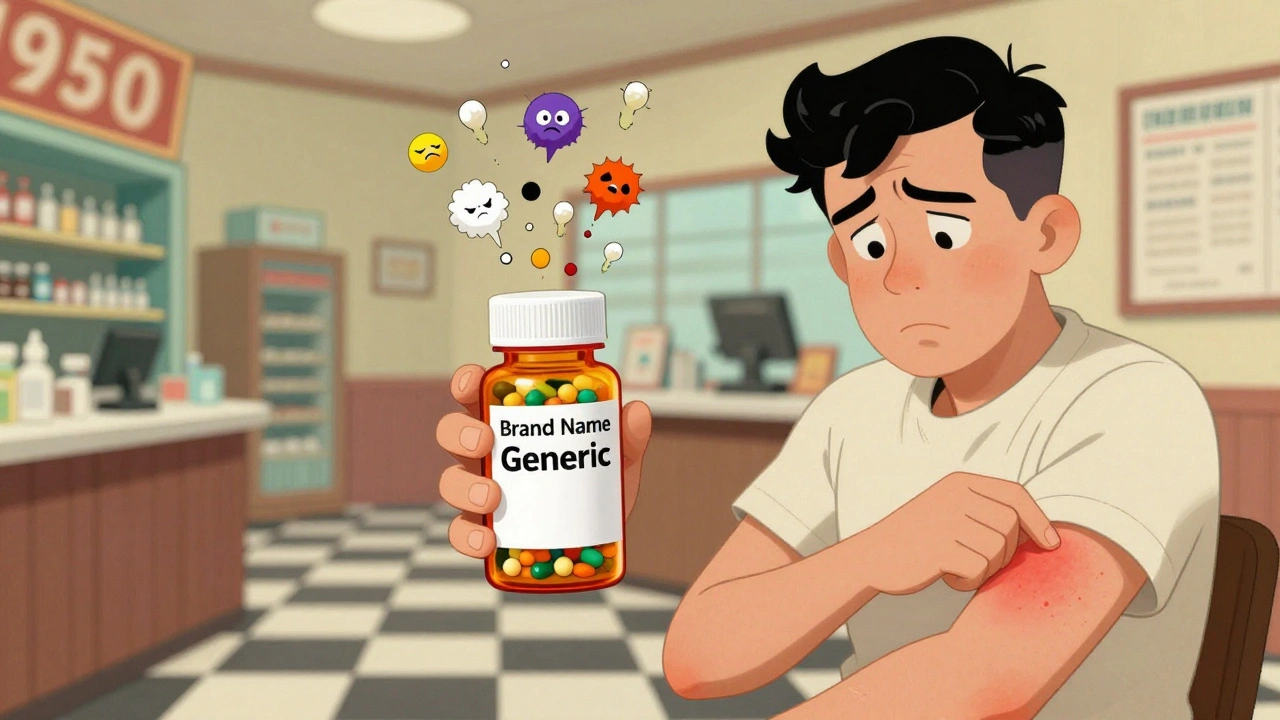
When you pick up a generic pill from the pharmacy, you expect the same effect as the brand-name version. And for the most part, you get it. But what if your body reacts differently - not to the active drug, but to something else in the pill? That’s not rare. In fact, allergic reactions to generics are more common than most people realize, and they’re often caused by ingredients you never knew were there.
Why Generics Can Trigger Allergies
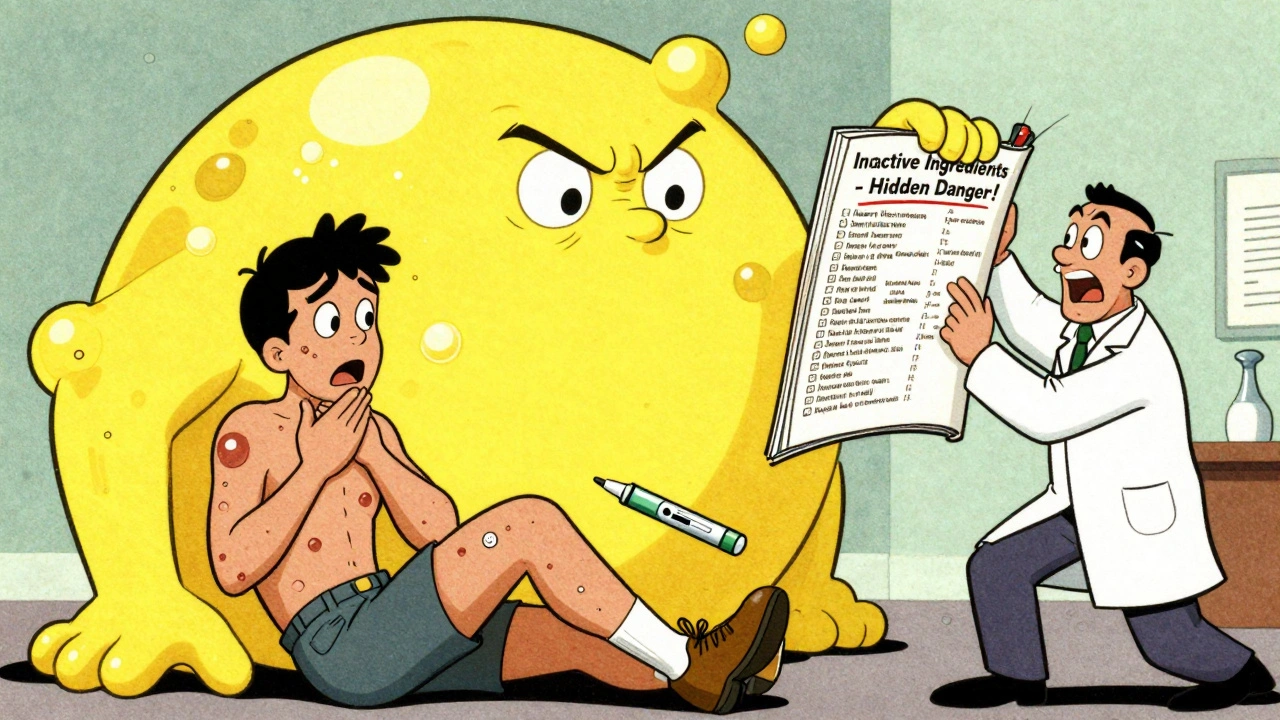
Generic drugs are required to have the same active ingredient as their brand-name cousins. That’s the law. But they don’t have to match the fillers, dyes, or binders. These are called inactive ingredients, and they’re the hidden culprits behind many allergic reactions. Think of them like the packaging of a product - same contents, different wrapper. A 2022 study found that 83% of generic medications contain at least one inactive ingredient that’s different from the brand version. And 27% of those include substances known to cause allergic reactions. Lactose, gluten, tartrazine (a yellow dye), and even peanut oil are all used in generics - and all can trigger reactions in sensitive people. One patient in California, who had taken brand-name sertraline for years without issue, broke out in hives after switching to the generic. Turns out, the generic version used FD&C Yellow No. 5, a dye linked to allergic responses. The brand version didn’t have it. This isn’t an isolated case. Reddit threads, patient forums, and clinic records are full of similar stories.What Do These Reactions Look Like?
Not all reactions are the same. They range from mild to life-threatening, and they can show up fast or slowly. Mild reactions usually mean skin stuff: itching, red rash, or hives. About 68% of mild cases involve a rash. Hives show up in 42%, and itching in 57%. These might seem like a nuisance, but they’re warning signs. Moderate reactions involve more than one system. You might get swollen lips or face, nausea, vomiting, or trouble breathing. Wheezing happens in about 31% of these cases. Facial swelling, especially around the eyes or throat, is a red flag - even if it doesn’t feel severe yet. Severe reactions - anaphylaxis - are rare but dangerous. They happen in about 0.02% to 0.04% of generic drug doses. But when they do, they hit hard. Throat tightness? 87% of cases. Blood pressure crashing? 78%. Trouble breathing? 92%. And here’s the scary part: 43% of these severe reactions start within 15 minutes of taking the pill. You don’t have time to wait and see.When to Call 911 - Right Now
If you take a generic and feel any of these, don’t wait. Don’t text your doctor. Don’t Google it. Call 911 or go to the ER immediately:- Difficulty breathing, wheezing, or a tight throat
- Sudden drop in blood pressure - feeling dizzy, faint, or passing out
- Swelling of the tongue, lips, or throat
- Hives or rash along with stomach pain, vomiting, or diarrhea
- Two or more systems reacting at once (like skin + breathing + stomach)
What About Mild Reactions? Should You Worry?
If you get a rash or itchy skin after switching to a generic, it’s tempting to brush it off. But don’t. A 2023 study from the American Academy of Family Physicians found that 65% of people who had a mild reaction to a generic later had a much worse one the next time they took it - even if it was the same generic. That means even a small reaction is a signal. Contact your doctor within 24 hours. If symptoms last more than six hours, or if swelling doesn’t go down in two hours, get checked. Don’t assume it’s just a coincidence. You might be allergic to one of the fillers.What Inactive Ingredients Are the Biggest Risks?
Here’s what to watch out for in generic meds:- Lactose - found in 28% of oral generics. If you’re lactose intolerant, this isn’t just a stomach issue. For some, it triggers immune reactions that look like allergies.
- Gluten - present in 12% of generics. For people with celiac disease, even tiny amounts can cause serious damage.
- Tartrazine (FD&C Yellow No. 5) - used in 15% of liquid generics. Linked to hives, asthma, and swelling in sensitive people.
- Peanut oil - used in some injectables. A known allergen. One patient with a peanut allergy went into anaphylaxis after getting a generic version of propofol that contained it.
- Magnesium stearate - a common lubricant. In rare cases, it’s triggered reactions in people allergic to penicillin, even though the active ingredient was safe.
How to Protect Yourself
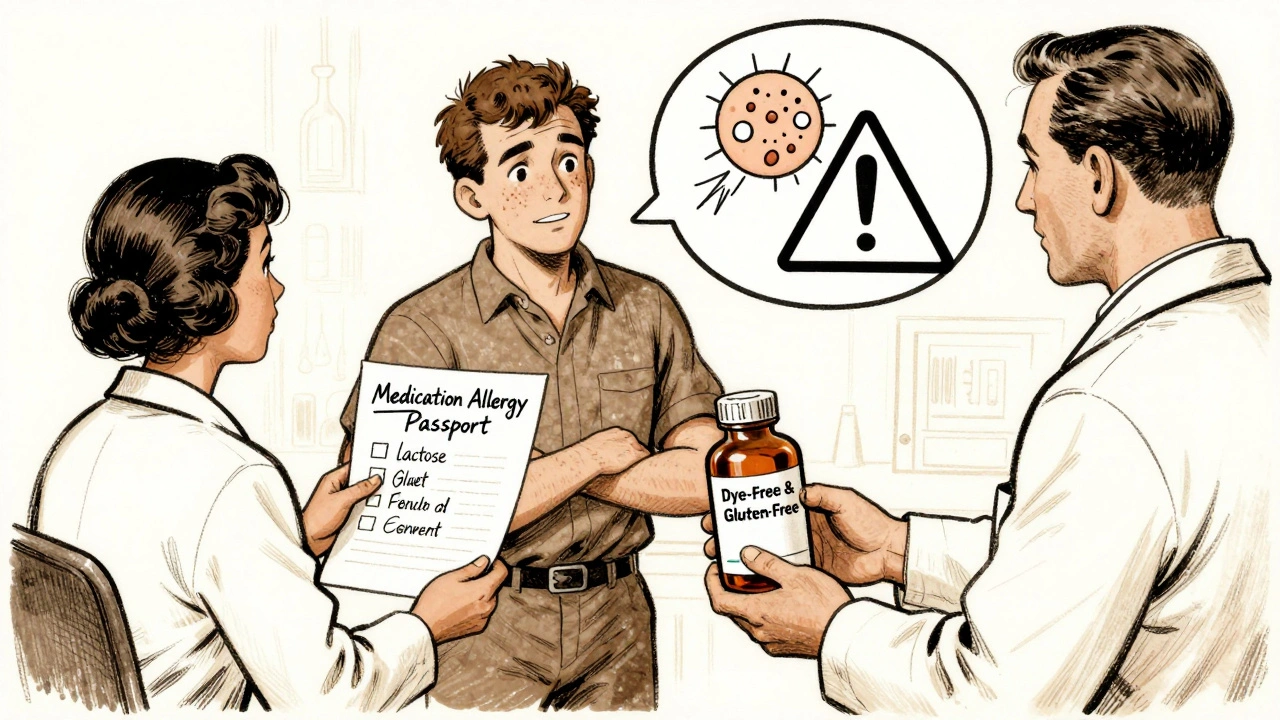
You don’t have to guess. Here’s what works:- Ask your pharmacist - not just for the generic name, but for the full list of inactive ingredients. Most pharmacists can pull up the manufacturer’s data sheet.
- Check the label - look for “lactose-free,” “gluten-free,” or “dye-free” on the bottle. About 38% of major generic makers now offer these versions.
- Keep a list - write down every ingredient you react to. Include the brand and generic names. This is your “medication allergy passport.” One pilot study showed it cuts adverse reactions by 29%.
- Get tested - if you’ve had a reaction, see an allergist. Many people think they’re allergic to penicillin, but 90% of them aren’t. Proper testing can save you from being stuck with less effective, more expensive drugs.
- Ask for the brand - if you’ve had a reaction to a generic, ask your doctor to write “dispense as written” or “no substitutions.” Insurance might push back, but your safety comes first.
Why This Isn’t Just a Patient Problem
Doctors and pharmacists often don’t know the difference between brand and generic inactive ingredients. That’s why 15-20% of these reactions go unreported. The FDA requires manufacturers to list all ingredients, but the info isn’t always easy to find. A 2023 survey found that 71% of allergy specialists now ask patients if they’ve had reactions to generics - up from just 42% in 2019. That’s progress. But most primary care doctors still don’t ask. So you have to be your own advocate.What Happens Next?
The FDA is pushing for clearer labeling of problematic ingredients by 2025. Until then, the burden falls on you. Generics make up 90% of all prescriptions in the U.S. That means you’re likely to encounter them often. If you’ve ever had a strange reaction after switching to a cheaper pill - don’t ignore it. It might not be your body rejecting the medicine. It might be your body rejecting the filler. Take notes. Ask questions. Demand transparency. Your next dose could be safer - if you know what to look for.Can generic medications cause allergic reactions even if the brand-name version didn’t?
Yes. Generic medications must have the same active ingredient as the brand, but they often use different inactive ingredients like dyes, fillers, or preservatives. These can trigger allergic reactions in people who tolerate the brand version just fine. For example, someone who takes brand-name Zoloft without issues might develop hives from generic sertraline because the generic contains tartrazine dye.
What are the most common allergens in generic drugs?
The most common allergens in generics are lactose (found in 28% of oral pills), gluten (in 12%), tartrazine (FD&C Yellow No. 5, in 15% of liquid forms), and peanut oil (in 8% of injectables). Magnesium stearate and other binders have also been linked to rare but serious reactions in sensitive individuals.
How soon after taking a generic drug can an allergic reaction occur?
Reactions can happen within minutes or take hours. About 43% of severe reactions start within 15 minutes, and 38% occur between 15 and 60 minutes. Some delayed reactions, especially with rashes or joint pain, can appear several hours or even days later. If you’ve just switched to a new generic, watch for symptoms for at least 24 hours.
Should I avoid all generic medications if I’ve had a reaction?
Not necessarily. The problem is often a specific inactive ingredient, not the drug itself. If you had a reaction to one generic version, ask your pharmacist for another brand of the same generic - different manufacturers use different fillers. You might tolerate a different formulation. Always get tested by an allergist to identify the exact trigger.
Can I find out what’s in a generic drug before I take it?
Yes. The FDA maintains a public Inactive Ingredient Database listing over 1,200 ingredients used in approved drugs. You can ask your pharmacist for the specific manufacturer’s product information sheet, which includes a full list of inactive components. Look for labels like “lactose-free” or “dye-free” - many generics now offer these options.
Is an allergic reaction to a generic drug the same as a side effect?
No. Side effects are predictable and related to the active drug - like nausea from antibiotics or drowsiness from antihistamines. Allergic reactions are immune responses triggered by something in the pill - usually an inactive ingredient. Symptoms like hives, swelling, or trouble breathing are signs of an allergy, not a side effect.
How can I prevent future reactions to generics?
Keep a written list of every ingredient you’ve reacted to, including the brand and generic names. Share this with every prescriber and pharmacist. Ask for dye-free, gluten-free, or lactose-free versions when available. Consider getting formal allergy testing to confirm triggers. Always check the label before taking any new generic - even if you’ve taken it before.

So let me get this straight - I pay $4 for a pill that’s supposed to be the same as the $40 one, but now I’m allergic to the glitter in it? 🙃
Next they’ll tell me the generic Advil has a secret emoji embedded in the filler.
At this point, I just want a pill that doesn’t come with a 12-page safety disclaimer.
Also, why is my pharmacist more knowledgeable about my medication’s fillers than my doctor?
And why does the FDA have a database for inactive ingredients but not a ‘DO NOT USE IF YOU’RE HUMAN’ sticker?
Someone’s making a fortune off our confusion.
Also, I now have a new hobby: reading tiny print like it’s the Book of Revelation.
My pharmacist just handed me a generic with ‘lactose-free’ on the label and I cried.
Not from joy. From exhaustion.
Also, if I’m allergic to peanut oil in a pill, does that mean I can’t take a pill that was manufactured in the same building as a peanut butter sandwich?
Someone please tell me I’m not the only one who feels like a lab rat with a prescription.
Also, I’m now Googling ‘how to make your own pills at home’ and it’s not a joke.
And yes, I did just text my mom asking if she remembers when pills didn’t come with a Yelp review section.
I’ve been taking generics for 12 years and never had an issue… until I switched to the one with the yellow dye.
Then I broke out like I’d been dipped in poison ivy and cried in the CVS parking lot.
My doctor said ‘it’s probably stress.’
Stress? I was fine until I took the pill.
Now I’m scared to take anything that doesn’t come in a glass vial with a unicorn sticker.
And don’t even get me started on the gluten in my thyroid med.
I have celiac. I know what gluten does to me.
And they still put it in? In a MEDICINE?
That’s not negligence.
That’s a war on people who are already sick.
And no, I won’t ‘just take the brand.’ I can’t afford to.
So yeah, I’m angry.
And I’m not alone.
Just check the comments.
They’re full of us.
💔
You’re not alone. And you’re not crazy.
If you had a reaction, trust it.
Write it down. Tell your pharmacist. Ask for the sheet.
There are dye-free, lactose-free, gluten-free options out there - they just take a little digging.
You’ve got this. Your body is talking. Listen.
And don’t let anyone make you feel silly for asking.
You’re saving your own life.
💙
It is imperative to recognize that the pharmacological equivalence of generic medications, as defined by the FDA, pertains solely to the active pharmaceutical ingredient - not the excipients. The presence of allergenic excipients such as lactose, gluten, or tartrazine in generic formulations represents a significant, yet underreported, public health concern. While the FDA mandates disclosure of inactive ingredients, the accessibility of this data remains inconsistent across retail pharmacies and digital platforms. Moreover, the absence of standardized allergen labeling for pharmaceuticals - unlike food products - creates a dangerous informational gap. A 2023 JAMA study indicated that 74% of patients who experienced an allergic reaction to a generic drug had no prior awareness of the offending excipient. Therefore, clinicians must proactively educate patients, and patients must demand transparency. The current system is not merely inadequate - it is indefensible. We must advocate for mandatory, legible excipient labeling on all drug packaging, regardless of brand or cost. This is not a luxury. It is a right.
- Paul Keller, PharmD Candidate, 2025
My cousin had the exact same thing with sertraline - hives after switching generics.
She went to her allergist, got tested, and found out it was the dye.
Now she only takes the brand or the one from a different manufacturer that uses white filler.
She says it took her three tries to find the right one.
But now she’s fine.
So don’t give up.
It’s a pain, yeah.
But you can find a version that works.
And your pharmacist? They’re your secret weapon.
Just ask for the ‘inactive ingredients sheet’ - they’ve got it.
Trust me, they’ve seen this a hundred times.
You’re not weird for caring.
You’re smart.
And you deserve to feel safe taking your meds.
💖
Wow, this is wild. I had no idea that the same pill could be a different experience based on what’s on the outside. 🤯
Like, I thought generics were just cheaper versions of the same thing - but now I’m realizing it’s like buying two different brands of bottled water - same H2O, but one has trace minerals from a glacier and the other has fluoride and a hint of plastic.
And now I’m paranoid about every pill I’ve ever taken.
Wait - did my antidepressant have gluten? Did my blood pressure med have peanut oil?
And how do I even check? Is there an app?
I’m going to call my pharmacist tomorrow.
Also, I just Googled ‘FDA inactive ingredient database’ and now I’m down a rabbit hole.
Thanks for the info - this changed how I think about medicine.
And yes, I’m now keeping a ‘medication allergy passport.’
Just like a passport for my body. 🛂💊
It is profoundly disturbing that in a nation that prides itself on scientific rigor, we allow pharmaceutical manufacturers to exploit regulatory loopholes that endanger the immunologically vulnerable. The FDA’s permissive stance on inactive ingredients is not merely negligent - it is an ethical abdication. Lactose, gluten, and tartrazine are not ‘fillers’ - they are potential immunogens. Their presence in life-sustaining medications constitutes a systemic failure of patient-centered care. The fact that 65% of patients who experience mild reactions later suffer severe ones indicates a pattern of institutional disregard. We are not talking about cosmetic additives; we are discussing substances that trigger IgE-mediated anaphylaxis. The onus should not be on patients to become pharmacologists. The onus should be on regulators to enforce standardized, allergen-free labeling - and on manufacturers to reformulate. Until then, we are not patients. We are test subjects in a profit-driven experiment. And I, for one, refuse to be a statistic. The next time your doctor says ‘it’s just a generic,’ ask them: ‘Would you take it?’
- Laura Baur, M.A. Bioethics
Oh wow. So now I’m supposed to be a detective just to take a pill? How about we stop pretending generics are ‘just as good’ and admit they’re the pharmaceutical equivalent of a knockoff handbag.
Brand name? Real ingredients.
Generic? Whatever filler was cheapest that week.
And now I’m supposed to be grateful because it’s cheaper?
My body doesn’t care about your budget.
Also, ‘dispense as written’? Good luck with that. Insurance will fight you like you’re trying to steal a Lamborghini.
Meanwhile, the CEOs of these companies are sipping champagne on a yacht.
So yeah. I’ll stick with the brand.
Even if it costs me my rent money.
Because my life > your profit margin.
And if you disagree, take the generic.
I’ll be the one in the ER.
✌️
There’s something deeply human about this - the idea that the same chemical can be safe or dangerous depending on the invisible things around it.
It reminds me of how people can be kind or cruel - same face, different context.
Our bodies are not machines. They’re ecosystems.
And sometimes, the smallest thing - a speck of dye, a trace of gluten - can unravel everything.
I think we’ve forgotten that medicine isn’t just about chemistry.
It’s about trust.
Trust that the pill won’t betray you.
Trust that the system cares enough to protect you.
Right now, that trust is broken.
And it’s not just about the fillers.
It’s about the silence.
Why aren’t we told?
Why isn’t it obvious?
Maybe the answer isn’t in the pill.
Maybe it’s in the way we’ve stopped listening.
- dave
in india we have same problem
generic medicine with lactose
and no one tell you
pharmacist just give you
you take it
then stomach pain
then you think you are weak
but no
it is in pill
so many people suffer
but no one talk
we need change
not just usa
world
❤️
Oh, so now we’re treating patients like lab rats with a side of capitalism? How quaint.
Let me guess - the next thing they’ll do is put a QR code on the pill that says ‘Scan to learn why you’re allergic to your own body.’
And the FDA? ‘Oh, we’re just waiting for 2025.’
2025? That’s when the next fiscal quarter ends.
Meanwhile, people are getting hives from their antidepressants.
And the solution? ‘Just pay more.’
So let me get this straight - your body is allergic to a dye, but your wallet has to be allergic to your own health?
Brilliant.
Capitalism wins again.
And we’re all just the cost of doing business.
👏
So… you’re telling me I need to be a chemist to take a pill? 🤦♀️
And I thought my 3am TikTok doomscrolling was bad.
Now I have to memorize FDA databases and beg pharmacists for ‘inactive ingredient sheets’?
Also, I just Googled ‘magnesium stearate allergic reaction’ and now I’m convinced I’m allergic to my own existence.
And why does every generic have a different version of ‘lactose’? Is it lactose? Lactose monohydrate? Lactose anhydrous?
It’s like reading a love letter written in binary.
Also, I now have a spreadsheet.
Column A: Pill Name
Column B: Manufacturer
Column C: Is it going to kill me?
Column D: Do I have the energy to care?
Answer: No.
But I’m doing it anyway.
Because I’m a grown woman who refuses to be poisoned by a 20-cent filler.
And if you think that’s dramatic…
you haven’t taken a generic since 2022.
❤️🩹
in my village we use only local medicine
no brand no generic
just plant
no dye
no lactose
no problem
simple
maybe we forgot something
not the pill
but the way
we trust nature more
than company
peace
Thank you, Arun. That’s a beautiful perspective.
Sometimes the simplest solutions are the ones we’ve forgotten.
Not every answer is in a lab.
And not every healing needs a patent.
❤️