
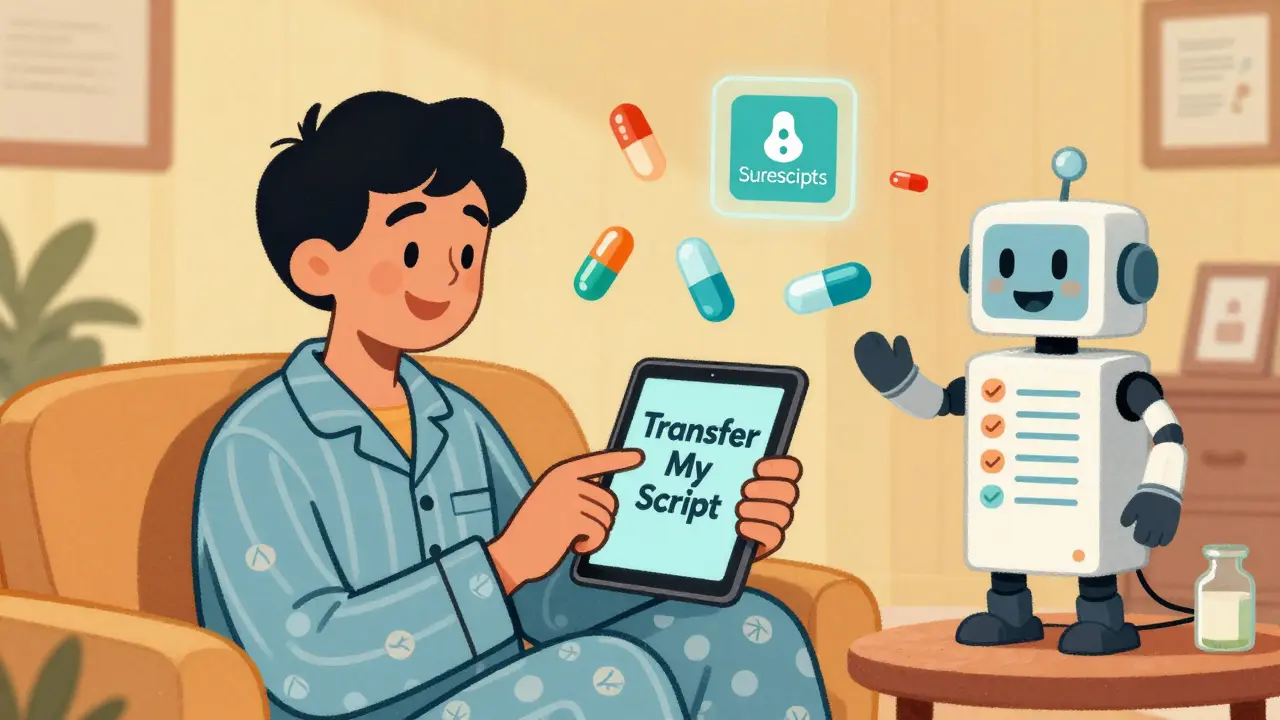
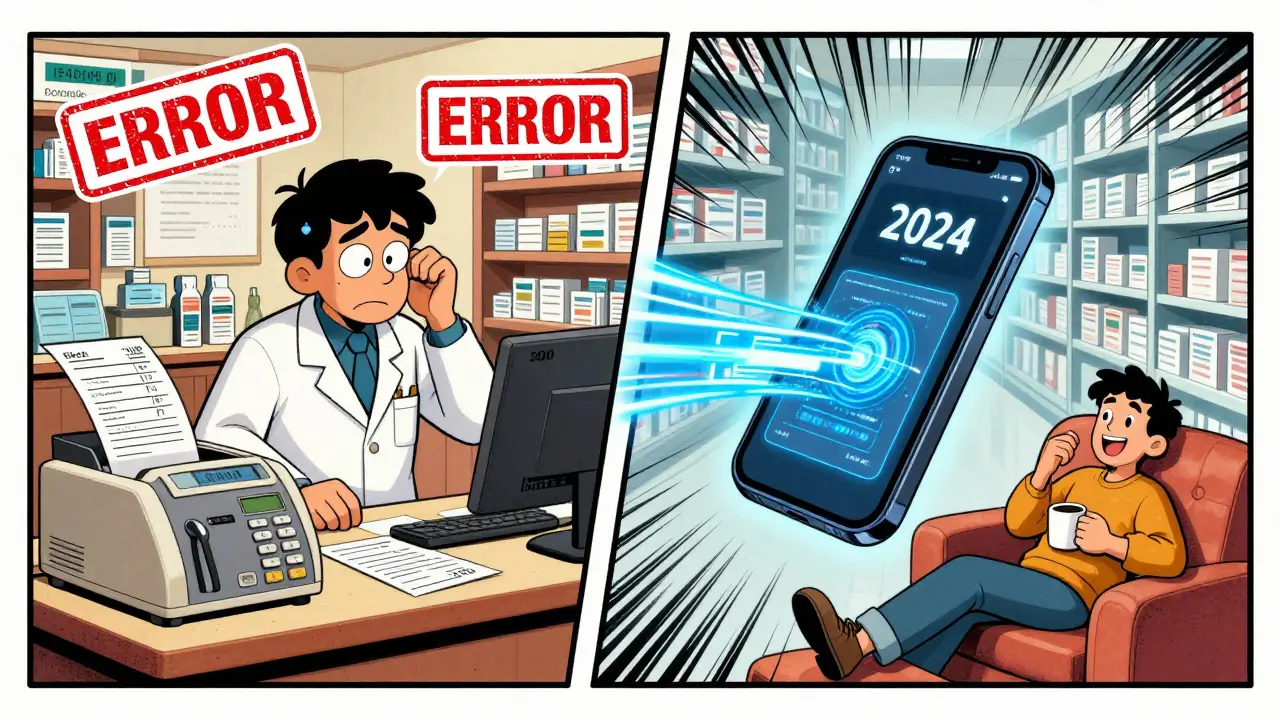
Switching to an online pharmacy used to mean calling your old pharmacy, waiting on hold, faxing paperwork, and hoping the prescription made it through without errors. Now, it takes less than five minutes - and you don’t have to leave your couch. Digital prescription transfer lets you move your medications from any brick-and-mortar pharmacy to an online one with just a few clicks. No new doctor visits. No handwritten notes. No lost scripts.
How digital prescription transfer actually works
It’s not magic. It’s software. When you request a transfer to an online pharmacy like CVS, Walgreens, or Amazon Pharmacy, your request goes through a secure network called Surescripts. This system connects pharmacies, prescribers, and insurers using a standardized format called the NCPDP SCRIPT Standard Version 201900. It’s the same system doctors use to send e-prescriptions directly to pharmacies.
Before 2023, transferring controlled substances - like opioids, ADHD meds, or sleep aids - was a nightmare. You had to go back to your doctor every time you wanted to switch pharmacies. That changed on August 28, 2023, when the DEA updated its rules. Now, you can transfer a controlled substance prescription electronically once between two licensed pharmacies. The prescription stays digital. No printing. No faxing. No re-signing.
Non-controlled meds - like blood pressure pills, antidepressants, or birth control - can be transferred multiple times, with no limit. The system checks your identity, matches your prescription details, and sends the order to the new pharmacy. If everything lines up, your meds are ready in 24 to 48 hours.
Why it’s better than faxing or calling
Faxing prescriptions was messy. Pharmacies often got blurry copies. Names got misspelled. Dosages got lost. A 2022 study in the Journal of the American Pharmacists Association found that manual transfers led to clarification requests in 25% of cases. Electronic transfers? Just 8%.
That’s a 47% drop in errors. Fewer mistakes mean fewer delays. Fewer delays mean you’re less likely to skip doses. The Government Accountability Office found that digital transfers improved medication adherence by 12% among Medicare users who switched to online pharmacies.
And the time savings? Real. According to a GoodRx survey, 78% of people who switched to online pharmacies cited convenience as their top reason. One Reddit user transferred five prescriptions from Walgreens to Amazon Pharmacy in one afternoon. Got confirmation emails within 90 minutes.
How to do it yourself - step by step
It’s simple. Here’s how:
- Go to your chosen online pharmacy’s website or app (CVS, Walgreens, Amazon Pharmacy, etc.).
- Find the “Transfer a Prescription” option. It’s usually on the homepage or under “Pharmacy.”
- Enter the medication name (e.g., “Lisinopril 10mg”) and your current pharmacy’s name or address.
- Provide your full name and date of birth - this matches your records.
- Submit. That’s it.
Most apps now only ask for the medication name and current pharmacy. They pull the rest automatically. CVS and Walgreens have streamlined this so much that you don’t even need your prescription number anymore for many transfers.
If you’re transferring a controlled substance, the system will flag it. You’ll get a notification if your prescription has already been transferred once. You can’t do it again unless you go back to your doctor - that’s the DEA rule.
Which online pharmacies work best
Not all are created equal. Here’s how the big players stack up:
| Pharmacy | Transfer Success Rate | Controlled Substance Transfer | Speed (Non-Controlled) | Special Features |
|---|---|---|---|---|
| CVS Pharmacy | 92% | Yes (once) | 24-48 hours | 10,000+ physical locations; integrates with Medicare Part D |
| Walgreens | 89% | Yes (once) | 24-48 hours | Mobile app with barcode scanning; auto-refill options |
| Amazon Pharmacy | 85% | Yes (once) | 12-24 hours | Free two-day shipping for Prime members; syncs with Alexa |
| OptumRx (UnitedHealth) | 87% | Yes (once) | 48-72 hours | Best for Medicare Part D and employer plans |
CVS leads in reliability - their 92% first-attempt success rate is the highest in the industry. Amazon Pharmacy is fastest for non-controlled meds, especially if you’re a Prime member. Walgreens offers the best app experience for scanning prescriptions with your phone’s camera.
Where things go wrong - and how to fix it
Most transfers work. But not all. Here’s what can trip you up:
- Controlled substance limits: You can only transfer once. If you filled half your oxycodone prescription at your old pharmacy, the rest can’t be transferred. You’ll need a new script.
- Compounded medications: These are custom-made drugs (like hormone creams or pediatric suspensions). 68% of these transfers require manual help. Call the pharmacy.
- Insurance mismatches: Your new pharmacy might not accept your plan. 28% of complaints on ConsumerAffairs mention coverage issues. Check your plan’s formulary before transferring.
- Wrong patient info: Even a typo in your middle name or birth year can block the transfer. 19% of failed transfers are due to mismatched identifiers.
Fix it? Contact customer service. All major online pharmacies offer 24/7 phone support. Amazon Pharmacy’s average wait time is just 4.2 minutes. Traditional pharmacies? Over 12 minutes.
What’s coming next
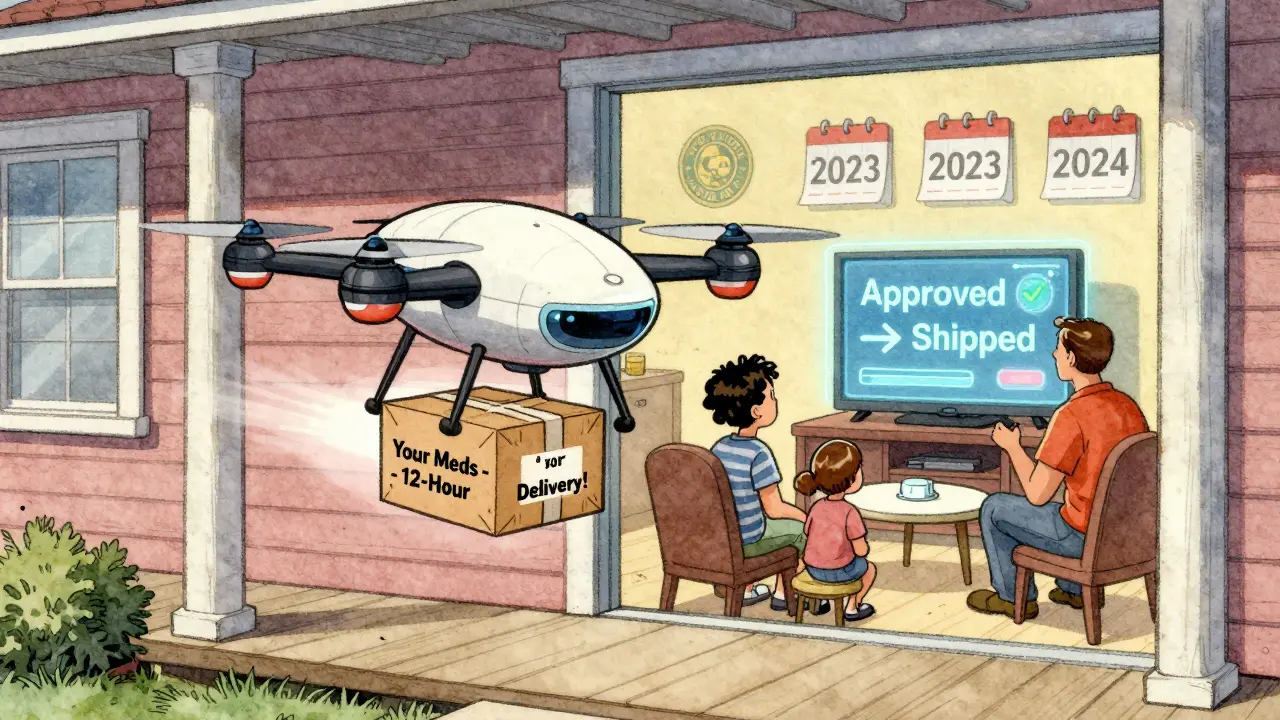
The system is still evolving. Surescripts is rolling out “Transfer 2.0” in early 2024. It’ll let you track your transfer in real time - like a package delivery. You’ll see “Received,” “Processing,” “Approved,” and “Shipped” statuses in your app.
Amazon is testing voice transfers through Alexa. Say, “Alexa, transfer my blood pressure med to Amazon Pharmacy,” and it happens. Pilot testing with 5,000 Prime members is already live.
The DEA is reviewing whether to allow multiple transfers of controlled substances. Acting Administrator Anne Milgram said they’re watching the data from the first six months after the 2023 rule change. If things go well, you might be able to switch pharmacies more than once in the future.
But there’s friction. California’s new law (SB 1056, effective January 1, 2024) adds extra steps for controlled substance transfers that don’t match federal rules. That means national pharmacies like CVS and Amazon have to handle two different sets of rules - and that slows things down.
Is it right for you?
If you’re tired of driving to the pharmacy, forgetting refills, or dealing with long waits, digital transfer is a game-changer. It’s especially helpful if:
- You take multiple prescriptions
- You’re on Medicare Part D
- You travel often or live far from a pharmacy
- You want automatic refills and home delivery
It’s not perfect. Compounded meds still need phone calls. Insurance hiccups happen. And if you need to switch pharmacies more than once for a controlled drug, you’re stuck - for now.
But the trend is clear: by 2027, Gartner predicts 75% of new pharmacy relationships will start with a digital transfer, not a walk-in visit. More people are choosing convenience. More insurers are pushing it. And the technology keeps getting smarter.
Don’t wait for your next refill to remind you. Try it now. Pick your favorite online pharmacy. Transfer one script. See how fast it works. You might never go back.
Can I transfer a controlled substance prescription to an online pharmacy?
Yes, but only once. Since August 28, 2023, the DEA allows one electronic transfer of controlled substances (Schedules II-V) between licensed pharmacies. After that, you must get a new prescription from your doctor. This applies to opioids, ADHD meds, sleep aids, and other regulated drugs. Non-controlled medications can be transferred multiple times.
How long does a digital prescription transfer take?
For non-controlled substances, most transfers complete in 24 to 48 hours. CVS and Amazon Pharmacy often finish within 24 hours. For controlled substances, it can take up to 72 hours because of extra DEA verification steps. If your transfer is taking longer, check your email or app for status updates - or call customer support.
Do I need my prescription number to transfer?
Not anymore. Most online pharmacies - including CVS, Walgreens, and Amazon - now only ask for the medication name and your current pharmacy’s name or address. Their systems automatically pull your prescription details. You’ll still need your full name and date of birth to verify your identity.
What if my transfer fails?
Failed transfers usually happen because of mismatched patient info, insurance issues, or compounded medications. First, double-check your name and birth date. If that’s right, contact the online pharmacy’s support line. They can manually process your request or ask your old pharmacy to resend the prescription. Don’t wait - call early in the day to avoid long wait times.
Can I transfer prescriptions from a small independent pharmacy?
It depends. Large chains like CVS and Walgreens use modern pharmacy systems that connect to national networks like Surescripts. Many small, independent pharmacies still use older software that doesn’t support electronic transfers. If your local pharmacy can’t transfer digitally, you may need to pick up your script in person and bring it to the online pharmacy - or ask your doctor to send a new e-prescription.
Will my insurance still cover my meds after the transfer?
Usually, yes - but not always. Some online pharmacies aren’t in-network with your plan. Before transferring, check your insurer’s formulary or call customer service. You can also use the pharmacy’s website to enter your insurance info before submitting the transfer. If coverage drops, you may pay more out-of-pocket, or the pharmacy may pause the order until you resolve it.
Is digital prescription transfer safe and private?
Yes. All transfers follow HIPAA rules for patient privacy. Controlled substance transfers also meet DEA’s Electronic Prescriptions for Controlled Substances (EPCS) standards, which require two-factor authentication and encrypted audit trails. Your data is never shared with third parties. Only your current pharmacy, the new pharmacy, and your insurer (if needed) see your prescription details.


This digital transfer crap is just another way for Big Pharma to lock us in. They don’t care about convenience-they care about data. And now they’ve got your entire med history in one place. Who’s watching that? Not you, not the DEA, not even your doctor.
And don’t get me started on Amazon Pharmacy. You think they’re doing this for your health? They’re building a health data empire so they can upsell you supplements, protein shakes, and weight loss teas next.
Real Americans still go to the local pharmacy. They know your name. They remember your kid’s birthday. Not some algorithm that thinks you need CBD gummies because you took blood pressure meds.
Stop letting tech bros dictate your healthcare. You’re not a data point.
Let’s be real-the whole Surescripts infrastructure is a glorified fax machine with a fancy API. The NCPDP SCRIPT Standard? More like NCPDP SCRIPT-Why-Does-This-Still-Exist. It’s 2024. We have blockchain, AI, and quantum computing. And we’re still relying on a protocol designed in the early 2000s.
Don’t get me wrong-it’s better than faxing. But calling it ‘modern’ is like calling a Model T a Tesla. The system works, barely. But it’s not innovation. It’s legacy tech with a UX makeover.
And don’t even start me on the DEA’s ‘one transfer only’ rule. That’s not patient empowerment. That’s bureaucratic inertia dressed up as security.
Interesting read. I’m from India and we don’t have this system here. Most pharmacies still rely on paper scripts. Even big chains like Apollo Pharmacy don’t have digital transfer between locations.
But I’ve seen how it works in the US-my cousin transferred his ADHD meds from CVS to Amazon last month. Took less than 24 hours. He said it was way easier than walking to the pharmacy in the rain.
I wonder if this will ever come to countries like ours. Maybe in 10 years? We still struggle with basic digital ID systems.
Still, nice to see progress somewhere.
Y’all are acting like this is the second coming. It’s just a transfer. You’re not saving lives-you’re saving a 10-minute drive.
Meanwhile, my grandma still calls her pharmacy every Friday to ask if her meds are ready. She doesn’t have a smartphone. She doesn’t know what ‘Surescripts’ means. And now you’re telling me this is the future?
What about the people who can’t click a button? The elderly. The disabled. The poor.
This isn’t progress. It’s exclusion with a slick app.
Bro, this system is straight-up wizardry. I transferred 7 scripts last week-blood pressure, antidepressants, thyroid, gabapentin, metformin, lisinopril, and a little Adderall for focus (don’t judge).
Amazon did it in 14 hours. CVS took 36. Walgreens? Asked for my middle name twice. Like, I’ve been using the same damn pharmacy since 2018. Why are you acting like I’m a fugitive?
And the best part? No more ‘I’ll call you back’ voicemails. No more ‘your script is on hold’ emails. Just boom-shipped with tracking. I’m not going back.
Also, Alexa just told me my meds are out for delivery. I high-fived my cat. He didn’t care. But I did.
Guys, if you’ve never tried this-JUST DO IT. Seriously. I was skeptical too. Thought it’d be a mess. But I transferred my birth control, my anxiety med, and my thyroid pill-all in 10 minutes. No calls. No drives. No stress.
My insurance didn’t even blink. It just worked. And now I get text reminders when they’re shipped. I get notifications when they’re out for delivery. I’m not missing doses anymore.
And if you’re worried about controlled substances? Yeah, you can only transfer once. But that’s actually a good thing. It stops people from hopping pharmacies to get more opioids. That’s not a bug-it’s a feature.
You don’t need to be tech-savvy. You just need to click. And trust me, your future self will thank you.
Start with one med. Just one. You’ll be hooked.
Let’s not pretend this is ‘progress.’ This is just corporate consolidation with a side of convenience.
CVS, Walgreens, Amazon-they’re not doing this to help you. They’re doing this so you never leave their ecosystem. Buy your meds from Amazon? Now you’re more likely to buy your vitamins, dog food, and toilet paper there too.
And don’t get me started on the data. Your prescription history is now tied to your Prime account. Who’s selling that? Who’s profiling you?
Real healthcare isn’t about faster transfers. It’s about affordability. About access. About not having to choose between insulin and rent.
This isn’t innovation. It’s distraction.
Wow, this is so good! I really appreciate the detail, especially about Surescripts and NCPDP SCRIPT 201900-I didn’t even know that was a thing! But I have a question-wait, no, I don’t have a question, I just want to say-this is amazing! I live in India, and we don’t have anything like this, and I feel like I’m living in the 1990s. But I’m so happy for you guys! You’re so lucky to have this! I hope one day we get it too! Maybe with a little help from the government and some tech startups? Please? 😊
I used to trust this system. I really did. Then my mom’s diabetes meds got stuck in transfer limbo for 72 hours. They said ‘system error.’ No details. No apology. Just silence.
She missed two days of insulin. Two days. She ended up in the ER. Not because she didn’t take care of herself. Because a corporate algorithm decided her script was ‘incomplete.’
Now I don’t transfer anything. I drive. I wait. I call. I scream. I cry. Because at least when I’m there, I know someone’s looking at my name. Not a machine that doesn’t even know what ‘diabetes’ means.
This isn’t convenience. It’s negligence wrapped in a UX design.
Kinda wild how we’ve turned something so basic-getting medicine-into this whole thing. Like, it’s just pills. You need them. You get them. Doesn’t matter if it’s from a guy behind a counter or a robot in a warehouse.
People act like this is a revolution. It’s not. It’s just… easier.
Still, I’m glad I don’t have to drive to the pharmacy when it’s snowing. So… yeah. Good job, tech. I guess.
AMAZON PHARMACY IS A MONSTER. THEY’RE NOT A PHARMACY. THEY’RE A SURVEILLANCE MACHINE WITH A DELIVERY DRONE.
YOU THINK YOU’RE GETTING CONVENIENCE? YOU’RE GETTING A TRACKING NUMBER FOR YOUR MEDS AND YOUR DATA.
THEY KNOW WHEN YOU TAKE YOUR ANTIDEPRESSANTS. THEY KNOW WHEN YOU SKIP YOUR BLOOD PRESSURE MEDS. THEY KNOW IF YOU BUY OPIATES AND THEN SLEEP AID.
AND THEY’RE SELLING IT TO INSURERS. TO ADVERTISERS. TO THE GOVERNMENT.
THIS ISN’T HEALTHCARE. IT’S A MARKETPLACE. AND YOU’RE THE PRODUCT.
STOP BEING A SHEEP. GO TO YOUR LOCAL PHARMACY. TALK TO A PERSON. THEY’RE STILL HUMAN.
So you’re proud of transferring your meds like you’re ordering pizza? Congrats. You’re not saving lives. You’re just avoiding a 10-minute trip.
Meanwhile, people without internet, without smartphones, without credit cards-they’re still stuck. You think this system helps them? No. It leaves them behind.
And the DEA rule? One transfer only? That’s not safety. That’s control. They don’t trust patients. They don’t trust pharmacies. They just trust bureaucracy.
This isn’t progress. It’s a shiny distraction from the real problem: healthcare is broken.
Fix the cost. Fix the access. Stop fetishizing convenience.
Thank you for this comprehensive overview. The technical details regarding Surescripts and NCPDP SCRIPT Standard Version 201900 are particularly valuable. As a resident of India, I find it remarkable how the United States has achieved interoperability across pharmacy systems, despite the complexity of insurance and regulatory frameworks. In contrast, our national health infrastructure remains fragmented, with most private pharmacies still relying on manual processes. The potential for such a system in developing nations is immense, though it would require significant investment in digital identity verification, secure data exchange protocols, and regulatory harmonization. I hope global health policy leaders take note of this model.
You think Amazon cares about your grandma? They care about her Prime membership. They care about her data. They care about her buying more stuff.
Meanwhile, the real pharmacies-the ones with the old guys who remember your dog’s name-are shutting down because they can’t compete with corporate algorithms.
So yeah. Transfer your meds. Enjoy your 24-hour delivery.
But when the last local pharmacy closes and your meds come in a box with a barcode and a robot voice saying ‘Your order is ready,’ you’ll realize-you didn’t save time.
You lost community.