
Most people don’t realize that a common virus you might have had without even knowing it could lead to cancer years later. Human papillomavirus, or HPV, is behind nearly all cervical cancers, 91% of anal cancers, and more than 70% of throat cancers in the U.S. today. And while cervical cancer rates have dropped thanks to screening, HPV-related throat cancer is rising fast-especially in men. This isn’t a distant threat. It’s happening now, in real time, and it’s largely preventable.
What HPV-Related Cancers Actually Look Like
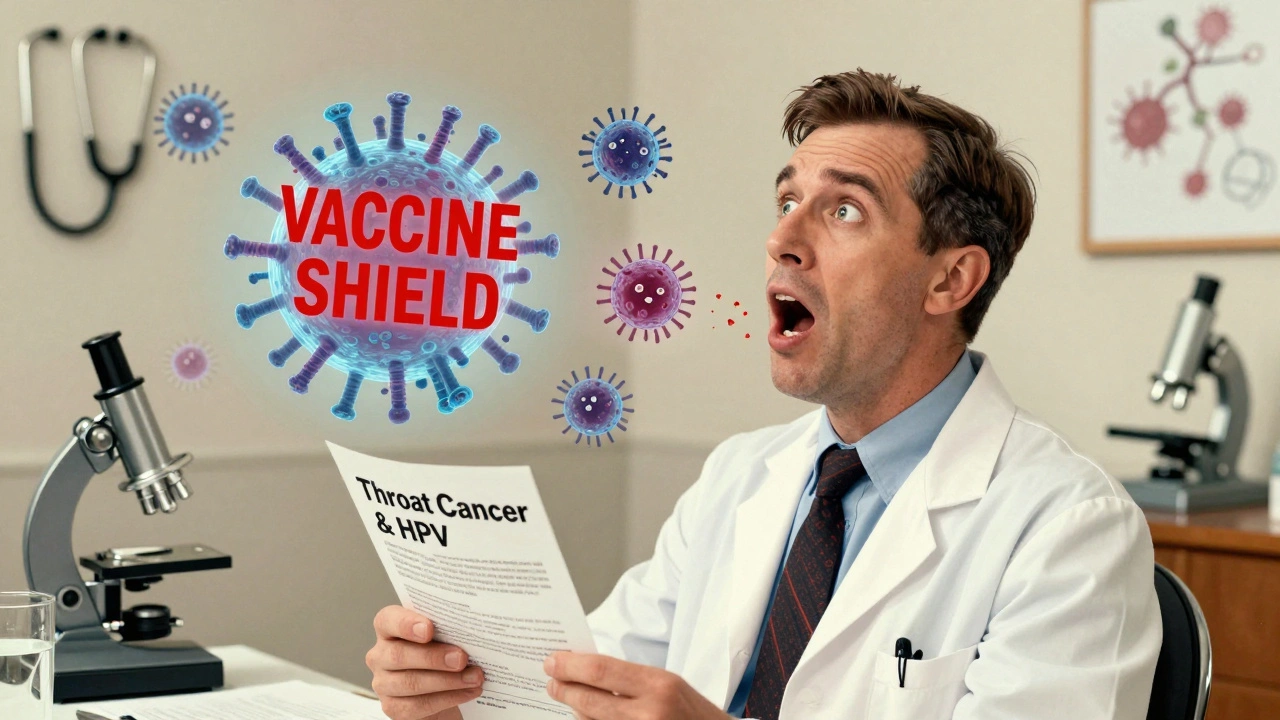
HPV doesn’t just cause warts. Certain high-risk strains, especially types 16 and 18, can stick around for years, quietly changing cells until they turn cancerous. The three most common HPV-linked cancers are cervical, anal, and oropharyngeal (throat). But they don’t affect everyone the same way.Throat cancer from HPV, also called oropharyngeal cancer, grows in the back of the throat, including the base of the tongue and tonsils. It’s often found in people who’ve never smoked. Unlike smoking-related throat cancers, HPV-positive ones tend to respond better to treatment-but they still require aggressive therapy. Survivors often face lifelong side effects: trouble swallowing, permanent voice changes, and feeding tubes for months. One patient in a 2023 support group shared his story: after treatment, he lost his ability to eat normally for half a year and racked up $127,000 in out-of-pocket costs, even with insurance.
Anal cancer is less talked about, but it’s growing too. About 91% of cases are caused by HPV. Symptoms include bleeding, pain, itching, or a lump near the anus. Because it’s often mistaken for hemorrhoids, many people delay seeing a doctor. By the time it’s diagnosed, it’s often advanced. In men, anal cancer is now more common than cervical cancer in women under 40.
Women still face the highest overall burden of HPV-related cancers, mostly because of cervical cancer. But among men, throat cancer is now the #1 HPV-linked cancer-making up 80% of all HPV cases in males. And while cervical cancer rates have dropped by over 50% since the 1970s, throat cancer rates in men have climbed by nearly 3% every year since 2001.
Why Men Are Getting Hit Harder
It’s not that men are more likely to get HPV. Everyone does-about 80% of sexually active people will have it at some point. But men don’t have routine screening like women do. No Pap test. No HPV test. No early warning system.That means when HPV turns into throat or anal cancer in men, it’s usually found at a later stage. The cancer is already growing, and treatment is more intense. The rise in cases is also tied to changing sexual behaviors over the past few decades. Oral sex is more common now, and HPV can be passed through it. The virus doesn’t care about gender-it just needs a host.
And it’s not just about age. The biggest spike in throat cancer from HPV is in men aged 40 to 60. These are people who were teens or young adults in the 1990s and 2000s-before the HPV vaccine existed. They had the exposure, but no protection. Now, they’re paying the price.
How Vaccination Stops Cancer Before It Starts
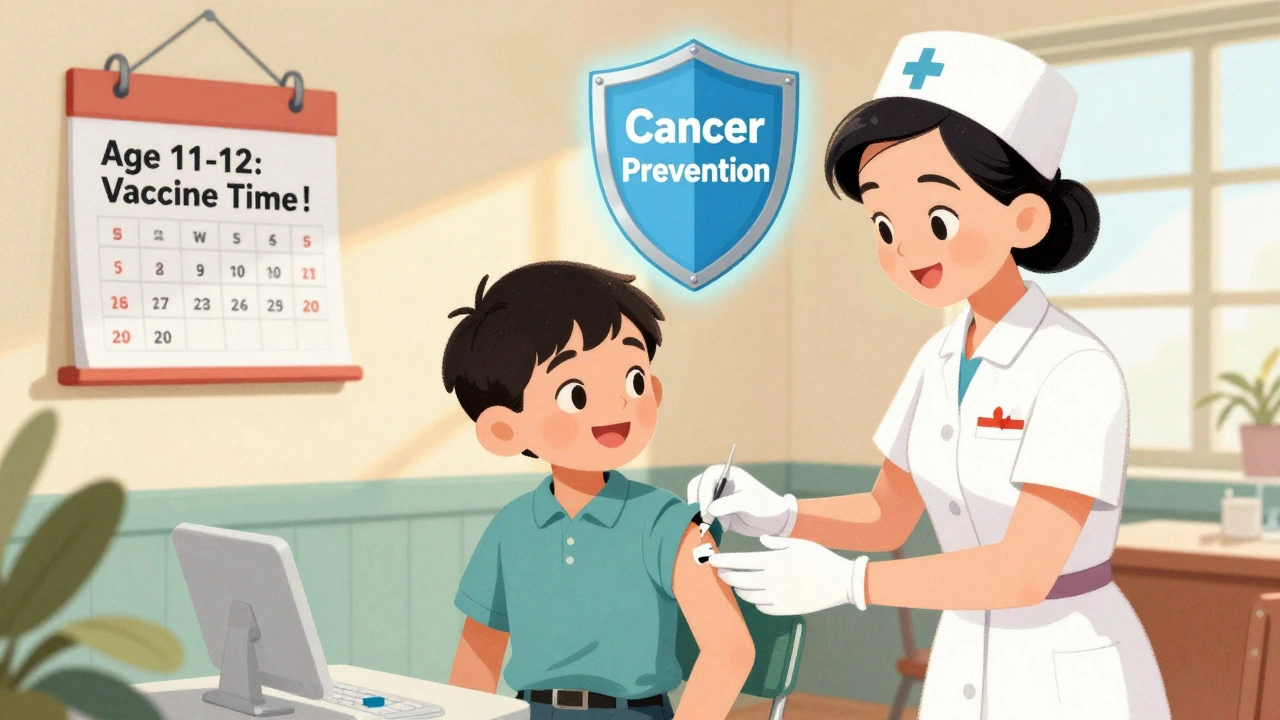
The HPV vaccine doesn’t just prevent warts. It prevents cancer. The current vaccine, Gardasil-9, protects against nine types of HPV, including the two that cause 70% of cervical cancers and 85% of throat cancers. It also prevents nearly all cases of anal, vaginal, vulvar, and penile cancers linked to HPV.It works best when given before anyone becomes sexually active. That’s why the CDC recommends the vaccine for kids at age 11 or 12. Two doses, six months apart, are all it takes. Even if someone is older, the vaccine still helps. It’s approved up to age 26 for everyone, and for adults 27 to 45, it’s an option after talking with a doctor.
But here’s the problem: only 65% of U.S. teens have completed the full series. In some rural areas, fewer than half of eligible kids are vaccinated. Why? Some parents worry about safety. Others think their child isn’t sexually active yet, so they wait. But the vaccine doesn’t work if you wait until after exposure. It’s a preventive tool, not a cure.
When vaccination rates go up, cancer rates go down. In Rhode Island, a school-based program pushed HPV vaccination from 53% to 84% in six years. The result? A 22% drop in high-grade cervical cell changes-precancerous lesions that could’ve turned into cancer. That’s not theory. That’s real data from real people.
Screening Isn’t Enough for Throat and Anal Cancers
For cervical cancer, we have a proven system: HPV testing every five years or Pap smears every three. But for throat and anal cancers? There’s no standard screening. No blood test. No swab. No easy way to catch it early.That’s why vaccination is even more critical for these cancers. If you can’t screen for it, you have to stop it before it starts. Doctors can’t find throat cancer early unless someone has symptoms-and by then, it’s often too late.
Some clinics are testing anal swabs for high-risk HPV in men who have sex with men, since they’re at higher risk. But this isn’t routine care. It’s not covered by insurance in most places. And it’s not available to the general public.
So if you’re a man over 30, or a woman who didn’t get the vaccine as a teen, don’t wait for symptoms. Talk to your doctor. Ask if you’re a candidate for the vaccine. Even if you’ve had HPV before, the vaccine can still protect you from other strains.
The Cost of Waiting
Treating HPV-related cancers is expensive. The average cost for throat cancer treatment is nearly $200,000. For cervical cancer, it’s over $140,000. Anal cancer runs about $135,000. These numbers don’t include lost wages. One study found that 68% of throat cancer patients missed an average of 14 weeks of work.And it’s not just money. Survivors deal with chronic pain, trouble speaking, eating, or having sex. Many feel shame-not because they did something wrong, but because society still links HPV to sexual behavior. A 2022 survey found that 58% of people with HPV-related cancer felt blamed for their diagnosis. That stigma stops people from seeking help, getting tested, or vaccinating their kids.
The truth? HPV is as common as the flu. Most people clear it on their own. But for a small number, it lingers. And when it does, it can change everything.
What You Can Do Right Now
If you’re a parent: Vaccinate your child at 11 or 12. Don’t wait. Don’t delay. The vaccine is safe, effective, and one of the most powerful cancer prevention tools we’ve ever had.If you’re between 13 and 26 and haven’t been vaccinated: Talk to your doctor. It’s not too late. Even if you’ve had sex, the vaccine can still protect you.
If you’re 27 to 45: Ask your doctor if the vaccine is right for you. It’s not a one-size-fits-all decision, but it could still make a difference.
If you’re a woman over 25: Get screened. Primary HPV testing every five years is now the gold standard. Don’t skip it because you feel fine. Cancer doesn’t always cause symptoms.
If you notice persistent symptoms-like a sore throat that won’t go away, trouble swallowing, bleeding from the anus, or a lump that won’t disappear-see a doctor. Don’t wait. Don’t assume it’s nothing.
What’s Next
The World Health Organization wants to eliminate cervical cancer by 2030. Their plan: 90% of girls vaccinated by 15, 70% of women screened by 35 and 45, and 90% of precancers treated. It’s ambitious. But possible-if we act.Right now, we’re on track to make throat cancer the most common HPV-related cancer by 2035. That’s not progress. That’s a failure of prevention. We have the tools. We know how to stop this. What we need now is action-on a personal level, in clinics, and in policy.
Every vaccine dose is a cancer avoided. Every screening is a life saved. And every conversation about HPV is a step toward ending the stigma.
Can you get HPV from kissing?
Yes, HPV can spread through deep kissing, especially if there’s oral contact with an infected area. But it’s more commonly passed through vaginal, anal, or oral sex. The virus enters through tiny breaks in the skin or mucous membranes. It’s not about how many partners you’ve had-it’s about exposure. Most people get it without knowing.
Is the HPV vaccine only for girls?
No. The vaccine is for everyone. Boys and girls both benefit. Vaccinating boys reduces the spread of HPV to partners and directly protects them from anal, throat, and penile cancers. In fact, since more men are getting HPV-related throat cancer than women are getting cervical cancer, vaccinating boys is just as important as vaccinating girls.
Do I need the vaccine if I already had HPV?
Yes. The vaccine protects against multiple strains of HPV. Even if you’ve had one type, you might not have been exposed to the others. Gardasil-9 covers nine types, including the two most dangerous for cancer. Getting vaccinated after an infection still reduces your risk of future problems.
Can HPV cause cancer in men who don’t have sex with men?
Absolutely. The rise in throat cancer from HPV is happening mostly in heterosexual men. It’s not about sexual orientation-it’s about exposure. HPV spreads through skin-to-skin contact during any kind of sexual activity. Most men who get HPV-related throat cancer have never had sex with another man.
Why isn’t there a screening test for throat cancer like there is for cervical cancer?
Because the throat is harder to access and monitor than the cervix. There’s no simple swab or visual exam that reliably catches early changes. Researchers are working on saliva tests and imaging tools, but nothing is approved or widely used yet. That’s why vaccination is the best defense-it stops the virus before it can cause damage.
Is the HPV vaccine safe?
Yes. Over 135 million doses have been given in the U.S. since 2006. Studies show it’s as safe as other teen vaccines. The most common side effects are soreness at the injection site, dizziness, or mild fever-none of which last long. No link has ever been found between the vaccine and serious long-term health problems. The benefits far outweigh any risks.
Can you get HPV from sharing towels or toilets?
No. HPV spreads through direct skin-to-skin contact during sexual activity. It doesn’t live long on surfaces like towels, toilet seats, or bedding. You can’t catch it from public restrooms or shared laundry. The virus needs a living host to survive and spread.
How long does the HPV vaccine last?
So far, protection lasts at least 15 years-and likely much longer. Studies tracking people since the vaccine’s launch show no drop in effectiveness over time. There’s no current recommendation for booster shots. If you got the full series as a teen, you’re protected for decades.
13 Comments
Write a comment