

When you land in Tokyo after a 14-hour flight from Sydney, your body still thinks it’s 3 a.m. But the sun’s up, your meeting starts in two hours, and you’re wide awake at 5 a.m. - then crashed by noon. That’s jet lag. And if you’ve tried time-released melatonin to fix it, you’re not alone. But here’s the truth: time-released melatonin doesn’t work for jet lag. In fact, it often makes it worse.
Why Jet Lag Happens (And Why It’s Not Just Tiredness)
Jet lag isn’t just being tired. It’s your internal clock - the circadian rhythm - stuck in the past. Your body runs on a 24-hour cycle: melatonin rises at night, cortisol peaks in the morning, your temperature dips and rises. When you cross time zones fast, your clock doesn’t instantly reset. It takes days. On average, you lose one day of adjustment for every time zone you cross going west. Going east? You need 1.5 days per zone. So a 9-time-zone flight to London from Sydney? You’re looking at 13-14 days to fully adjust without help.What Melatonin Actually Does - And Doesn’t Do
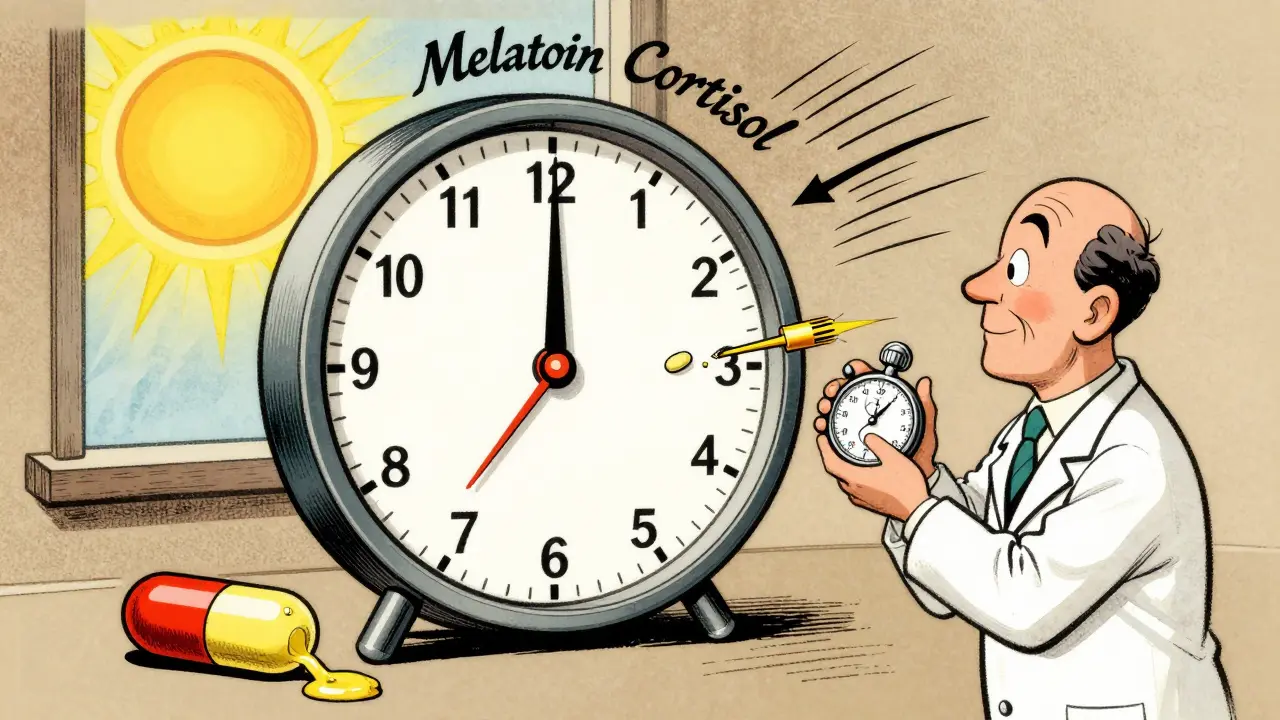
Melatonin isn’t a sleeping pill. It’s a signal. Your brain makes it naturally when it’s dark. Taking it at the right time tells your body: “It’s time to prepare for sleep.” That’s how it shifts your clock. But it only works if the timing is exact. Take it too early? You delay your rhythm. Too late? You confuse your system. The window for effect is narrow - just 2 to 3 hours.Why Time-Released Melatonin Fails for Jet Lag
Time-released melatonin is designed for insomnia in older adults. It slowly leaks melatonin into your system over 6-8 hours. That’s fine if you’re trying to stay asleep all night. But for jet lag? It’s a disaster. Your body needs a sharp, short signal - not a slow drip. Research from the CDC Yellow Book 2024 says it plainly: slow-release melatonin “stays in the system too long and confuses the circadian clock.” Studies show it delivers melatonin during biological morning - when your body should have zero of it. That’s like turning on a light at 4 a.m. when your brain is trying to wake up. The result? You wake up groggy, your rhythm gets scrambled, and you take longer to adjust. A 2023 Sleep Cycle app survey of over 5,000 travelers found people using time-released melatonin took 2.4 days longer to recover from jet lag than those using immediate-release. On Reddit’s r/Biohackers, 78% of users reported worse morning grogginess and slower adaptation with time-released versions. Amazon reviews for time-released melatonin average just 2.8 out of 5 stars. Common complaints? “Woke up at 3 a.m. feeling wired.” “Felt like I was drugged all day after my Tokyo trip.”What Works: Immediate-Release Melatonin
Immediate-release melatonin dissolves in 20-30 minutes. It spikes quickly, signals your clock, then clears out in 1-2 hours. That’s exactly what your circadian rhythm needs. The American Academy of Sleep Medicine gives a strong recommendation (Level A) for immediate-release melatonin for eastward travel across 2+ time zones. Dose? 0.5 to 3 mg. Surprisingly, 0.5 mg works just as well as 5 mg for shifting your clock - higher doses just make you sleepier, not more adjusted. Here’s how to use it:- Going east (e.g., Sydney to London): Take 0.5-3 mg 30 minutes before your target bedtime at your destination. Start 1-2 days before departure if possible. For a 9-time-zone jump, use 3 mg. Take it for 4-5 nights.
- Going west (e.g., New York to LA): Take it upon waking at your destination for 2-3 days. This helps delay your rhythm. Less commonly used, but effective.
Timing Is Everything - And Most People Get It Wrong
The biggest mistake? Guessing the time. If you take melatonin at 10 p.m. local time but your body thinks it’s 3 a.m., you’re making jet lag worse. A University of Surrey study found 65% of first-time users mis-timed their doses by 2 or more hours. Use an app. Timeshifter, used by over 1.2 million travelers as of early 2024, calculates your ideal dosing time based on your flight path, chronotype, and sleep history. It’s not magic - it’s science. One Business Insider columnist adjusted from Sydney to London in 3.5 days using 1 mg immediate-release melatonin timed by Timeshifter. He said the time-released version he accidentally took once left him disoriented for two days.Light Is Your Secret Weapon
Melatonin isn’t enough. Light is the strongest signal your circadian clock responds to. After taking melatonin at night, avoid bright light - especially blue light from phones. In the morning, get sunlight for 30-60 minutes. If it’s cloudy? Use a 10,000-lux light box. Harvard researchers found that combining timed melatonin with light exposure cuts jet lag recovery time by nearly half.What About Prescription Options?
Some doctors prescribe zolpidem (Ambien) or modafinil (Provigil). Zolpidem helps you fall asleep. Modafinil keeps you awake. But they don’t fix your clock. They mask symptoms. Melatonin actually resets your rhythm. That’s why sleep specialists recommend melatonin as the first-line treatment - not sedatives or stimulants.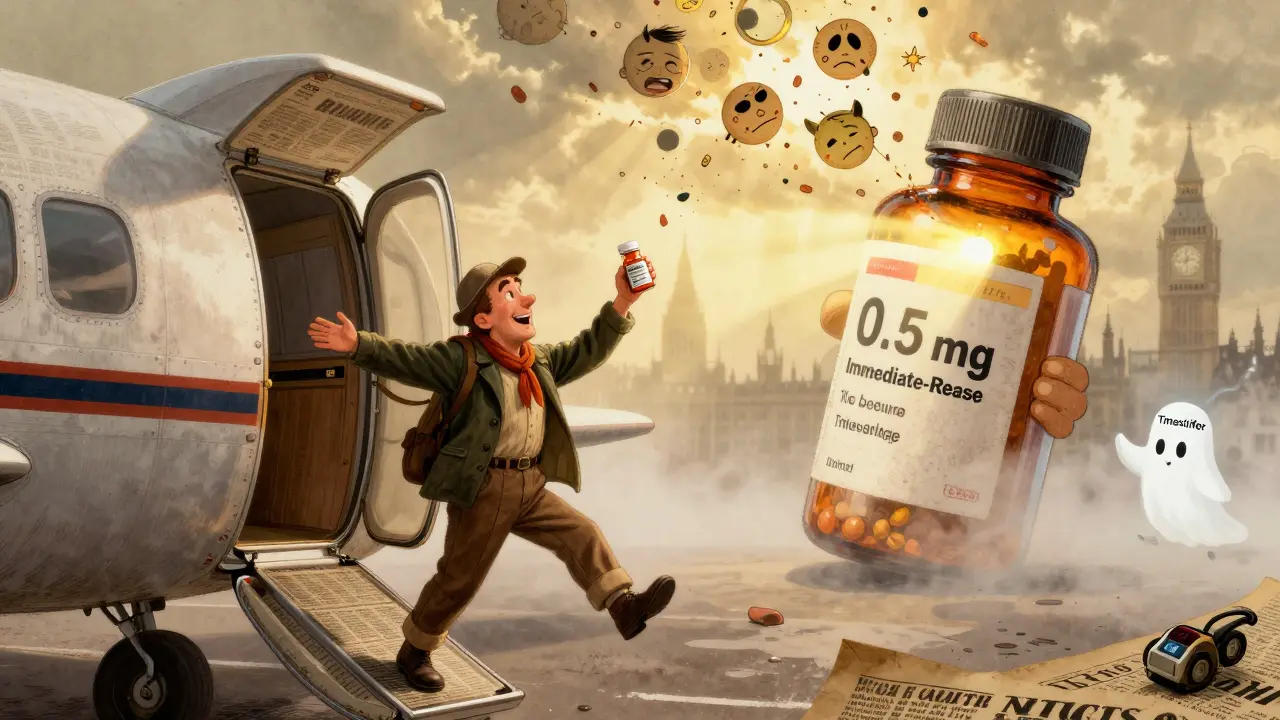
The Market and the Misinformation
The global jet lag market is worth $1.7 billion. Melatonin makes up 68% of it. But here’s the problem: most products on shelves don’t match what science says. The FDA doesn’t regulate melatonin as a drug - it’s sold as a supplement. A 2023 FDA warning found melatonin supplements contained 83% to 478% more than what’s on the label. One pill labeled “1 mg” had 4.7 mg. That’s dangerous if you’re trying to time it precisely. Even worse? Many brands market time-released melatonin as “better for jet lag.” That’s not true. The European Medicines Agency approved Circadin (a time-released melatonin) for insomnia in people over 55 - but specifically excluded jet lag because there’s no evidence it works for that. Fortune 100 companies are catching on. 42 of them now give employees immediate-release melatonin and timing guides for international travel. Not one endorses time-released versions.What’s Next?
New drugs like Hetlioz (tasimelteon) are approved for rare circadian disorders, but they’re not better for jet lag. The real future is personalization. Researchers at UCSF are testing genetic markers - like the CRY1 gene - that affect how your body responds to melatonin. Some people need it at 8 p.m. Others at 11 p.m. That’s why apps like Timeshifter are becoming essential.Bottom Line: Skip the Time-Released Stuff
If you’re flying across time zones, forget time-released melatonin. It’s designed for the wrong problem. Use immediate-release instead. Take 0.5-3 mg 30 minutes before your destination’s bedtime. Avoid light after dosing. Get sunlight in the morning. Use an app to time it right. Most people recover in 3-4 days - not 7. Your body doesn’t need a slow drip. It needs a precise signal. Give it that - and you’ll land, not crash.Is time-released melatonin safe for jet lag?
Time-released melatonin isn’t unsafe, but it’s ineffective for jet lag. It keeps melatonin in your system for 6-8 hours, which interferes with your body’s natural rhythm. The CDC and American Academy of Sleep Medicine advise against it because it confuses your circadian clock instead of resetting it. You’re more likely to wake up groggy, feel disoriented, and take longer to adjust.
What’s the best dose of melatonin for jet lag?
Start with 0.5 mg of immediate-release melatonin. Research shows this dose is just as effective as 5 mg for shifting your circadian rhythm. Use 3 mg only if you’re crossing 7+ time zones or if 0.5 mg doesn’t help you fall asleep. Higher doses don’t improve adjustment - they just make you sleepier. Always use immediate-release, not time-released.
When should I take melatonin for eastward travel?
For eastward travel (like flying from Australia to Europe), take immediate-release melatonin 30 minutes before your target bedtime at your destination. Start 1-2 days before departure if possible. For example, if you’re flying to London (10-hour time difference), take it at 10 p.m. London time - even if your body says it’s 4 a.m. Do this for 4-5 nights after arrival.
Can I use melatonin every night for a week?
Yes, short-term use (3-7 days) for jet lag is considered low-risk by sleep specialists. The 2023 JAMA Internal Medicine meta-analysis found no major safety concerns for brief use. But don’t use it long-term unless under medical supervision. Stick to the minimum effective dose - 0.5 mg - and stop once you’re adjusted.
Do I need a prescription for melatonin?
No, melatonin is available over-the-counter in the U.S., Australia, and most countries. But because it’s sold as a supplement, quality varies wildly. Some pills contain 3-5 times the labeled dose. Look for brands tested by third parties like USP or NSF. If you’re unsure, ask a pharmacist for a reputable brand.
What else can I do besides melatonin?
Light exposure is just as important. Get 30-60 minutes of bright sunlight (or use a 10,000-lux light box) in the morning at your destination. Avoid blue light from screens after taking melatonin. Stay hydrated, avoid alcohol, and try to sleep on the plane if it’s nighttime at your destination. Combine these with timed melatonin, and you’ll recover faster than with any single method.





so like... i took that time-released melatonin crap before my trip to Tokyo and woke up at 3am feeling like my brain was being slowly boiled? yeah. that’s not sleep. that’s a chemical hostage situation. why do companies even make this stuff? someone’s getting rich off our suffering.
The assertion that time-released melatonin is ineffective for jet lag is empirically supported by the CDC Yellow Book 2024 and multiple peer-reviewed studies. The pharmacokinetic profile of sustained-release formulations is fundamentally incompatible with circadian phase-shifting requirements, which demand a transient, pulsed signal rather than prolonged exposure.
You people are still arguing about melatonin? Have you tried just staying awake the whole flight and forcing yourself to be awake at local time? No pills. No apps. Just discipline. You’re overcomplicating biology with marketing gimmicks.
Let me break this down simply: your body isn’t broken. It’s just confused. Melatonin isn’t a sleep drug-it’s a signal. Think of it like turning off the lights in your house to tell your brain it’s bedtime. If you leave the lights on all night, your brain doesn’t know when to rest. That’s what time-released does-it’s like leaving every light on. Immediate-release? That’s flipping the switch once, then turning it off. Clean. Clear. Effective. And yes, 0.5 mg is enough. You don’t need to overdose just because it’s cheap.
They don’t want you to know this-but the FDA knows time-released melatonin is a scam. Big Pharma doesn’t profit from 0.5 mg pills. They profit from $20 bottles of slow-release junk that makes you groggy for days. And don’t get me started on Timeshifter-they’re probably owned by the same people who sell you those 4.7 mg pills labeled as 1 mg. Wake up, sheeple. 🤡
Oh wow, science says time-released doesn’t work? Shocking. Next you’ll tell me the moon landing was real. I’ve been using time-released for years and I feel amazing. Maybe your body is just weak. Or maybe you’re just bad at sleeping. Not everyone needs to be a biohacker.
Stop taking pills. Just go to bed when it’s dark where you are. That’s it. No apps. No science. Just basic human behavior.
I’ve tried both. The time-released one? Yeah, I woke up at 3 a.m. feeling like I’d been hit by a truck made of dreams. The immediate-release? Took 1 mg, slept like a baby, woke up at 7 a.m. feeling like I’d napped in a hammock on a beach. And I didn’t even use an app. Just... did it. It’s not magic. It’s biology. And yeah, light matters. I sat outside with my coffee for 45 minutes. It helped. A lot.
It is profoundly regrettable that the commercialization of melatonin has devolved into a marketplace of unregulated, mislabeled, and misleading products. The public’s trust in chronobiological interventions is being systematically eroded by corporate negligence and regulatory apathy. One cannot reasonably expect laypersons to discern between pharmacologically inert supplements and scientifically validated therapeutics when the very labels are fraudulent.
Really appreciate this breakdown. I used to take 5 mg of time-released before every trip and wonder why I felt like a zombie for a week. Switched to 0.5 mg immediate-release 30 minutes before destination bedtime-no more midday crashes. Light exposure made the difference too. I didn’t realize how much blue light at night was sabotaging me. This isn’t just advice-it’s a life hack.
The empirical data presented herein is both methodologically sound and statistically significant. However, one must consider the confounding variable of individual chronotype variability. While the aggregate evidence supports immediate-release melatonin, a subset of the population may exhibit atypical melatonin metabolism, rendering the general recommendation insufficiently nuanced for personalized application.
OMG YES!! 😍 I just tried the 0.5 mg immediate-release + morning sunlight thing and I actually slept through the night in London for the first time ever!! No more 3 a.m. panic-awake sessions. Also, I stopped checking my phone after 9 p.m. and it changed everything. Thank you for this!! 💪🌞
Who’s really behind this ‘science’? The WHO? The CDC? Or is this just another psyop to get us to rely on pills instead of natural rhythms? I’ve been syncing with the moon for years. No melatonin. No apps. Just primal alignment. They don’t want you to know that your circadian rhythm is a sacred biological frequency that corporations are trying to patent. Wake up. 🌙🔮
Just did this on my trip to Singapore-0.5 mg, 30 min before bedtime, sunlight at 7 a.m. I was functional by day 2. No grogginess. No caffeine crashes. Just clean, quiet adjustment. This isn’t hype. It’s physics. Your body’s clock is a pendulum. You don’t push it with a sledgehammer-you nudge it with precision. And yeah, ditch the time-released junk. It’s like trying to tune a guitar with a chainsaw.
So... you’re telling me I’ve been wasting $120 a year on time-released melatonin because I believed the label that said ‘for all-night sleep’? 😅 And now I’m supposed to trust a 0.5 mg pill that costs $3? I’m suspicious. But... I’ll try it. If I wake up at 5 a.m. feeling like a human again, I owe you a beer. If not? I’m coming for you with a lawsuit and a Yelp review.