
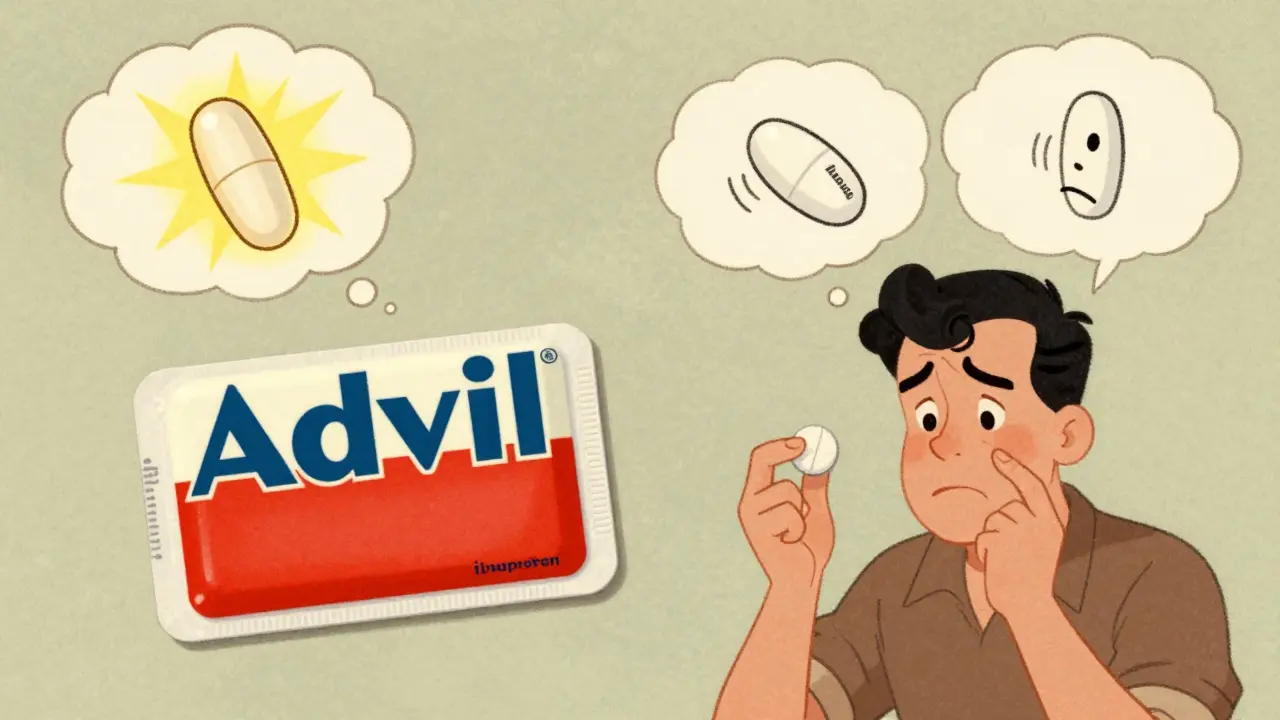
Two pills. Same active ingredient. Same dose. Same manufacturer, even. But one says ibuprofen and the other says Advil. Which one do you think works better?
If you’re like most people, you’d pick the brand name - even if you know they’re chemically identical. That’s not logic. That’s psychology. And it’s changing how your body responds to medicine.
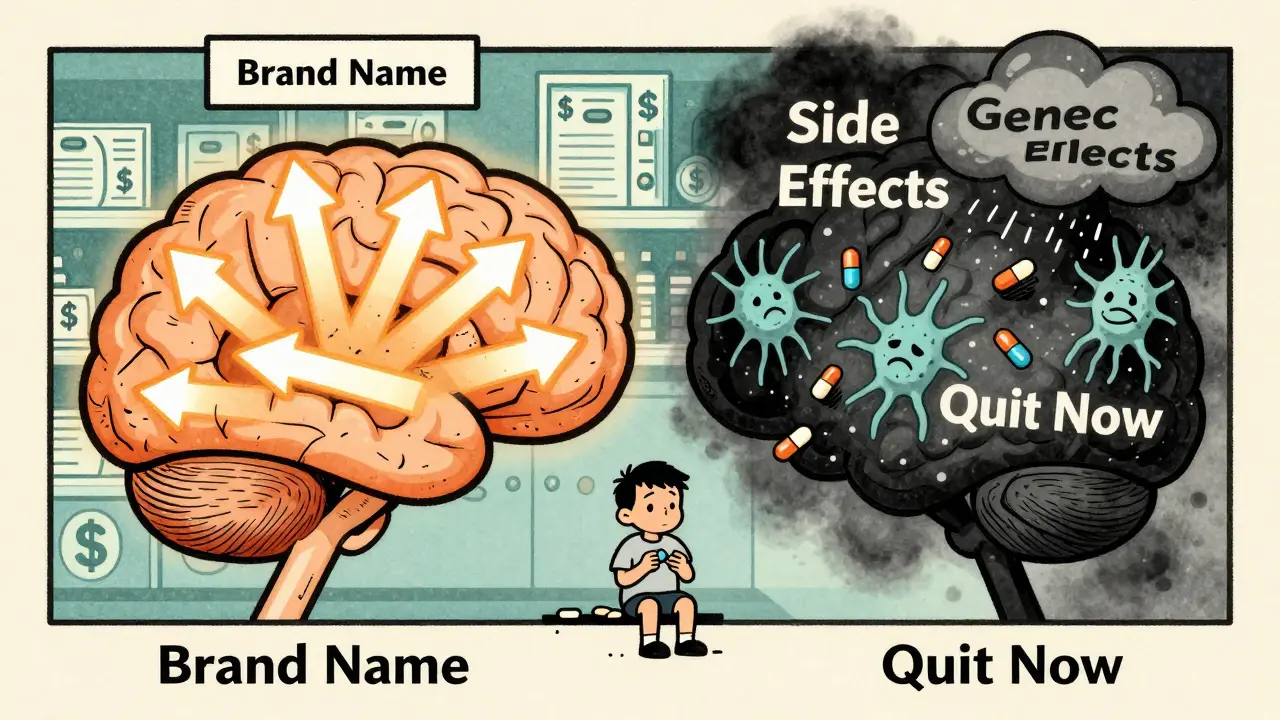
This isn’t just about marketing. It’s called the labeling effect - and it’s real, measurable, and quietly undermining the savings we expect from generic drugs. When a pill is labeled as generic, patients report more pain, more side effects, and are far more likely to stop taking it - even when the drug is exactly the same as the brand-name version.
Why a Generic Label Feels Like a Weaker Medicine
In 2019, researchers at the University of Auckland ran a simple but powerful experiment. They gave 72 people identical placebo pills - no active ingredient at all - and told half they were a brand-name drug, half they were generic. Over seven days, 54% of those who thought they were taking a generic drug stopped taking it early. Only 33% of the brand-name group did. That’s a 64% higher dropout rate - just because of the label.
And it wasn’t just about quitting. People in the generic group reported higher pain levels. They were more likely to reach for over-the-counter painkillers on their own. They blamed the pill for side effects that didn’t even exist. The pill didn’t change. Their perception did.
Another study in 2016 gave people real ibuprofen - but also fake pills labeled as either brand-name or generic. The brand-name placebo worked almost as well as the real drug. The generic placebo? Barely worked at all. Patients said their headaches improved by 3.2 cm on a pain scale with the brand-name placebo. With the generic placebo? Just 1.8 cm. The pill was the same. The label made the difference.
This isn’t about being gullible. It’s about how our brains link cost, quality, and trust. We’ve been conditioned to believe that expensive = better. That big names = reliable. When you slap a plain label on a pill - no logo, no flashy packaging - your brain assumes it’s inferior. And your body reacts accordingly.
The Cost-Saving Paradox
Generic drugs save the U.S. healthcare system $373 billion a year. They’re 80-85% cheaper than brand-name versions. In 2022, 90.5% of all prescriptions filled were generics. That’s a win for the system.
But here’s the catch: if patients stop taking their meds because they think the generic doesn’t work, those savings vanish. The World Health Organization says only about half of people stick to long-term prescriptions for chronic conditions like high blood pressure or diabetes. The labeling effect makes that number worse.
People with lower health literacy are hit hardest. In the 2019 study, those with less understanding of medicine were 67% more likely to quit taking a generic-labeled pill than those with higher health literacy. It’s not that they’re careless - they’re responding to the signal the label sends: this isn’t as good.
And it’s not just about stopping. One study found that 47% of patients blamed side effects on generic-labeled placebos - compared to 28% for the same pill labeled as brand-name. That’s a 70% increase in perceived side effects - just from the label.
What’s Really on the Label?
Here’s where it gets even messier. The label isn’t just a word. It’s a whole document - and sometimes, the generic version doesn’t match the brand’s.
A 2020 study looked at 31 drug products and found that every single one had differences between the brand-name and generic labels. Ten of them - over a third - had differences that could lead to serious or even life-threatening mistakes. One drug’s generic label left out a warning about a dangerous interaction. Another didn’t mention a key side effect that the brand-name version clearly listed.
This isn’t a flaw in the system. It’s a loophole. When generic companies apply for approval, they don’t have to copy the brand’s full label word-for-word. They just have to prove their drug works the same. That means the instructions, warnings, and even dosing advice can drift over time - especially for older drugs that have been on the market for decades.
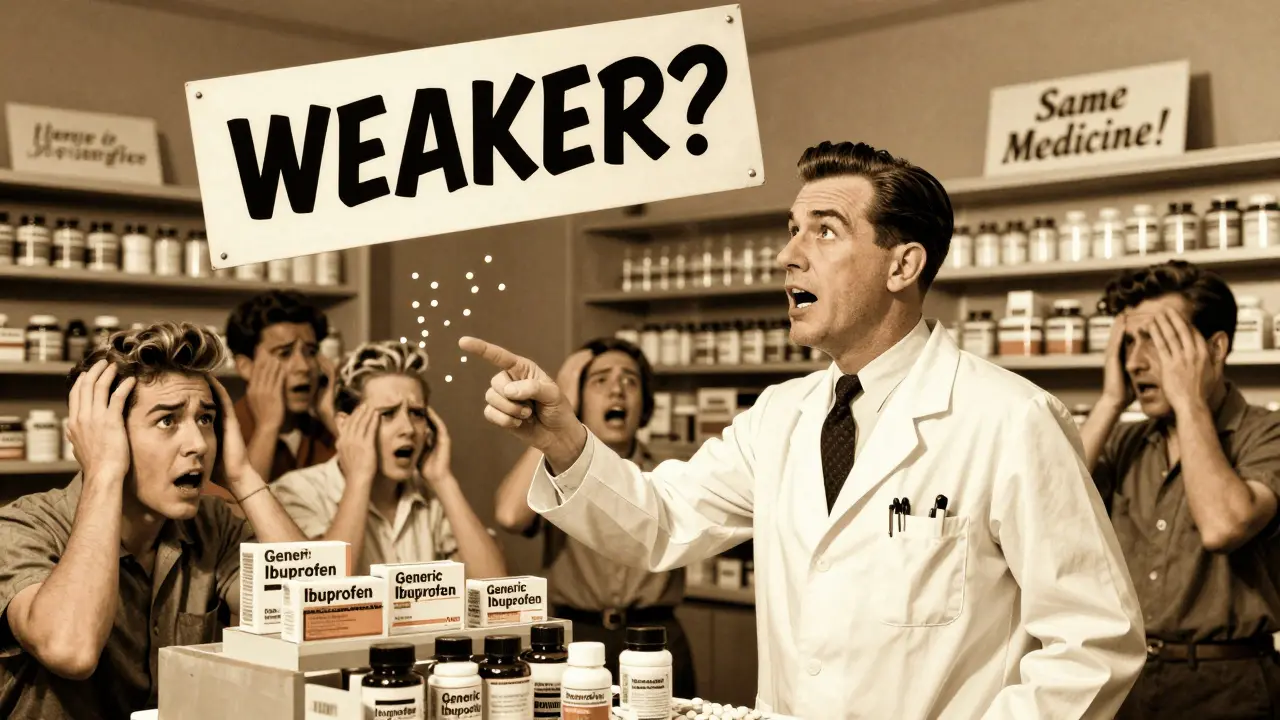
Doctors and pharmacists are caught in the middle. A 2022 survey found that 63% of pharmacists have had patients or doctors question whether a generic drug is safe or effective - purely because of the label. Some doctors still write prescriptions for brand names just to avoid the pushback.
Can We Fix This?
Yes - and we already know how.
The FDA launched a campaign in 2020 called “It’s the Same Medicine”. In a pilot across 12 health systems, it cut patient concerns about generics by 28% in just six months. Simple messages - “Same active ingredient. Same strength. Same quality.” - made a real difference.
Even better? Adding one line to the generic label: “Therapeutically equivalent to [Brand Name].” A 2023 trial showed that this tiny addition dropped discontinuation rates from 52% to 37%. That’s a 29% improvement - just by changing the wording.
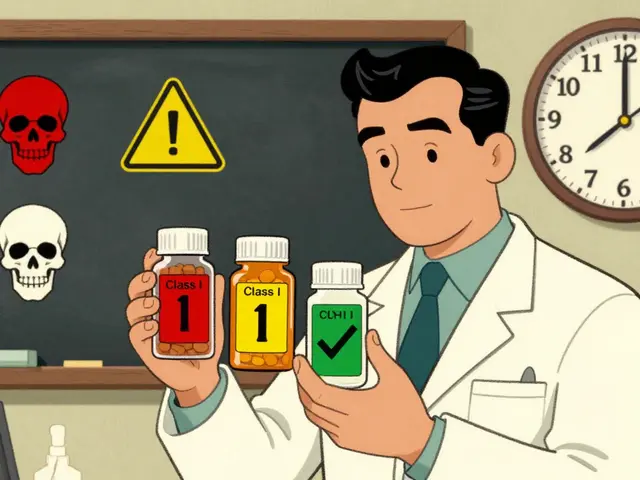
Some experts are pushing for risk-based labeling. High-risk drugs - like blood thinners, epilepsy meds, or insulin - should have labels that match the brand-name version exactly. Lower-risk drugs could have more flexibility. It’s about matching the label’s precision to the drug’s danger.
And the industry is finally listening. In January 2024, the Generic Pharmaceutical Association launched a $50 million education campaign called “Generic You Can Count On.” It’s not just ads. It’s brochures in pharmacies, videos for patients, even training for doctors.
What This Means for You
If you’re taking a generic drug and feel like it’s not working - ask yourself: Is it the pill? Or the label?
Before you switch back to the brand name, talk to your pharmacist. Ask: “Is this the same as the brand?” Show them the label. Ask if they’ve seen this issue before. You might be surprised.
And if you’re a patient with a chronic condition - high blood pressure, diabetes, depression - stick with the generic. The science is clear: it works. The problem isn’t the drug. It’s the story we’ve been told about it.
Changing that story isn’t just about saving money. It’s about saving lives. When people stop taking their meds because they think generics are weaker, they end up in the hospital. They get sicker. They cost more. And the system loses.
The answer isn’t to ban generics. It’s to fix the label. To make it clear. To make it honest. To make it trustworthy.
Because medicine shouldn’t be about branding. It should be about healing.

The labeling effect is a fascinating intersection of neurocognitive priming and pharmacoeconomic dissonance. Our brains are predictive engines, and when the heuristic cue of 'brand = efficacy' is stripped away, the placebo response attenuates dramatically. This isn't gullibility-it's evolutionary heuristics misfiring in a capitalist pharmacopeia. The brain doesn't care about molecular equivalence; it cares about perceived reliability. That’s why the FDA’s 'It’s the Same Medicine' campaign is a step in the right direction-rebranding the narrative to align with biological reality.
It is not merely a psychological phenomenon-it is a systemic failure of regulatory oversight. The FDA permits generic manufacturers to deviate from brand-label wording, thereby introducing dangerous ambiguity into clinical decision-making. This is not innovation. This is negligence. The standard of therapeutic equivalence must be codified in verbatim labeling, especially for high-risk medications. Anything less is an affront to patient safety.
This literally made me cry 😭 I’ve been on generic blood pressure meds for 3 years and I always felt like I was taking a ‘discount’ version of my health… but now I get it. The label was lying to me. Thank you for this. 🙏❤️
Of course the placebo effect is stronger with branded drugs-because the pharmaceutical industry has spent decades weaponizing consumer psychology. They don’t care about your health. They care about your wallet. The labeling effect? It’s just the tip of the iceberg. You think your insulin works because it’s labeled ‘Lantus’? No. You think it works because you’ve been conditioned to believe that $300 vials are superior to $15 ones. Wake up. This isn’t medicine-it’s a cult.
You people are ridiculous. It’s not about perception. It’s about the fact that generics are often manufactured in countries with zero quality control. I’ve seen patients on generics who end up in the ER because the active ingredient was 30% off. You think the FDA checks every batch? They don’t. You’re trusting your life to a label that says ‘same’ while the actual pill could be junk. This isn’t psychology-it’s a death sentence wrapped in a feel-good slogan.
Let me tell you about my cousin who took generic statins. He was fine for six months, then his liver enzymes went through the roof. Turned out the generic had a different excipient-something called croscarmellose sodium-that he was allergic to. The brand version used a different filler. The label didn’t say. The pharmacist didn’t know. The doctor didn’t care. So now he’s on a $400/month brand name drug because the system didn’t care enough to make the labels match. And you’re telling me this is just about perception? No. It’s about a regulatory framework that treats patients like data points, not humans. We need mandatory identical labeling across all versions, full stop. No loopholes. No exceptions. No more ‘it’s just a label’ excuses.
So what you’re saying is that if I put a sticker that says ‘FDA APPROVED’ on a rock, people will think it’s a painkiller? Brilliant. Let’s just label all the generic drugs with the brand name. That’ll fix everything. 😏
im not a doctor but i read a lot online and i think the part about the labels being different is scarry. i had a friend who took a generic and got super dizzy and no one knew why until they checked the label and it had a different warning. i think they should make all labels the same. just saying. 🤔
The labeling effect reveals a deeper truth: medicine is not merely a biological intervention, but a symbolic ritual. The pill is not just a molecule-it is a covenant between patient and system. When the symbol is stripped of its prestige, the covenant fractures. The solution is not to deceive with branding, but to elevate the generic with dignity-not by copying the brand’s packaging, but by restoring its narrative: that quality is not purchased, but earned through science. The label should reflect not cost, but confidence.